

Sunday, January 08, 2012
Of course, as noted in the Al Jazeera article, there may be such clusters of birth defects to varying degrees elsewhere in Iraq as well, because the US did not limit the use of white phosphorus and depleted uranium weapons to Fallujah. Furthermore, according to Dr. Sharif al-Alwachi, cancer rates have escalated substantially in Babil Province in southern Iraq. Another doctor measured radiation rates in Basra and Kerbala, and the indicator on the Geiger counter went beyond the range. It is impossible to know the severity of the problem because of a lack of doctors and researchers available to conduct a comprehensive investigation, but 42 sites with high levels of nuclear radiation and dioxin contamination have been identified by the Iraqi government:Dr Samira Alani, a paediatric specialist at Fallujah General Hospital, has taken a personal interest in investigating an explosion of congenital abnormalities that have mushroomed in the wake of the US sieges since 2005.
We have all kinds of defects now, ranging from congenital heart disease to severe physical abnormalities, both in numbers you cannot imagine, Alani told Al Jazeera at her office in the hospital, while showing countless photos of shocking birth defects.
As of December 21, Alani, who has worked at the hospital since 1997, told Al Jazeera she had personally logged 677 cases of birth defects since October 2009. Just eight days later when Al Jazeera visited the city on December 29, that number had already risen to 699.
There are not even medical terms to describe some of these conditions because we've never seen them until now, she said. So when I describe it all I can do is describe the physical defects, but I'm unable to provide a medical term.
Most of these babies in Fallujah die within 20 to 30 minutes after being born, but not all.
Four-year-old Abdul Jaleel Mohammed was born in October 2007. His clinical diagnosis includes dilation of two heart ventricles, and a growth on his lower back that doctors have not been able to remove.
Abdul has trouble controlling his muscles, struggles to walk, cannot control his bladder, and weakens easily. Doctors told his father, Mohamed Jaleel Abdul Rahim, that his son has severe nervous system problems, and could develop fluid build-up in his brain as he ages, which could prove fatal.
This is the first instance of something like this in all our family? Rahim told Al Jazeera. We lived in an area that was heavily bombed by the Americans in 2004, and a missile landed right in front of our home. What else could cause these health problems besides this?
Dr Alani told Al Jazeera that in the vast majority of cases she has documented, the family had no prior history of ongenital abnormalities.
Alani showed Al Jazeera hundreds of photos of babies born with cleft palates, elongated heads, a baby born with one eye in the centre of its face, overgrown limbs, short limbs, and malformed ears, noses and spines.
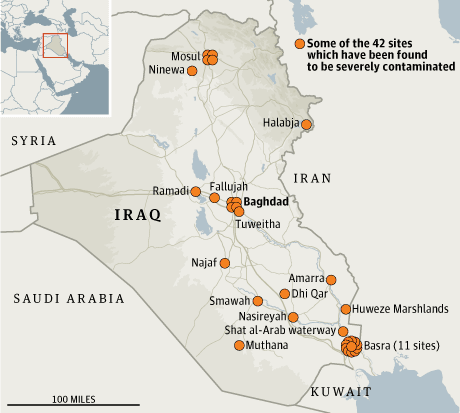 Southern Iraq, especially Basra, have been adversely affected by such contamination:
Unfortunately, the Guardian article does not explain the potential sources for the dioxin contamination, but, in regard to radiation, one one can reasonbly conclude that it probable that many parts of Iraq have experienced levels of radiation exposure and contamination substantially in excess what is known about Japan after the Fukushima nuclear plant meltdowns. And, it is important to recognize that the US did not first commence to subject Iraq to radiation contamination in 2003 as explained in this 2002 Seattle Post-Intelligencer article:The environment minister, Narmin Othman, said high levels of dioxins on agricultural lands in southern Iraq, in particular, were increasingly thought to be a key factor in a general decline in the health of people living in the poorest parts of the country.
If we look at Basra, there are some heavily polluted areas there and there are many factors contributing to it, she told the Guardian. First, it has been a battlefield for two wars, the Gulf war and the Iran-Iraq war, where many kinds of bombs were used. Also, oil pipelines were bombed and most of the contamination settled in and around Basra.
The soil has ended up in people's lungs and has been on food that people have eaten. Dioxins have been very high in those areas. All of this has caused systemic problems on a very large scale for both ecology and overall health.
On the Highway of Death, 11 miles north of the Kuwait border, a collection of tanks, armored personnel carriers and other military vehicles are rusting in the desert.
They also are radiating nuclear energy.
In 1991, the United States and its Persian Gulf War allies blasted the vehicles with armor-piercing shells made of depleted uranium -- the first time such weapons had been used in warfare -- as the Iraqis retreated from Kuwait. The devastating results gave the highway its name.
Today, nearly 12 years after the use of the super-tough weapons was credited with bringing the war to a swift conclusion, the battlefield remains a radioactive toxic wasteland -- and depleted uranium munitions remain a mystery.
Although the Pentagon has sent mixed signals about the effects of depleted uranium, Iraqi doctors believe that it is responsible for a significant increase in cancer and birth defects in the region. Many researchers outside Iraq, and several U.S. veterans organizations, agree; they also suspect depleted uranium of playing a role in Gulf War Syndrome, the still-unexplained malady that has plagued hundreds of thousands of Gulf War veterans.
While the US military denies it, retired Major Doug Rokke believes that the use of depleted uranium during the 1991 Gulf War was responsible for subsequent cancer clusters in the Basra area:
Andrew Kershaw of The Independent graphically described the horrific birth defects of the children in Basra in 2001:Major Doug Rokke, now retired, was in charge of cleaning up American tanks hit by DU during the Gulf War—casualties of friendly fire. He said the DU dust got blown far away by the wind and entered the soil and water supply. Dr. Rokke, who holds a Ph.D. in physics, said many of the men in his cleanup crew developed the same kinds of cancers seen among Iraqi children.
The first member of our staff to develop cancer was sleeping downwind from where we collected the contaminated equipment, he said. This was in Saudi Arabia. He developed cancer of the larynx and throat within nine months. He was breathing in the dust, which we know goes tremendous distances. The first lung cancers were within two years and the first deaths were fairly rapid.
When DU hits a hard target, it creates a small, radioactive fireball.
Dr. Rokke believes depleted uranium poses a particular danger for children because their young bodies are more vulnerable. DU is both radioactive and a toxic, heavy metal. Children who breathe or eat even a small amount can be affected. He said using depleted uranium in Iraq may well cause serious health problems in years to come.
For those born without such defects, Kershaw discovered that there was a dramatic increase in leukemia, and a lack of medication to treat them. If they did not die for lack of the medication, they subsequent died when they ran out of it.I thought I had a strong stomach - toughened by the minefields and foul frontline hospitals of Angola, by the handiwork of the death squads in Haiti and by the wholesale butchery of Rwanda. But I nearly lost my breakfast last week at the Basrah Maternity and Children's Hospital in southern Iraq.
Dr Amer, the hospital's director, had invited me into a room in which were displayed colour photographs of what, in cold medical language, are called congenital anomalies, but what you and I would better understand as horrific birth deformities. The images of these babies were head-spinningly grotesque and thank God they didn't bring out the real thing, pickled in formaldehyde. At one point I had to grab hold of the back of a chair to support my legs.
I won't spare you the details. You should know because - according to the Iraqis and in all likelihood the World Health Organisation, which is soon to publish its findings on the spiralling birth defects in southern Iraq - we are responsible for these obscenities.
During the Gulf war, Britain and the United States pounded the city and its surroundings with 96,000 depleted-uranium shells. The wretched creatures in the photographs for they were scarcely human are the result, Dr Amer said.
He guided me past pictures of children born without eyes, without brains. Another had arrived in the world with only half a head, nothing above the eyes. Then there was a head with legs, babies without genitalia, a little girl born with her brain outside her skull and the whatever-it-was whose eyes were below the level of its nose.
Then the chair-grabbing moment - a photograph of what I can only describe (inadequately) as a pair of buttocks with a face and two amphibian arms. Mercifully, none of these babies survived for long.
Labels: American Empire, Iraq War, Iraqi Deaths, Occupation of Iraq, US Military
Monday, December 19, 2011
Just Imagine Shutting Down US Military Bases
Labels: American Empire, Iraq War, Occupation of Iraq, US Military, YouTube
Monday, September 12, 2011
The Hinkiness of Bill Keller (Part 2)
INITIAL POST: Krugman concisely condemns Keller's self-absorbed rationalization for his mistaken support for the invasion of Iraq, and posts it to his New York Times blog on the morning of 9/11:
Within the overall context of the post, which specifically indicts those who exploited 9/11 for the purpose of generating public support for the invasion of Iraq, it is hard to see this statement as anything other than a thinly veiled criticism of those at the New York Times, like Keller, who publicly advocated for the invasion. He may well have decided to post it after reading Keller's evasion of responsibility earlier in the week. Refreshingly, Krugman, unlike Keller, is able to reach his own conclusions about such matters in the absent of manipulative references to his children.How many of our professional pundits — people who should have understood very well what was happening — took the easy way out, turning a blind eye to the corruption and lending their support to the hijacking of the atrocity?
One can certainly quibble about Krugman's statement. He doesn't object to the invasion and ongoing occupation of Afghanistan as well. At the time, he wasn't much of a voice against going forward with either invasion. To quote Patrick Buchanan, he hid out in the tall grass. Regardless, he pissed all over the sentimental, sanctimonious coverage of the tenth anniversary of 9/11 by the Times, and he did it with an extraordinarily timed post as the ceremonial events were taking place: The memory of 9/11 has been irrevocably poisoned; it has become an occasion for shame. And in its heart, the nation knows it.
Labels: 9/11, Iraq War, Mainstream Media, Neoconservatives, New York Times, Occupation of Iraq
Tuesday, September 06, 2011
The Hinkiness of Bill Keller (Part 1)
There's an old adjective that applies to Keller here, bootlicker. Kiss ass is a contemporary synonym.Keller mentions Paul Wolfowitz in passing but fails to note his lengthy profile of the war architect in the Times magazine from Sept. 22, 2002. Sample quote: Paul Wolfowitz, who is interesting and complicated, has been cast since Sept. 11 in the role of zealot... . The shorthand version of Paul Wolfowitz, however, is inadequate in important ways. It completely misses his style, which relies on patient logic and respectful, soft-spoken engagement rather than on fire-breathing conviction. Keller described three important things Wolfowitz brings to the table, including something of a reputation as a man who sees trouble coming before others do, his long anxiety about Iraq being one example. Another striking thing about Wolfowitz: an optimism about America's ability to build a better world.
INITIAL POST: The self-absorbed mendacity of the people at the New York Times who supported the invasion of Iraq after 9/11 is almost beyond belief, or, at least, it would have been beyond belief pre-9/11. Turn out that Bill Keller, Executive Editor of the Times from July 2003 until June 2011, was partially persuaded to advocate for the invasion of Iraq because of the birth of his second daughter:
So, let's get this straight, Keller decided to take a public advocacy role for the invasion of a country that presented no threat to the US so that he could feel more secure about the safety of his daughters. The US just had to go and kill a bunch of Arabs in Iraq, and destabilize the society, so that he could sleep less fitfully. Of course, the fact that many of the children of Iraq, 28% according to one medical estimate, suffer from post-traumatic stress disorder as a consequence of the invasion and subsequent violence goes unmentioned in his rambling, evasive mea culpa.But my prudent punditry soon felt inadequate. I remember a mounting protective instinct, heightened by the birth of my second daughter almost exactly nine months after the attacks. Something dreadful was loose in the world, and the urge to stop it, to do something — to prove something — was overriding a career-long schooling in the virtues of caution and skepticism. By the time of Alice’s birth I had already turned my attention to Iraq, a place that had, in the literal sense, almost nothing to do with 9/11, but which would be its most contentious consequence. And I was no longer preaching the real-world vigilance of intelligence and law enforcement.
For Keller, the lives of his daughters, and those of the children of other people like him, are personal, intimate and justify the embrace of irrational violence, while those of the people of Iraq are merely faceless numbers. In the end, Keller can only bring himself to characterize the invasion as a monumental blunder, while seeking mitigation for his role in of promoting it, because, after all . . Whether it was wrong to support the invasion at the time is a harder call . . as he begrudgingly admits his error.
Needless to say, I am angered when I read such self-serving, expedient rationalizations for the embrace of violence in the service of the US empire. I have a four and a half year old son, and, unlike Keller, I have never emotionally responded to global violence, even when experienced within the US, with the urge to advocate for the indiscriminately killing of others. But then, unlike Keller, I don't perceive the people of Iraq, or the rest of the Middle East and Central Asia, for that matter, as quite so otherly as he does. He is, in effect, using his children as rhetorical human shields to defend his depraved response to 9/11. He is so desperate to defend himself that he has put this in print where it will haunt his two daughters, Alice and Molly, for the rest of their lives.
Shockingly, one cannot even describe Keller's response as a desire for retribution, because the people of Iraq had nothing to do with 9/11. This is a bloodlust beyond vigilantism, a perverse moral failure beyond that examined in a famous film on the subject, The Ox Bow Incident. Here again, Keller exposes his particularly manipulative form of dishonesty when he describes Iraq as a place that had, in the literal sense, almost nothing to do with 9/11. Having placed himself under the bright klieg lights of his own personal interrogation, he, like many garden variety fraud artists, can't fully admit their culpability. Like, yeah man, I might have co-signed that check when confronted with irrefutable proof of their signature. If Keller was subjected to a real interrogation by the police, the detectives would conclude that there was something hinky about him. Keller just can't come clean.
As you might expect, Keller attempts to recover the sympathy of his audience by complaining about how people frequently confront Times' reporters and condemn them as propagandists for the war on terror. Again, we are subjected to another one of those evasive, hinky mea culpas ineptly crafted to reestablish credibility while ensuring that no one is responsible:
Poor Bill, John and Dexter, so maligned from all sides while trying to file honest reports and opinions. Predictably, one searches Keller's article in vain for any reference to Judith Miller and Michael Gordon. Nor does he mention that he held up the publication of an article revealing the scope of warrantless domestic wiretapping by the Bush administration for over a year after the 2004 election, and subsequently refused to respond to inquiries initiated by the Times' Public Editor at the time, Byron Calame, relying upon, as here, the issuance of a written public statement. Calame concluded that the explanation of the delay by those involved was woefully inadequate. All in all, Keller comes across as a careerist with little concern for the consequences of his actions with an exaggerated confidence in his ability to talk himself out of trouble when he can insulate himself from public accountability.For years, our early stories hyping Iraq’s menace (and to a lesser extent what people like me wrote on the opinion pages) fed a suspicion, especially on the left, that we were not to be trusted.
John F. Burns, a correspondent who chronicled the tyranny of Hussein while the man was still in power and stayed on to cover the invasion and aftermath, recalls the reflexive hostility he encountered as a Times reporter on trips home. We were all liars, warmongers, lapdogs of Bush and Cheney and so forth, he told me.
Whatever we wrote — no matter what it was, and no matter how well documented — was dismissed as Bush propaganda, added Dexter Filkins, who covered the battlefields and politics of Afghanistan and Iraq for The Times before moving last January to The New Yorker. That was probably going to happen anyway, but the paper’s real failings gave those criticisms more credibility — and longer legs — than they deserved. Remember that the right-wingers (and a lot of the military) hated us at the time, too, since the war had started to go badly from the get-go, and we were reporting that.
Labels: "War on Terror", 9/11, Afghanistan, American Empire, Iraq War, Iraqi Deaths, Mainstream Media, New York Times, Occupation of Iraq
Saturday, December 11, 2010
Iraqis Are Free to Play Soccer and Playstation
Labels: Alternative Media, American Empire, Iraq War, Iraqi Deaths, YouTube
Monday, November 08, 2010
Justice Cooke's condemnation of her actions was, shall we say, a bit peculiar:A 21-year-old student has been jailed for life at the Old Bailey for trying to murder Labour MP Stephen Timms because he voted for the war in Iraq.
Roshonara Choudhry, of East Ham, stabbed the 55-year-old MP for East Ham twice in the stomach at a constituency surgery in Newham, east London, in May.
She was found guilty of attempted murder and two counts of possessing a knife on Tuesday.
Choudhry, of Central Park Road, was jailed for a minimum of 15 years.
Of course, Tony Blair, George Bush and all of those in the Congress and House of Commons who authorized the invasion of Iraq intended to kill in a political cause. They also committed evil acts coolly and deliberately. Yet, in Blair's case, he's now a Catholic in good standing. Furthermore, Blair, like Choudhry, was also influenced by the Internet in regard to his decision to launch the war.Mr Justice Cooke told Choudhry: You said you ruined the rest of your life. You said it was worth it. You said you wanted to be a martyr.
You intended to kill in a political cause and to strike at those in government by doing so.
You did so as a matter of deliberate decision making, however skewed your reasons, from listening to those Muslims who incite such action on the internet.
I also hope that you will come to understand the distorted nature of your thinking, the evil that you have done and planned to do, and repent of it.
You do not suffer from any mental disease. You have simply committed evil acts coolly and deliberately.
During the trial the court heard Choudhry had made a list of MPs who had voted for the Iraq war. Choudhry would continue to be a danger to MPs, the judge added.
Beyond this, there are the additional facts, outside the record, so to speak, that the US and Israel frequently seek to assassinate people in the Middle East and Central Asia, sometimes successfully, sometimes not. In addition, they do so in circumstances that frequently result in the deaths of others who are misfortunate enough to be near the intended target. Choudhry, by contrast, attacked Timms in a setting that put the lives of no one else at risk.
So, we are left with a puzzler. What was it about Choudhry's attack that so angered Justice Cooke? As already implied here, it can't be because she sought to kill Timms for political reasons. Bush, Blair and those who supported their policies have done the same. Nor can it be because she did so coolly and deliberately. Bush, Blair and those who have supported their policies have done that, too. Rather, it appears that Justice Cooke was outraged because she wanted to be a martyr.
As noted elsewhere in the article:
Oh my, now that's not good. For if there is one thing we know about Bush and Blair, we are certain that they were not intending to martyr themselves when they invaded Iraq. Indeed, both, particularly Blair, have done quite well for themselves as a result. Killing for profit, killing for geopolitical advantage, killing for the purposes of political manipulation, that's acceptable, but seeking to kill someone for ideological reasons and taking responsibility for it, that's something not to be tolerated.Following the attack she told officers it was a punishment and to get revenge for the people of Iraq, the Old Bailey heard.
Choudhry, who had refused to appear in court, told her barrister Jeremy Dein QC she did not accept the court's jurisdiction and did not wish him to challenge the prosecution case.
I go through all this not to make light of what happened to Timms. I'm sure that it has been a frightening and painful experience for him, although he has undoubtedly gotten better medical care for his injuries than most Iraqis wounded by US/UK weaponry. Nor do I do it to suggest that Choundhry's response to Timm's authorization for the war was legitimate. Instead, I do so to emphasize that those who live by violence should not be surprised when others decide to conduct themselves as violently as those who purport to exercise a monopoly over it.
Last year, I was having a discussion with my co-host on my KDVS public affairs program about gang violence. Not surprisingly, being the liberal sort that he is, he started complaining about the pervasive violent conduct described in a lot of hip hop songs. But, also rather predictably, he didn't mention the possibility that when young people frequently encounter the leadership of this country, including the President, perpetually using violence and the threat of it to achieve their objectives, that they, too, come to the conclusion that violence is an acceptable means to an end. If so, they rightly perceive violence as yet another form of privilege, like inherited wealth, social status and cultural reproduction, one that they therefore attempt to arrogate to themselves. Nor did he consider the potentially even more alarming possibility that life in our society is inescapably violent, rendered even more so by the attempted oligopolization of it by nation states and elites, and that the real challenge is how to transform it.
Labels: "War on Terror", American Empire, Iraq War, Israel, Neoliberalism, Political Violence, Tony Blair
Friday, September 03, 2010
A Journey: The Twitter Version (Part 2)
After wading through these tweets, I have a number of observations. First, Blair's reflexive support for Israel, and, by extension, state violence generally, as expressed in similar remarks about the wars in Iraq and Afghanistan, is remarkable. One gets the sense that there is no act of state violence that he would condemn, including the use of nuclear weapons. Although he apparently does not address it, Blair's perspective on the wars in Gaza, the West Bank, Lebanon, Iraq and Afghanistan suggest he believes that the US use of nuclear weapons at Hiroshima and Nagasaki was appropriate, and would probably support their use again, such as, for example, in an attempt to destroy Iran's nuclear research and power program.Blair, p. 653: I met a very bouncy Sarkozy at the start of his Presidential campaign and told him that he sounded like Napoleon.
Blair, p. 645: And on social exclusion, you shd concentrate on dysfunctional families, not on poor people or young people in general.
Blair, p.644: in these speeches I gave lessons to my successors, eg that to deal with the criminal underclass you need draconian powers.
Blair, p. 634: Twice I thanked God for the independence of the British judiciary, over cash for honours and the Hutton inquiry.
Blair, p. 607: Putting campaign donors in the Lords is a murky business, but it is the system as it has operated for a long, long time.
Blair, p. 602: But it wasn't that I didn't get public opinion on Lebanon, nor that I cdn't have articulated it... I didn't agree with it.
Blair, p.600: If I condemned Israel, it wd be more than dishonest; it wd have undermined the worldview I had come to hold passionately.
Blair, p. 598: In Sept 2006 I visited Beirut... Unsurprisingly, I was not popular with many Lebanese people.
Blair, p.597: The occupation of Palestinian land may be an injustice, depending on yr viewpt, but this is a region w plenty of injustices.
Blair, p. 596: Israel is a government with a well-armed & well-trained army & air force. They do not target civilians.
Blair, p. 594, on the Israel / Lebanon war in 2006: That event, & my reaction to it, prob. did me more damage than anything since Iraq.
Blair throws around stupid metaphors, p. 592: the bazooka of outrage, the blowpipe of ridicule.
Blair, p. 591: Politicians shag around bc of the supreme self-control you have to exercise to be at the top.
Blair, p.585, thinks abt pensions, wanting a framework that over time wd...tilt the responsibility for provision from state to individual.
Blair, p. 577: Academies were great, because they were freed from extraordinarily debilitating & often politically correct interference.
Second, Blair reveals himself to be an autocratic figure in the tradition of late 19th Century and early 20th Century progressives as it relates to the working class and lower income people. He believes that workers should pay their own pensions with no state assistance, placing him squarely among those in the US who want to reduce Social Security and Medicare benefits, and consistently describes the lives of many low income people in pathological terms. Recall his comment, posted here yesterday: The right-wing phrase, underclass, was ugly, but it was accurate. People at the bottom had dysfunctional lives, full stop. Today, we get more elaboration: to deal with the criminal underclass you need draconian powers.
In this, Blair brings to mind the perpetual urban renewal efforts of the last century, most prominent in the 1930s and 1960s. Such efforts were usually justified by reference to the purported urgency of eliminating blight, an antiseptic term that identified lower middle income and low income communities as disease infested, crime ridden areas that must be destroyed so that they could be replaced by modern middle class neighborhoods. As a result, many vibrant lower middle income and lower income communities were forever lost, with their residents cast to the winds. Most recently, as noted by Yusef, the same sad transformation has taken place in post-Katrina New Orleans.
But Blair is more aggressive in his approach as he approved the installation of public surveillance equipment, greater police power and increased criminal penalties. In this, he again acted upon his adoration of the US, which has pioneered such measures as a solution to social disorder. Hence, he perceives the state as beset by threats from within and without, an international Islamic insurgency that will take decades to overcome, and an internal class of lumpenproletarians that invariably threaten to disrupt the lives of its citizens if not strictly controlled. While not explicit, he seems to perceive immigration as something that intensifies both threats, as he elsewhere states that the post-Holocaust asylum policy was no longer tenable. In effect, Blair possesses an extreme vision of a utopian, middle class consumer society, perhaps even more extreme than the one promoted by Thatcher and Reagan, as Blair lacks the residue of libertarian values, however slight, that motivated them. Of course, it can only be implemented by recourse to coercion and violence, which he readily embraces.
Labels: "War on Terror", American Empire, Iraq War, Iraqi Deaths, Islam, Neoconservatives, Neoliberalism, Police, Postmodernism, Racism, Religion, Tony Blair, United Kingdom
Thursday, September 02, 2010
A Journey: The Twitter Version (Part 1)
Some excerpts (please note that they are best read from the bottom up):
For the full, rich experience, you have to read Brooke's dissection in its entirety. It has the riveting quality of a compelling work of experimental fiction. He has about 170 pages to go before completing the task that he has set for himself.Blair, p. 516: If Condi Rice has a fault, it is that she is probably too decent for the world of politics.
Yes, Blair really does call Ariel Sharon, p. 515, a big man in every sense.
Blair, p.513: Even Gitmo, a policy that was both understandable &, done in a different way, justifiable was seen as anti- the rule of law.
Blair, p, 501: Gerhard Schroeder was a really tough cookie.
Blair, p, 482: Top US universities were the best in the world plainly & inescapably due to their system of fees.
Blair, p. 467: on the pics from Abu Ghraib, no doubt they were exceptional incidents, and the offenders were prosecuted.
Blair, p. 458: The reception was ecstatic. They got up and applauded throughout, a total of thirty-five times.
Blair, pp.457-8, quotes at length from his speech to the US Congress, one of the most important and, in my judgement, best speeches I made"
Blair, p. 410: Even people who didn't like me or agree with me still admired the fact I counted, was a big player, was a world... leader.
Blair, p. 409: But Cheney's manner of doing it was incomplete. We needed to win the war at the level of ideas, by engaging Muslims.
Blair, p. 408: Cheney is the object of so much conspiracy theory that it's virtually impossible to have a rational discussion about him.
Blair visits Crawford, TX, April 2002, p. 399. It is pretty much in the middle of nowhere.
Blair, p. 394: George had immense simplicity in how he saw the world.
Blair, p. 387: the Middle East was urgently in need of modernisation.
Pre-9/11 terrorism, Blair calls, p. 343, the price that America paid for being America.
Blair, p.204: The right-wing phrase, underclass, was ugly, but it was accurate. People at the bottom had dysfunctional lives, full stop.
Blair, p. 116: I wanted to preserve, in terms of competitive tax rates, the essential Thatcher/Howe/Lawson legacy.
Blair says, p. 88, that it wd have been wickedly irresponsible to send his kids to an average state school.
Labels: American Empire, Iraq War, Iraqi Deaths, Neoconservatives, Neoliberalism, Postmodernism, Religion, Tony Blair, United Kingdom
Wednesday, September 01, 2010
Blair's fat little compendium of pseudo-revelations, attacks on personal acquaintances and colleagues, self-justifying circumlocutions, political polemic, and narcissistic reflections, comes with its own self-destruct button. Comparing himself to the people's princess, he says: We were both in our ways manipulative people, perceiving quickly the emotions of others and able instinctively to play with them. Elsewhere, he informs astonished readers that sometimes politicians must conceal the full truth ... bend it and even distort it. This being the case, you might suspect that he is not always being honest with his readers, and that the impression he tries to give of opening up and being fully frank is as counterfeit as his intelligence on Iraq. You might wonder what is the point of your parting with a portion of your spending power even for one of the thousands of half price copies that your local WH Smith will be shoving in your direction, if all that's going to happen is that Tony Blair lies to you. Again. When all he's ever done is lie to you, at taxpayers' expense. Will there come a time, you might wonder, when we will stop paying Tony Blair to lie to us?
INITIAL POST: Today, the memoirs of Tony Blair went on sale in the United Kingdom. Needless to say, there has been a media frenzy. Given Blair's return to the spotlight, if only for a few days, I thought it appropriate to repost my film review of the 2007 movie, The Queen, in so far as it addresses Blair.
Please note that the reference to Frears is shorthand for the director, Stephen Frears, while the reference to Morgan alludes to the scriptwriter, Peter Morgan. Both of them fulfilled their responsibilities in stellar fashion in regard to the film generally and most particularly in their characterization of Blair, along with the actor who played the role, Michael Sheen:
Not surprisingly, consistent with his attainment of his petty aspirations, he supports the ruthless budget cutting of the Tory/Liberal Democrat coalition, and urges an attack upon Iran if it continues to develop nuclear weapons.. . . Another pleasant suprise was Michael Sheen's performance as Tony Blair. Indeed, the film is actually as much about Blair and his abandonment of his Labour idealism as it is about the crisis within the royal family after Diana's death. Blair had just been installed as Prime Minister when Diana died, and his closest advisors are startled by his increasing identification with the conservative royals as the media circus intensifies. Sheen, again assisted by Morgan's top drawer script, portrays Blair sympathetically, but accurately, as a middle class man who aspires to political power so that he can attain social acceptance by the elite. Through such a well rounded, empathetic presentation, Sheen (and Morgan) indict Blair as a cogenial little man who would cheerfully sell out anyone or anything for his self-aggrandizement, and it is an indictment far more compelling than any issued by the left.
In a telling scene near the end, a scene that highlights the allegorical aspect of this part of the story, the Queen, after having been subjected to the most brutal personal insults by her subjects, finds herself, to her dismay, being consoled by Blair. Never mind, he says, the bond between you and your subjects is now stronger than ever. The Queen, not so sure, demurs, and warns, someday, Mr. Blair, you may also find yourself equally reviled by the public. Blair, of course, ever supremely confident of his hold over the populace (and, at times, even the royals), expresses his disagreement through his body language. Frears and Morgan, with benefit of hindsight, recognized that such arrogance lead inevitably to the catastrophe in Iraq.
For someone born and raised in the United Kingdom, it is rather odd to realize that Blair most closely resembles a small town social climber out of a Sinclair Lewis novel, like Babbitt or Elmer Gantry, with the absence of any capacity for self-reflection. Accordingly, he is more akin to the self-serving evangelist Gantry than the emotionally adrift real estate agent George Babbitt. Like Gantry, Blair exploited religion, but in the related field of politics, where there is also a demand for messiahs:
Blair has been notoriously described by many as Bush's poodle, but, in fact, the relationship was the other way round, as recognized years ago by Richard Gott. Just as Joseph Lieberman can be accurately described as the person most responsible for the current orientation of the Democratic Party, Blair is the person who most effectively proselytized the neoconservative values of the war on terror, introducing them into the mainstream discourse, as it were, commencing his effort, as did the participants of the Project for a New American Century, before 9/11.The strongest support for Bush's war came from Tony Blair, Britain's most religious leader since Gladstone. Like Bush, Blair prays. He keeps a Bible by his bed and says he will only answer to my maker for British deaths in Iraq. When David Frost asked if he and Bush prayed together on Iraq, Blair declined to answer.
Labels: "War on Terror", American Empire, Iraq War, Iraqi Deaths, Neoconservatives, Neoliberalism, Religion, Tony Blair, United Kingdom
Friday, January 08, 2010
Robert Fisk has previously written on this subject in relation to the 1991 Gulf War and the Bosnian conflict in 1996:Forget about oil, occupation, terrorism or even Al Qaeda. The real hazard for Iraqis these days is cancer.
Cancer is spreading like wildfire in Iraq. Thousands of infants are being born with deformities. Doctors say they are struggling to cope with the rise of cancer and birth defects, especially in cities subjected to heavy American and British bombardment.
Here are a few examples. In Falluja, which was heavily bombarded by the US in 2004, as many as 25% of new- born infants have serious abnormalities, including congenital anomalies, brain tumors, and neural tube defects in the spinal cord.
The cancer rate in the province of Babil, south of Baghdad has risen from 500 diagnosed cases in 2004 to 9,082 in 2009 according to Al Jazeera English.
In Basra there were 1885 diagnosed cases of cancer in 2005. According to Dr. Jawad al Ali, director of the Oncology Center, the number increased to 2,302 in 2006 and 3,071 in 2007. Dr. Ali told Al Jazeera English that about 1,250-1,500 patients visit the Oncology Center every month now.
Not everyone is ready to draw a direct correlation between allied bombing of these areas and tumors, and the Pentagon has been skeptical of any attempts to link the two. But Iraqi doctors and some Western scholars say the massive quantities of depleted uranium used in U.S. and British bombs, and the sharp increase in cancer rates are not unconnected.
Tragically, Iraqis will continue to pay the price for the 1991 and 2003 invasions for decades. One hopes that the Iranians will avoid a similar fate.Only a few weeks earlier, a team of UN scientists – sent to Kosovo under the set of UN resolutions that brought Kfor into the province – had demanded to know from Nato the location of DU bombings in Kosovo. Nato refused to tell them. Nor was I surprised. From the very start of the alliance bombing campaign against Serbia, Nato had lied about depleted uranium. Just as the American and British governments still lie about its effects in southern Iraq during the 1991 Gulf War. US and British tanks had fired hundreds of rounds – thousands in the case of the Americans – at Iraqi vehicles, using shells whose depleted uranium punches through heavy armour and then releases an irradiated aerosol spray.
In the aftermath of that war, I revisited the old battlefields around the Iraqi city of Basra. Each time, I came across terrifying new cancers among those who lived there. Babies were being born with no arms or no noses or no eyes. Children were bleeding internally or suddenly developing grotesque tumours. UN sanctions, needless to say, were delaying medicines from reaching these poor wretches. Then I found Iraqi soldiers who seemed to be dying of the same "Gulf War syndrome" that was already being identified among thousands of US and British troops.
At the time, The Independent was alone in publicising this sinister new weapon and its apparent effects. Government ministers laughed the reports off. One replied to Independent readers who drew the Ministry of Defence's attention to my articles that, despite my investigations, he had seen no "epidemiological data" proving them true. And of course there was none. Because the World Health Organisation, invited by Iraq to start research into the cancers, was dissuaded from doing so even though it had sent an initial team to Baghdad to start work. And because a group of Royal Society scientists told by the British authorities to investigate the effects of DU declined to visit Iraq.
Labels: American Empire, Iraq War, US Military
Tuesday, November 10, 2009
Labels: "War on Terror", Afghanistan, Iraq War, Occupation of Iraq, US Military
Tuesday, October 20, 2009
Face Time with the Poodle (Part 2)
Labels: American Empire, Iraq War, Palestine, Tony Blair
Sunday, October 11, 2009
Face Time with the Poodle (Part 1)
Facilitating the deaths of hundreds of thousands of Iraqs in the service of the American Empire pays quite well, apparently, as the remainder of the article, well worth reading in its entirety, demonstrates. It is also a good career move, as it is rumored that the Presidency of the European Union awaits the Poodle.Snaking round the buffet tables of a corporate-looking ballroom at a Vancouver hotel on Tuesday, a queue of local businessmen and minor dignitaries chatted nervously among themselves in excited anticipation of meeting their celebrated guest of honour.
Waiting to greet this procession of the great and the good was Tony Blair, tight-grinned and expensively tanned, beaming fixedly in the manner of an American game-show host welcoming his latest starstruck contestant on stage.
As each of the 100 guests was ushered forward to meet the former Prime Minister, there was time only for the very briefest of handshakes, snapped by a waiting photographer, before they were quickly led away and another eager delegate stepped forward for their fleeting audience with our ex-leader.
As they filed out, each of those lucky enough to meet him was invited to place his or her business card on a tray so a photo of their lightning-fast encounter with Mr Blair could be dispatched in the post.
These days, even such snatched ‘face time’ with the former Labour PM comes at a price.
Each guest at the Canadian event was asked to stump up £180 just for the privilege of having their picture taken with the great man.
Labels: American Empire, Iraq War, Tony Blair
Monday, June 22, 2009
We live in an age when such damning information can be released to the public without consequence.A confidential record of a meeting between President Bush and Tony Blair before the invasion of Iraq, outlining their intention to go to war without a second United Nations resolution, will be an explosive issue for the official inquiry into the UK's role in toppling Saddam Hussein.
The memo, written on 31 January 2003, almost two months before the invasion and seen by the Observer, confirms that as the two men became increasingly aware UN inspectors would fail to find weapons of mass destruction (WMD) they had to contemplate alternative scenarios that might trigger a second resolution legitimising military action.
Bush told Blair the US had drawn up a provocative plan "to fly U2 reconnaissance aircraft painted in UN colours over Iraq with fighter cover". Bush said that if Saddam fired at the planes this would put the Iraqi leader in breach of UN resolutions.
The president expressed hopes that an Iraqi defector would be "brought out" to give a public presentation on Saddam's WMD or that someone might assassinate the Iraqi leader. However, Bush confirmed even without a second resolution, the US was prepared for military action. The memo said Blair told Bush he was "solidly with the president".
The five-page document, written by Blair's foreign policy adviser, Sir David Manning, and copied to Sir Jeremy Greenstock, the UK ambassador to the UN, Jonathan Powell, Blair's chief of staff, the chief of the defence staff, Admiral Lord Boyce, and the UK's ambassador to Washington, Sir Christopher Meyer, outlines how Bush told Blair he had decided on a start date for the war.
Labels: American Empire, Bush, Iraq War, Tony Blair
Sunday, May 31, 2009
Takaki was a leading figure in comparative ethnic studies. He described an Asian American experience that had long been marginalized. In doing so, he deconstructed the mythology of Asian Americans as a model minority, and thus, returned them to their rightful place within the interwoven processes of American history from whence they had been ideologically extracted. He placed this experience within the broader context of the histories of people of color and immigrants within this country, with a particular focus upon the intersection of race and class. In this respect, he resembles Peter Linebaugh, another innovative historian who identified anarchic instances of liberatory social transformation within a turbulent mix of immigrants, runaway slaves and poor white laborers created by the Anglo-American globalization of the 17th, 18th and 19th centuries.
In other words, Takaki, as Linebaugh has done, dedicated his career to the publication of histories from below. Takaki, growing up in Hawaii, was not, unlike his continental brethren, interned during World War II. He grew up in an environmental where Japanese Americans were, by and large, considered the equals of whites. He committed the unpardonable sin of talking back, a sinfulness that only became more incorrigible as he lived through the radicalism of the 1960s. Even worse, he possessed the skill of presenting his works in a popular form that reached large numbers of Americans. His books, such as Strangers from a Different Shore and A Different Mirror, among others, were academic works that fared well in the marketplace. Predictably, he became a lightning rod from conservative discontent.
Older white historians did not appreciate the exposure of their biases and inadequacies by Takaki. Liberal Arthur Schlesinger was embarrassingly scornful of the multiculturalism represented by younger academics like Takaki. Takaki dismissed Schlesinger with a short, dry observation of his incompetence:
More than ever before, there is a growing realization that the established scholarship has tended to define America too narrowly. For example, in his prize-winning study, The Uprooted, Harvard historian Oscar Handlin presented -- to use the book's subtitle -- "the Epic Story of the Great Migrations That Made the American People. But Handlin's "epic story" excluded the "uprooted" from Africa, Asia, and Latin America -- the other "Great Migrations" that also helped to make "the American People." Similarly, in The Age of Jackson, Arthur M. Schlesinger, Jr., left out blacks and Indians. There is not even a mention of two marker events -- the Nat Turner insurrection and Indian Removal, which Andrew Jackson himself would have been surprised to find omitted from a history of his era.One can only imagine what Takaki said in private: how in the world can Schlesinger talk about the insidious influence of afro-centrism and the use of history as group therapy for minorities, when he doesn't know anything about the history of anyone except white people?
Of course, at a more mundane level, this dispute was a reflection of increasing competition for positions within the academy, the proteges of historians like Takaki were now being hired, while the ones of historians like Schlesinger increasingly were not. I had a personal encounter with sort of thing about 15 years ago, when I accidentally overheard a couple of old professors in the UC Davis American Studies program talking about a new Latina hire over dinner at a restaurant. They described her scholarship with the words vomit and diarrhea. Confronted with the demands of people that their heretofore buried histories and social experiences be told, such academics responded with the language of white supremacy instead of with an open, tolerant inclusiveness.
There is an irony in this. Historians like Schlesinger, and the American Studies professors that I encountered, were, no doubt, proponents of American exceptionalism, a belief that the US is a unique society that should be emulated around the world. Takaki, quite clearly, was not. Yet, it was Takaki, and the historians and sociologists that brought the experiences of women, people of color, immigrants, workers and poor people into the academic mainstream, in short, all those people who lived their lives outside the elite histories of government, geopolitics and economic development, that facilitated the creation of a new American identity. The current version of American exceptionalism now in vogue is one of inclusion, one in which the social experiences of people of various races, cultures, gender, even sexual orientation and religions are recognized, and yet remain fused in a decentralized, but firm, form of nationalism. The election of Barack Obama enshrined it as semi-official doctrine.
But the irony is more insidious than just this paradox. The new multicultural American identity, co-authored by Takaki and others, constitutes a critical ideological support for the so-called war on terror which includes the invasion, and ongoing occupations, of Iraq and Afghanistan. Our culture is purportedly inclusive, tolerant and, by and large, non-violent, in its resolution of domestic conflict. Their culture, by contrast, is not. Our multiculturalism is contrasted with the inherent violence of Islam and the peoples of the Middle East and Central Asia as a justification for perpetual military intervention and custodial oversight.
Needless to say, this is an extremely reductionist perspective about the US, the Middle East and Central Asia, but it is this, more than anything, I think, that explains the inability of many moderates and liberals to dissociate themselves from American militarism. It also creates doubt among non-whites that might otherwise be predisposed, in reliance upon memories of past national liberation movements, to oppose it. And, if there were any question about the proprietary of the project, just look at our military as opposed to their fighters, insurgents, or just plain terrorists. Our military is multi-colored, and even permits Arab Americans and Muslims to serve (only gays and lesbians are excluded as a result of an antiquated social policy that even the multiculturalists couldn't expunge), while the resistance is supposedly organized along lines of religious and ethnic intolerance. Again, simplistic and reductionist, but hard to effectively refute within the confines of limited American discourse.
Ronald Takaki was a bright, opinionated, insightful man. Chapter 1 of A Different Mirror, written in the aftermath of the 1992 Los Angeles riots, is one of best statements about the urgency of recognizing the realities of race and class in America that I have ever read:
Of course, Chapter 1 should be read in its entirety to appreciate the richness of Takaki's perspective, and as I do so, I cannot avoid the persistent questions. Did he become aware that the pursuit for a more accurate history pushed us down the road to Baghdad and Kabul? In the last years of his life, did he recognize the tragic consequences that flowed from the opportunistic expropriation of the values of multiculturalism? A social perspective motivated by a desire to further understanding about Americans from different backgrounds, and, implicitly, to further understanding about people from all over the world, was put in the service of the expansion of the American empire. All in all, a sad, humorless instance of what Lefebvre described as dialectical irony.What is fueling this debate over our national identity and the content of our curriculum is America's intensifying racial crisis. The alarming signs and symptoms seem to be everywhere -- the killing of Vincent Chin in Detroit, the black boycott of a Korean grocery store in Flatbush, the hysteria in Boston over the Carol Stuart murder, the battle between white sportsmen and Indians over tribal fishing rights in Wisconsin, the Jewish-black clashes in Brooklyn's Crown Heights, the black-Hispanic competition for jobs and educational resources in Dallas which Newsweek described as "a conflict of the have-nots," and the Willie Horton campaign commercials, which widened the divide between the suburbs and the inner cities.
This reality of racial tension rudely woke America like a firebell in the night on April 29, 1992. Immediately after four Los Angeles police officers were found not guilty of brutality against Rodney King, rage exploded in Los Angeles. Race relations reached a new nadir. During the nightmarish rampage, scores of people were killed, over two thousand injured, twelve thousand arrested, and almost a billion dollars of property destroyed. The live televised images mesmerized America. The rioting and the murderous melee on the streets resembled the fighting in Beirut and the West Bank. The thousands of fires burning out of control and the dark smoke filling the skies brought back images of the burning oil fields of Kuwait during Desert Storm. Entire sections of Los Angeles looked like a bombed city. "Is this America?" many shocked viewers asked. "Please, we can get along here," pleaded Rodney King, calling for calm. "We all can get along. I mean, we're all stuck here for a while. Let's try to work it out."
But how should "we" be defined? Who are the people "stuck here" in America? One of the lessons of the Los Angeles explosion is the recognition of the fact that we are a multiracial society and that race can no longer be defined in the binary terms of white and black. "We" will have to include Hispanics and Asians. While blacks currently constitute 13 percent of the Los Angeles population, Hispanics represent 40 percent. The 1990 Census revealed that South Central Los Angeles, which was predominantly black in 1965 when the Watts rebellion occurred, is now 45 percent Hispanic. A majority of the first 5,438 people arrested were Hispanic, while 37 percent were black. Of the 58 people who died in the riot, more than a third were Hispanic, and about forty percent of the businesses destroyed were Hispanic-owned. Most of the other shops and stores were Korean-owned. The dreams of many Korean immigrants went up in smoke during the riot: two thousand Korean-owned businesses were damaged or demolished, totaling about $400 million in losses. There is evidence indicating they were targeted. "After all," explained a black gang member, "we didn't burn our community, just their stores."
"I don't feel like I'm in America anymore," said Denisse Bustamente as she watched the police protecting the firefighters. "I feel like I am far away." Indeed, Americans have been witnessing ethnic strife erupting around the world -- the rise of Neo-Nazism and the murder of Turks in Germany, the ugly "ethnic cleansing" in Bosnia, the terrible and bloody clashes between Muslims and Hindus in India. Is the situation here different, we have been nervously wondering, or do ethnic conflicts elsewhere represent a prologue for America? What is the nature of malevolence? Is there a deep, perhaps primordial, need for group identity rooted in hatred for the other? Is ethnic pluralism possible for America? But answers have been limited. Television reports have been little more than thirty-second sound bites. Newspaper articles have been mostly superficial descriptions of racial antagonisms and the current urban malaise. What is lacking is historical context; consequently, we are left feeling bewildered.
How did we get to this point, Americans everywhere are anxiously asking. What does our diversity mean, and where is it leading us? How do we work it out in the post-Rodney King era? Certainly one crucial way is for our society's various ethnic groups to develop a greater understanding of each other. For example, how can African Americans and Korean Americans work it out unless they learn about each other's cultures, histories, and also economic situations? This need to share knowledge about our ethnic diversity has acquired new importance and has given new urgency to the pursuit for a more accurate history.
Labels: "War on Terror", Afghanistan, American Empire, California, Iraq War, Obituaries, Occupation of Iraq, Racism
Thursday, April 30, 2009
Of course, Blair was far too concerned about the situation. A complaisant media ignored the findings of the Lancet while relying upon the much lower, less credible figures developed by Iraq Body Count. And, even more, the people behind Iraq Body Count, the same people who estimated the number of dead Iraqis by primarily reading the foreign language media, enthusiastically stepped forward to malign the statistical methodology of the Lancet, even as Blair's science advisor found it all too credible. If you can't prevent the evidence from being released to the public, sound the alarm for assistance from your allies in the NGO world. Or, maybe, they come to the rescue without being asked.Government uncertainty about how to reply to a medical journal's article on the numbers killed in Iraq has been revealed in official documents.
In October 2004 the Lancet published estimates that 98,000 people died in the conflict's first 18 months.
Then-Prime Minister Tony Blair rejected the figure, but one official warned the government would be "ripped apart" if it questioned the Lancet's methodology.
The government tried to stop publication, but was over-ruled.
A subsequent Lancet article claimed that the number of deaths caused by the conflict up to 2006 was more than 650,000.
Labels: Iraq Body Count, Iraq War, Iraqi Deaths, Tony Blair
Thursday, December 04, 2008
The Persistence of Nixonian Foreign Policy
People with good memories will recall that this was essentially the same approach that Nixon and Kissinger devised to implement Nixon's secret plan to end the Vietnam War. They marketed it as Vietnamization, turning the war over to the Vietnamese to fight. It prolonged the war until 1975, resulting in the deaths of thousands more Americans, and who knows how many hundreds of thousands, if not more, Vietnamese.On the campaign trail, Senator Barack Obama offered a pledge that electrified and motivated his liberal base, vowing to “end the war” in Iraq.
But as he moves closer to the White House, President-elect Obama is making clearer than ever that tens of thousands of American troops will be left behind in Iraq, even if he can make good on his campaign promise to pull all combat forces out within 16 months.
"I said that I would remove our combat troops from Iraq in 16 months, with the understanding that it might be necessary — likely to be necessary — to maintain a residual force to provide potential training, logistical support, to protect our civilians in Iraq,” Mr. Obama said this week as he introduced his national security team.
Publicly at least, Mr. Obama has not set a firm number for that “residual force,” a phrase certain to become central to the debate on the way ahead in Iraq, though one of his national security advisers, Richard Danzig, said during the campaign that it could amount to 30,000 to 55,000 troops. Nor has Mr. Obama laid out any timetable beyond 16 months for troop drawdowns, or suggested when he believes a time might come for a declaration that the war is over.
In the meantime, military planners are drawing up tentative schedules aimed at meeting both Mr. Obama’s goal for withdrawing combat troops, with a target of May 2010, and the Dec. 31, 2011, date for sending the rest of American troops home that is spelled out in the new agreement between the United States and the Iraqi government.
That status-of-forces agreement remains subject to change, by mutual agreement, and Army planners acknowledge privately that they are examining projections that could see the number of Americans hovering between 30,000 and 50,000 — and some say as high as 70,000 — for a substantial time even beyond 2011.
As American combat forces decline in numbers and more provinces are turned over to Iraqi control, these military planners say, Iraqi security forces will remain reliant on significant numbers of Americans for training, supplies, logistics, intelligence and transportation for a long time to come.
Fast forward to the chaos in Iraq that was unanticipated by the architects of the 2003 invasion. What to do? The people around Defense Secretary Rumsfeld, more specifically comptroller Dov S. Zakheim, pondered the poor quality of the options available to them, and finally discovered an answer: yes, you guessed it, Vietnamization! Not very surprising given that Rumsfeld served in several posts in the Nixon administration, including US ambassador to NATO.
Or, as the Times reported: Mr. Zakheim has estimated that no more than 75,000 troops would be required, compared with the approximately 160,000 troops the United States will have in Iraq when the additional brigades in Mr. Bush’s plan are deployed. Sounds a lot like . . but that's getting a little ahead of ourselves.
Unfortunately for Rumsfeld and Zakheim, the ferocity of the Iraqi insurgency rendered a proposed draw down of US troops impossible (as it may still be today). As time passed, and the party primary season began, Hillary Clinton proposed her own variation of the Zakheim plan. Obama supporters implied that she was more hawkish than him because of it.
Now, with with Obama having subcontracted foreign policy out to Clinton, Obama has adopted his own variant. It will probably work about as well in Iraq as it did in Vietnam. From the standpoint of an American political figure like Obama, it does have the allure of forestalling acknowlegment of defeat while requiring Iraqis to incur even more of the casualties associated with the attempt to impose an American client state upon the country. No wonder Henry Kissinger is pleased with Obama's selection of Clinton to serve as Secretary of State.
Labels: American Empire, Barack Obama, Hillary Clinton, Iraq War
Monday, November 24, 2008
Enter Hawks, Stage Right (Part 2)
By selecting such hawks, Obama is pushing antiwar supporters to the sidelines:Mr Obama has moved quickly in the last 48 hours to get his cabinet team in place, unveiling a raft of heavyweight appointments, in addition to Hillary Clinton as his Secretary of State.
But his preference for General James Jones, a former Nato commander who backed John McCain, as his National Security Adviser and Arizona Governor Janet Napolitano, a supporter of the war, to run the Homeland Security department has dismayed many of his earliest supporters.
The likelihood that Mr Obama will retain George W Bush's Defence Secretary, Robert Gates, has reinforced the notion that he will not aggressively pursue the radical withdrawal of all combat troops from Iraq over the next 16 months and engagement with rogue states that he has pledged.
The article, written by Tim Shipman, is a very good one that highlights the fundamental issues in play, despite recourse to some questionable characterizations of the participants. For example, the defense of human rights and the spread of democracy have often been a pretext for US imperial activity, as it was in Iraq, so advisors with such a background aren't necessarily superior to conservative realists. It all depends on the situation and the particular realist and human rights defender involved.There is growing concern among a new generation of anti-war foreign policy analysts in Washington, many of whom stuck their necks out to support Mr Obama early in the White House race, that they will be frozen out of his administration.
Mrs Clinton is expected to appoint her own top team at the State Department, drawn from more conservative thinkers.
A Democratic foreign policy expert told one Washington website: "They were the ones courageous enough to stand up early against Iraq, which is why many supported Obama in the first place." Their fear, he added, is that they will not now secure the mid-level posts which will enable them to reach the top of the Washington career ladder in future.
Suspicion of Mr Obama's moves has been compounded, for some liberals, by the revelation that Mr Obama has for several months been taking advice from Brent Scowcroft, the national security adviser to the first President Bush.
His return to prominence in Washington represents a resurgence of the old school conservative realists, who were largely eclipsed during this Bush administration by the neoconservatives.
They place US national interests above the quest to defend human rights or to spread democracy. Progressives and liberals see Mr Scowcroft's hand in the move to retain Mr Gates, an old friend, at the Pentagon and also in the expected elevation of Gen. Jones.
With this aside, the article points towards three important issues related to US democratic processes. First, Obama's abandonment of his antiwar advisors demonstrates how impervious the foreign policy establishment is towards even the most mildly dissenting view. US intervention in the Middle East has been historically bipartisan, and remains so. Regardless of any electoral result, representatives of the bipartisan consensus will remain in power, except that the means to achieve agreed upon objectives may change. Hence, US forces may soon find themselves predominately engaged in combat in Afghanistan, rather than the other way round in Iraq, but the goal of imperial dominance remains.
Second, there is the fact that the institutions of the military-industrial complex, as manifest in the Defense Department, Homeland Security, the Pentagon and, yes, even the State Department, possess accumulated institutional values that cannot be challenged within the electoral process. It is acceptable for ambitious people who intend to make careers in these institutions to make aggressive errors in support of US policy, recalling Barry Goldwater's famous line, extremism in the defense of liberty is no vice, but even the mildest criticism or public disclosure of internal decisionmaking processes is heresy.
Accordingly, that new generation of antiwar policy analysts in Washington has been taught a rather painful lesson. They won't make the mistake of publicly expressing their antiwar views again, if anything, they will err on the side of utterances of a markedly violent, unilateralist kind, and the generation behind them will be instructed to keep their mouths shut as well. We are not just experiencing a short term fight over patronage within the Obama administration, but one that will shape the contours of acceptable dissent within the foreign policy establishment for many years. It is a great tragedy that will cast a long shadow.
Finally, there is the even more frightening prospect as to whether the US electoral process itself is merely an entertainment spectacle for the purpose of inducing the public to believe that it has a power that it does not, in fact, have. Obama frequently relied upon his opposition to the war in Iraq to differentiate himself from Hillary Clinton. He emphasized it as an indication that his election would result in meaningful change, a departure from the bipartisan practices of military aggression that characterized the Bush presidency. And, yet, now we discover that Hillary will be approving the appointments to the State Department, and that his appointments to military, foreign policy and intelligence positions are nearly uniformly in support of the war, as is his chief of staff.
One is tempted to call this a coup, but that would be a mistake, because we are merely observing the intended operation of the system. Predictably, local progressives counsel me to be patient, even as the right pushes on, full steam ahead. Has American liberalism, or progressivism, if you like, been reduced to a form of social symbolism, divorced from the material realities of the world around it? We will soon find out, because Obama has already expressed his intention to send 15,000 to 25,000 more troops to Afghanistan immediately upon taking office. Will they object?
Labels: Activism, Afghanistan, American Empire, Barack Obama, Democrats, Hillary Clinton, Iraq War, Liberals
Sunday, November 23, 2008
20 Hawks, Clintonistas and Neoconservatives to Watch in the Obama White House
Labels: "War on Terror", Afghanistan, American Empire, Iraq War, Neoliberalism, War with Iran
Enter Hawks, Stage Right (Part 1)
Leonard Doyle of The Independent tells the story as primarily one of political inside baseball, a story of personalities caught up in the fight for spoils as a new administration takes power. But it is much more serious than that. Hillary Clinton has been consistently hawkish in regard to Iraq and Iran, and her advisors, the people that are now going to find themselves in the State Department, despite backing the losing candidate, share those views:Before Hillary Clinton has been formally offered the job as Secretary of State, a purge of Barack Obama's top foreign policy team has begun.
The advisers who helped trash the former First Lady's foreign policy credentials on the campaign trail are being brutally shunted aside, as the price of her accepting the job of being the public face of America to the world. In negotiations with Mr Obama this week before agreeing to take the job, she demanded and received assurances that she alone should appoint staff to the State Department. She also got assurances that she will have direct access to the President and will not have to go through his foreign policy advisers on the National Security Council, which is where many of her critics in the Obama team are expected to end up.
The first victims of Mrs Clinton's anticipated appointment will be those who defended Mr Obama's flanks on the campaign trail. By mocking Mrs Clinton's claims to have landed under sniper fire in Bosnia or pouring scorn on her much-ballyhooed claim to have visited 80 countries as First Lady they successfully deflected the damaging charge that he is a lightweight on international issues.
Foremost among the victims of the purges is her old Yale Law School buddy Greg Craig, a man who more than anyone led the rescue of his presidency starting the very night Kenneth Starr's lurid report into the squalid details of the former president's sex scandal with Monica Lewinsky were published on the internet in 1998. Despite his long and loyal friendship with the Clintons, Mr Craig threw his lot in with Mr Obama at an early stage in the presidential election campaign. As if that betrayal to the cause of the Clinton restoration was not enough, Mr Craig did more to undermine Mrs Clinton's claims to be a foreign policy expert than anyone else in the some of the ugliest exchanges of the battle for the Democratic nomination.
Until this week he was poised to be the eminence grise of the State Department, organising as total revamp of America's troubled foreign policies on Mr Obama's behalf. Its turns out that Mrs Clinton's delay in accepting the president elect's offer to be his top foreign policy adviser had much to do with her negotiating the terms of the job and insisting on the right to choose her own state department staff and possibly even some of the plumb Ambassador postings. She wanted guarantees of direct access to the president – without having to go through his national security adviser. Above all she did not want to end up like Colin Powell who was completely out-manoeuvred by the hawkish Vice President Dick Cheney who imposed neo-conservative friends like John Bolton on the State Department and steered the US towards a policy of using torture to achieve its aims.
Or, to put it concisely, Obama has subcontracted foreign policy out to Clintonista hawks.It should come as no surprise that during the run-up to the Iraq invasion, Obama spoke at a Chicago anti-war rally while Clinton went as far as falsely claiming that Iraq was actively supporting al-Qaeda. And during the recent State of the Union address, when Bush proclaimed that the Iraqi surge was working, Clinton stood and cheered while Obama remained seated and silent.
Clinton's advisors are similarly confident in the ability of the United States to impose its will through force. This is reflected to this day in the strong support for President Bush's troop surge among such Clinton advisors (and original invasion advocates) as Jack Keane, Kenneth Pollack and Michael O'Hanlon.
Clinton's top foreign policy advisor -- and her likely pick for Secretary of State -- Richard Holbrooke, insisted that Iraq remained "a clear and present danger at all times." He rejected the broad international legal consensus against such offensive wars and insisted European governments and anti-war demonstrators who opposed a U.S. invasion of Iraq "undoubtedly encouraged" Saddam Hussein.
Clinton advisor Sandy Berger, who served as her husband's national security advisor, insisted that "even a contained Saddam" was "harmful to stability and to positive change in the region" and insisted on the necessity of "regime change." Other top Clinton advisors -- such as former Clinton Secretary of State Madeleine Albright -- confidently predicted that American military power could easily suppress any opposition to a U.S. takeover of Iraq.
By contrast, during the lead-up to the war, Obama's advisors recognized as highly suspect the Bush administration's claims regarding Iraq's "weapons of mass destruction" and offensive delivery systems capable of threatening U.S. national security.
Now advising Obama, former Carter National Security Advisor Zbigniew Brzezinski, for example, argued that public support for war "should not be generated by fear-mongering or demagogy." Brzezinski seems to have learned from mistakes like arming the Mujahideen. He warned that invading a country that was no threat to the United States would threaten America's global leadership because most of the international community would see it as an illegitimate act of aggression.
Another key Obama advisor, the Carnegie Endowment's Joseph Cirincione, argued that the goal of containing the potential threat from Iraq had been achieved as a result of sanctions, the return of of inspectors, and a multinational force stationed in the region serving as a deterrent. Meanwhile, other future Obama advisors -- such as Susan Rice, Larry Korb, Samantha Power, and Richard Clarke -- raised concerns about the human and material costs of invading and occupying a large Middle Eastern country and the risks of American forces becoming embroiled in post-invasion chaos and a lengthy counter-insurgency war.
These differences in the key circles of foreign policy specialists surrounding these two candidates are consistent with their diametrically opposing views in the lead-up to the war, with Clinton voting to let President Bush invade that oil-rich country at the time and circumstances of his choosing, while Obama was speaking out to oppose a U.S. invasion.
Hillary Clinton has a few advisors who did oppose the war, like Wesley Clark, but taken together, the kinds of key people she's surrounded herself with supports the likelihood that her administration, like Bush's, would be more likely to embrace exaggerated and alarmist reports regarding potential national security threats, to ignore international law and the advice of allies, and to launch offensive wars.
By contrast, as The Nation magazine noted, a Barack Obama administration would be more likely to examine the actual evidence of potential threats before reacting, to work more closely with America's allies to maintain peace and security, to respect the country's international legal obligations, and to use military force only as a last resort.
In terms of Iran, for instance, Cirincione has downplayed the supposed threat, while Clinton advisor Holbrooke insists that "the Iranians are an enormous threat to the United States," the country is "the most pressing problem nation," and Iranian President Mahmoud Ahmadinejad is like Hitler. This is consistent with Clinton's vote for the Kyl-Lieberman amendment that opened the door to a potential Bush attack on Iran, and with Obama's opposition to it.
Oh, but you say that he will stand up to them when Hillary, taking advantage of her direct line to the President, pushes their crazy interventionist ideas? Sure he will, just like he stood up to her when she and Bill demanded that he throw some of his most loyal foreign policy advisors over the side of the boat. This is beginning to look more and more like an unmitigated catastrophe. Even I'm shocked at the rapidity by which Obama is abandoning loyal constituencies in a misguided attempt to consolidate his power inside the Beltway. Meanwhile, I continue to get self-congratulatory e-mails from local progressives who supported Obama even as the election is stolen from them.
UPDATE: The content of The Independent article is briefly confirmed in a soft focus personality piece in today's New York Times.
Labels: American Empire, Barack Obama, Hillary Clinton, Iraq War, War with Iran
