

Saturday, August 04, 2012
Possible New Occupy Oakland Occupation/People Smash Windows at Oakland Obama Campaign Office
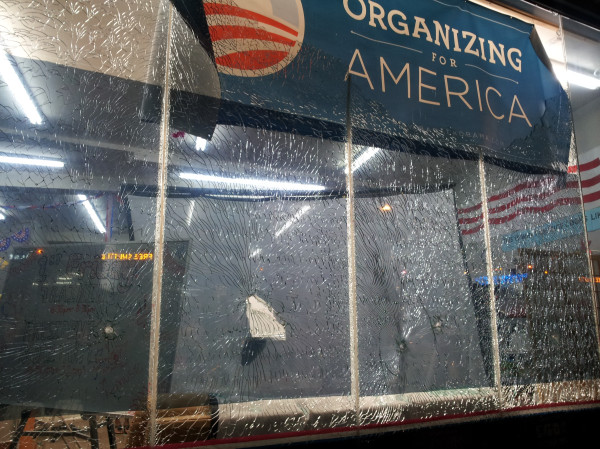
Photograph attributed to David Colburn.
UPDATE (10:40 PM PST): CourtneyOccupy is ustreaming from Oakland. Others will probably soon be doing so as well. Find them through the Twitter hashtags mentioned below.
INITIAL POST: This is breaking news at 10:22 PM PST. People in Oakland have smashed the windows of the Obama 2012 campaign office, unknown as to whether people involved in Occupy Oakland were involved, although Chris Hedges is probably already certain that Black Bloc elements were responsible. Could have been participants in a large Fuck the Police march, could have been people out for the art walk, could have been a spontaneous action by an amorphous group on the scene. We can certain, though, that Obama supporters will be horrified about this after tolerating his wars, his drone strikes, his indefinite detentions, his refusal to help millions of people who have suffered severe economic distress during his first term. For more information as it emerges, follow the hashtags #OO, #OccupyOakland and #FTP, among others, on Twitter. The Oakland Police Department reports an occupation at 19th Street and Telegraph.
Labels: Activism, Alternative Media, Bay Area, California, Occupy Wall Street
Thursday, June 28, 2012
A Response to Party-Building in the 21st Century
For example, Proyect is scornful of those Marxist formations that have seemingly existed solely for the purpose of denigrating the efforts of others to organize broad based anti-imperialist, anti-capitalist coalitions. He emphasizes that it is essential for the left to engage people in terms of the difficulties that they experience in their daily lives. Hence, his positive references to Lenin's 1899 draft programme for the Russian Social-Democrats, the Black Panther breakfast program and the recent SYRIZA 40-point program, which, along with structural measures like cutting military spending, taxing the banks and reforming the electoral process, includes proposals such as housing the homeless in churches, government buildings and banks, opening dining rooms in public schools to offer free breakfast and lunch to children and free health benefits to the unemployed, homeless and those with low salaries. For someone like me, who lives in a city, Sacramento, that has been devastated by the bursting of the real estate bubble, with a proliferating homeless population that constituted one of the most prominent features of the local Occupy effort, such an approach has great appeal.
Interestingly, as acknowledged by Proyect and Pham Binh, anti-authoritarians grasped this concept while Marxists did not, working upon issues within Occupy that were seemingly at odds with their vision of society. As a result, we have observed the peculiarity of anarchists participating in the defense of people threatened with foreclosure, protests against university fee increases and resistance to the closure of public schools. Of course, it only appears peculiar if one is unaware of the anti-authoritarian emphasis upon the need to provide support for those victimized by the deprivation and violence of the capitalist system. It remains an open question as to whether they can continue to do so, but they should be credited for the right response at a critical moment.
With Occupy currently out of public view as a consequence of police repression, there is much discussion how to proceed. Proyect, not surprisingly, along with other Marxists, sees the way forward through through a humanitarian program that forms the basis of a new socialist party, evoking the tangled history of such efforts going back to the 19th Century. Given that he knows his history well, his presentation, on its own terms, is flawless. But what does it mean to engage in party-building in the 21st Century by reference to examples that, in some instances, are over 100 years old? Of course, there is much to learn from them, but one must also account for the social evolution that have occurred during this period, with one of the most significant aspects of it being the disintegration of collective social institutions that engaged the working class. When anarchists and Marxists competed for the support of workers in the late 19th and early 20th centuries, these workers, whether Marxist or anarchist, had networks of housing, schools, social centers, gymnasiums and newspapers. They created such networks because the governmental and non-profit programs that provide such services today either didn't exist, or were grossly inadequate. One of the paradoxes of the creation of the liberal social welfare state is that it substituted the governmental and non-profit provision of assistance for earlier efforts created by workers, providing, at least until recently, higher levels of support while simultaneously disempowering them. In parts of the world that experienced industrialization after the United States and northern Europe, like Italy and South America, this process was not concluded until the 1970s. Contemporary neoliberalism is distinctive because it extracts the value of these governmental forms of social assistance for the benefit of private investors.
For purposes of this discussion, however, it is essential to understand that the socialist parties described by Proyect emerged, in most instances, as part of the vibrant, independent institutional universe created by workers prior to the creation of the welfare state. In other words, party-builders had fertile ground in which to construct them, with workers readily accessible to them and thereby responsive to an attempt to assert their interests through a collectively organized party structure. Along these lines, even Proyect's reference to the Black Panthers is consistent with this, as many African Americans, in places like Oakland, Los Angeles, Detroit and Newark, had been excluded from the benefits of the welfare state through discriminatory practices (consider, for example, that there was a housing shortage in Watts just prior to the 1965 riots while thousands upon thousands of homes were being constructed for whites in the Los Angeles suburbs nearby). Accordingly, it was still necessary for them to rely upon informal networks of social support that were no longer necessary for others, especially the white working class. Even anarchists, while hostile to the electoral process, did, in many instances, as anarcho-syndicalists, participate in unions that served a similar purpose.
In this, the great socialist parties of the 20th Century, the Labor Party in the United Kingdom, the Parti Comunista Italiano in Italy, the Social Democratic Party of Germany and the Socialist and Communist parties in France, among others, were all dependent upon a collective ethos that facilitated the emergence of the mass based, modern political party. The repudiation of this collective ethos is one of the most salient features of our time, and presents a challenge that must be confronted by anyone, like Proyect and, to a lesser extent, Binh, who proposes a socialist party-building enterprise for the left. We need not linger long over the evidence of this repudiation, it is all around us, the abandonment of the political parties by larger and larger segments of the population, the atomization of people within their communities and the prominence of a virtual culture that increasingly manipulates people through simulation and stimulation, as anticipated by intellectual figures like Bifo and Baudrillard. Constructing a party in such circumstances requires more than a willingness to participate in coalitions and the creation of a platform that speaks directly to needs of people.
Put bluntly, it additionally requires a traumatic delegitimization of the existing structures of political, social and cultural authority. We can identify three places where it has occurred: Venezuela, Bolivia and Greece. In Venezuela, the 1989 caracazo ignited a process that lead to the 1998 election of Hugo Chavez and the implementation of measures designed to alleviate the extreme inequality within the country. In Bolivia, Evo Morales and the Movement Towards Socialism took power through the generational efforts of indigenous social movements in opposition to neoliberal policies and drug eradication measures dictated by the United States. Meanwhile, in Greece, the imposition of extreme austerity measures since 2009 has resulted in the success of SYRIZA, a coalition of leftist parties, in recent elections. Greece, and, perhaps, Bolivia as well, presents the prospect of a possible socialist formation contemplated by Proyect, while Venezuela remains a country where power is still exercised through elites, with the mobilization of the populace through participatory political structures being tentative at best.
Proyect has periodically said that he expects conditions in the United States to continue to decline because of the rapaciousness of global capitalist elites. It is a rational assessment with a high probability of being accurate. He therefore insists that there is a great urgency towards the undertaking of the party-building effort that he advocates. Perhaps so, but if it proceeds, it is likely to move forward absent the vanguardism that he mentions in relation to the Nicaraguan revolution. SYRIZA relies upon a consensus decisionmaking process that preserves unity around a coherent statement of policy objectives in opposition to austerity. By doing so, it highlights the fact that future socialist formations, to the extent that they can be considered parties at all, will not administer themselves in accordance with the Leninist practices of the past. Instead, they will operate more horizontally, exposing the irrelevancy of anti-authoritarian critiques centered around the pernicious hierarchies within them. Accordingly, we may be moving towards a squaring of the circle whereby anti-authoritarians concede the necessity of participation within the electoral processes of the state, while Marxists acknowledge that it must be done through a formation that is horizontal to the greatest degree possible.
But can this be done in the United States as proposed by Proyect? I tend to believe that the country is too large, too fragmented, too much in the thrall of capital and militaristic nationalism for it to happen anytime soon. Instead, there will be a prolonged period of direct action and mutual aid efforts to expose the deprivation of the system and ameliorate its effects. In doing so, the participants must necessarily engage the populace in terms of their daily needs. But building the new in the shell of the old is not just an aphorism, it is considered a realistic, immediate strategy for dealing with the loss of jobs, housing, educational opportunities and medical care required to survive in this society. Hence, the parents of children in the Oakland Unified School District, faced with the closure of 5 elementary schools, didn't decide to organize a local socialist coalition, instead, they seized one of the schools planned for closure, Lakeview Elementary, and reopened it to continue to educate their children. Through the proliferation of such actions over time, the left may accumulate sufficient power to accelerate the collapse of American capitalism. But I doubt that it will happen peaceably through participation in the electoral process. At most, such participation, if it happens, will merely be one instrument among many that the left pragmatically utilizes to bring about this outcome.
Labels: Activism, American Empire, Anarchism, Bay Area, Marxism, Neoliberalism, Occupy Wall Street
Friday, June 22, 2012
The People's School for Public Education @ Lakeview Elementary
INITIAL POST:The entrance to Lakeview on Grand Avenue was guarded by Occupy Oakland protesters on Thursday, who tried to limit who came and went from the school to only parents and students. Inside the campus, elementary-school aged children worked in the garden and then inside the classroom of longtime Lakeview teacher Pamela Chinn-Scoffern on art projects, including designing a logo for the People’s School.
Nirali Jani, who lives near Lakeview, sat behind her 3-year-old son at the art table on Thursday afternoon. Jani said she was hoping to send her son to Lakeview when he got old enough because this is our neighborhood school. When Jani heard about the protest this week, she decided to pull her son out of preschool in the afternoon and bring him to the People’s School. Thursday was his first day.
The activities here are really beautiful, and hands-on, and I felt like since it’s summertime I wanted to get our hands dirty, Jani said as she watched her son draw at the table. I think it’s important to be around parents and teachers who are building together.
As she was leaving campus when classes ended at 3 pm, Jani spoke with Velasquez about returning to the school next week to help teach a social justice course. Still, she knows police could move in at any time and evict the protesters. I see it as an inevitability, Jani said.
On June 14th, parents, teachers, students and other members of the community announced their intention to enter Lakeview Elementary and conduct a sit-in after it had been ordered closed by the Oakland Unified School District:
After taking over the school property, they reopened the school on Monday and began to conduct classes and organize activities for children, and continue to do so. As one person in the video says . . . we start to build the world we want to see in the shell of the old.At the end of this school year, the Oakland Unified School District plans to close 5 public elementary schools and hand children’s school buildings over to private charter schools and district administration offices. Hundreds of the displaced students have been placed by the district in elementary schools that are 10 miles away, and the school district has offered no guarantee that transportation will be provided for families. In response . . .
Oakland Parents and Teachers Are Sitting-in to Keep Neighborhood Schools Open!
We Need Your Support!!
On June 15th, after the last day of school, Oakland parents and teachers will sit-in at Lakeview Elementary demanding that the district keep all neighborhood schools open. The district has not listened to lawsuits, pleas from parents and teachers, or protests. We know the money exists, but still they insist on closing flatland schools serving predominantly black and brown children. We say no more excuses! We’re keeping the schools open the last way left to us, by sitting-in. But we cannot do this alone. We need your support! Demand the district and the politicians give us full funding for quality education in neighborhood public schools. Join the fight for our kids’ futures.

Tomorrow, if you live in the Bay Area, there will be a rally and march in defense of this action. You can also show your support by signing a petition and donating funds. By visiting saveoaklandschools.org and the Twitter hashtag @LakeviewSitIn, you can stay informed in regard to breaking news, as the police have already posted a stay away order. Not surprisingly, it appears that the school district is losing money by shutting down Lakeview and 4 other elementary schools in lower income areas, but, then, I guess money is no object when it comes to subsidizing the expansion of charter schools. Yesterday, California legislature leaders reached an agreement with the governor for a revised budget that decreases funding for the public schools by 3 billion dollars while increasing the block grant for charter schools.
Labels: Activism, Anarchism, Bay Area, California, Education, Neoliberalism
Wednesday, April 25, 2012
Occupy and Inviolability of Private Property
But what is it that these progressives believe requires the protection of the police, even at the cost of the violent suppression of Occupy protesters? Upon reflection, the answer is obvious: private property and the hierarchical social relations inscribed by it. Of course, Occupy participants are not all anarchists or communists, far from it, but they have adopted direct action tactics that have frightened progressives with the ghost of expropriation. Initially, occupiers set up encampments in public spaces as a means of highlighting enormous income inequality and corruption. They sought to prefigure an alternative, much more egalitarian, social order that stood in marked contrast to the existing one. If we were living back in the 1960s or 1970s, the government would have responded with a program of increased public assistance, a program that would have drained away support for Occupy by providing housing, jobs, student aid and medical care, but that would have threatened to reverse the neoliberal process of the marketization of all aspects of our lives, and, hence, was never seriously considered.
Instead, with the federal government guiding them behind the scenes, cities, starting with Oakland in October of last year, cleared out the encampments with force. There was an initial broad based criticism of these police attacks, but, as it became apparent that Occupy had evolved into a loose coalition of anti-authoritarians, people of color, the homeless and other marginalized people, such criticism dissipated. Meanwhile, particularly on the West Coast, occupiers organized more confrontational actions in response, such as the November 2nd general strike in Oakland, the December 12th port shutdown, the January 20th Occupy Wall Street West protests and the attempted seizure of the Kaiser Auditorium on January 28th. The failure of Occupy to extract any meaningful political response to the distress of millions of impoverished Americans and the interrelated corruption of the financial and political systems was pushing its participants towards more and more radical approaches. Within occupations, this resulted in increasingly acrimonious personal conflicts, as most publicly displayed in Oakland, while the progressives that should have been allies became hostile.
One might call this the operational explanation for the evolution of Occupy. Such an explanation elides, however, a more engaged one for why this evolution occurred, and necessitates an investigation as to the perspectives about private property held by those within Occupy and those outside of it. Within Occupy, the creation and manipulation of scarcity, particularly in relation to the lack of housing and social services, is associated with the conscious decision to allow properties to remain vacant instead of using them to address human needs. Such a stance is not, paradoxically, necessarily in opposition to capitalism, as mercantilists like John Locke justified the seizure of the lands of indigenous peoples for the reason that it had not been efficiently utilized. Governments in South America still possess the authority to seize vacant land and facilities upon the payment of compensation on the basis of that such lack of use constitutes waste, as the Chavez government has done on occasion in Venezuela. Of course, there is a distinction to be made between seizures to generate economic activity and seizures to address social needs, but the essential point is that even previous capitalist and pre-capitalist, mercantile societies did not consider private property to be so sacrosanct. In today's postmodern world, however, the dead weight of empty residential and commercial buildings serves the essential purpose of preemptively suppressing any resistance by intensifying poverty, while retaining the illusory promise of future, lucrative development opportunities directed towards the upper middle class. So, those involved in Occupy find themselves pulled by gravity into a confrontation with the legitimacy of private property itself.
Conversely, middle class progressives perceive the situation very differently. Beyond being a measure of their personal economic well-being, private property makes them feel more secure because it, by its very nature, excludes. Hence, they respond with dismay if the construction of a low income housing project is proposed near where they live. For them, Occupy threatens to level social differences to an exponentially greater degree bordering on nihilism. Participants within Occupy may be focusing upon empty lots and empty buildings, sometimes in the possession of churches and universities, as with the 888 Turk Street takeover and the UC farm plot in the Albany, but the progressive middle class perceives the peril. It is not just that they frequently identify with the institutions involved and their administrative practices, such as the University of California in the case of the seizure of the farm plot, but that they understand that, if not stopped, the trickle could become a flood that approaches the steps of their homes. Incapable of forcing the government and transnational financial insitutions to adopt Keynesian social welfare measures that would alleviate the distress experienced by those associated with Occupy, they find themselves caught between hammer and anvil, between a rapacious neoliberal regime that puts their livelihoods, and those of their children, at risk, and an increasingly radicalized, anti-authoritarian social movement that threatens to dismantle what limited defenses against such impoverishment that remain.
Labels: Activism, Anarchism, Bay Area, California, Liberals, Occupy Wall Street, Police
Monday, April 23, 2012
After exiting down the Arden Steps and along the Mosswood Path, we returned to our car and made our way over to People's Park in a search for a parking space near Telegraph, where we could get something more to drink as we had run out of water. Fortunately, there was a water fountain at the restrooms by the basketball court. Upon quenching his thirst at the fountain, he noticed a small playground nearby. I used the word "playground" advisedly, because it consisted of a small slide, about five or six feet tall, a slight structure with two swings and a small sandbox that was partially overgrown with grass. But he recognized none of these comparative defects with the more recent grandiose ones that he visits in Sacramento. He asked me if we could go there, and I reluctantly said yes, not because I was dismissive of the playground, but because of fatigue.
As he climbed up the stairs of the slide, I looked around and thought about Daniel and his willingness to play in what others would consider the daunting atmosphere of People's Park. In the trees just to the east, and near the small amphitheatre to the west, homeless people were either sleeping or relaxing as the wisps fog floated past the sun. The playground and the bathrooms displayed the worn, rustic quality associated with facilites that had been there for many years. Of course, none of this made the slightest impression upon him. For him, the homeless people were people like anyone else, and the playground and bathrooms were, well, just a playground and a bathroom. Later, another, slightly older little boy named Phoenix came by, and Daniel played with him for about half an hour or so. Despite his hippie parents, Phoenix wore a Spider Man shirt, which delighted Daniel, who identifies with him as well. Like me, his parents had apparently conceded the struggle against popular culture, perhaps with the expectation that they could eventually induce resistance through familiarity.
After Phoenix left with his parents, I thought about how Daniel has yet to display the socially judgmental behaviors of older children and adults. If people are nice to him, he is nice to them. He doesn't care about their appearance, and hasn't yet internalized the markers of social status. In Sacramento, his favorite playground is located in Southside Park, a park situated in a lower middle income neighborhood with an old housing project, Seavey Circle, nearby. Seavey Circle has long been known for having a veritable rainbow of tenants, including immigrant families from Russia and South and Southeast Asia, and he joyfully plays with anyone who wants to play tag or hide and seek. He asks the Hmong families at the lake nearby if he can help them fish, and they invariably briefly allow him to do so. He prefers this playground to one a few miles away in McKinley Park in East Sacramento, a more exclusive, upper middle income neighborhood, for reasons that have nothing to do with race, class or poverty.
As he slept in the carseat while I drove home, I wondered when Daniel would start distinguishing people and places as we all too often do. Upon entering elementary school? Upon participating in activities like soccer and Little League baseball? For me, in the 1970s, I didn't begin to encounter social differences until I went to junior high school, but things have obviously changed for the worse, with children seeking to differentiate themselves from one another at much younger ages. Baudrillard was, I think, on the mark when he asserted that the transformation from primitive to feudal to mercantile to capitalist society was instigated by a human desire for hierarchical differentiation, and not by material scarcity, as claimed by Marxists. Fortunately, Sacramento is not as extreme as the coastal regions, where families search for pre-schools that will expose their children to French and classical music, while providing them with the latest technological baubles. No child has ever been dropped off at my son's pre-school with a cell phone, as happens in the Bay Area. In one notorious incident, a mother wondered whether she should get her four year old son a phone after the other kids at his pre-school teased him upon discovering that he had been talking into a toy one.
Sadly, Daniel will probably begin to do it sometime soon. It is, arguably, the most essential cultural norm in this society. It is pervasive in every aspect of our relationships with others. But, to his credit, he has a strong, oppositional nature, one that will place him at risk of being characterized as hyperactive, particularly in future educational settings that value conformity. Fortunately, he does think for himself, which my wife and I encourage, and, hopefully, he will successfully call upon this quality as necessary to engage the world on his terms, and not those imposed by others.
Labels: Bay Area, California, Education, Sacramento
Monday, April 02, 2012
OccupySF Occupies 888 Turk Street
UPDATE 1: 75 arrested at 888 Turk Street after an SFPD raid that started at approximately 1:35 PM today.
INITIAL POST: Justin Beck ustreamed it live yesterday:
EyeofRah of OccupySFTV is ustreaming live from the roof of the building this morning:
Live Video streaming by Ustream
He is reporting that there are 8 police vehicles at the scene. Of course, it is anticipated that the police will raid it. There's a march from the Civic Center to the building starting in about half an hour at 10:00am. A call for support has gone out through the Twitter hashtag #888Turk. You can obtain real time updates there as well, including new livestream and video sources throughout the day.
Here's the statement released by OccupySF:
. . . . Occupy SF, through the OccupySF Commune, has inhabited a vacant building onTurk St. for the purpose of creating a community center in the spirit of this building’s original intention–to create a center for health and healing.
In a city with ten thousand homeless people and thirty-two thousand vacant but habitable units, it is a crime against humanity that people are prevented from sleeping through the night as part of a political protest or as a basic human right. The city wants OccupySF and the homeless off the street–harassing, intimidating, and arresting us every night–so now we are inside creating a vibrant space for health, humanity, and free expression.
This building has been empty for five years and was previously a mental health clinic providing a valuable service to the community. Five years ago the Board of Supervisors cut the funding to this vital community center causing many people with mental illness to be put out on the street and become subject to arrest and harassment simply for now existing in these very same streets they were forced into. This funding cut was brought on by the international financial crisis caused by a corrupt banking system which profits off the backs of the 99%.
This Turk St. building is owned by the Church and the owners, therefore, pay no property tax for it. It has been vacant and unused for over five years and no services have been provided here. Further, the owners have failed to register the building as vacant, avoiding their duty to pay vacancy fees to the public coffers. The building is now occupied by a group of people willing to offer services such as food, housing, education, and community-building skills for free.
We assert our human rights to free expression, dissent, and 24-hour protest without undue harassment.
Labels: Activism, Bay Area, California, Occupy Wall Street, Police
Friday, February 24, 2012
Reflections of an Aging Leftist
Prior to the start of the movie, there was a video admonition that no texting is allowed during the feature presentation. The specific theatre for our film was nearly empty, which could be a reflection of the fact that we went on Thursday evening, or that the movie isn't very popular, but I had the disquieting feeling that it was indicative of the fact that movie theatres are now an endangered species, about to become extinct. The previews went on interminably, especially for someone like me used to watching films at the Pacific Film Archive (amazingly, you sit down, the light dims, and the film starts!) and arthouses, so much so, that, after about the sixth one, my impatient son gently asked, are they going to end soon? Fortunately, the film itself was a delight.
Upon coming to work this morning, I went to a nearby cafe and got some tea. The man at the register was talking to his friend about Arkham City, a recently released Batman game. As with my trip to the mall, I experienced a sense of being a foreigner, capable of speaking the language but otherwise isolated. Gaming is a phenomenon that is mystery to me. Millions of people buy them and play them on their playstations at home, and I have the most minimal understanding of the experience, except that they appear to be very good at keeping kids occupied, frighteningly so. Surely, there are significant social and political implications to this phenomenon, but, if so, I have no idea what might be, other than an observation that it appears to be yet another way for people to isolate themselves with technology.
Such experiences cause me to wonder, what is the purpose of trying to engage people politically, either through this blog or over the radio, two increasingly antiquated forms of communication? How it is possible to reach people who have socially organized themselves in ways that I don't understand? Even if I can, does what I say have relevance to them, or do I sound like some hill country Baptist preacher, speaking in a dialect long since abandoned? And, if I have these problems, imagine what it must be like for people trained in the baroque rhetoric flourishes of 20th Century Marxism and feminism.
Ultimately, I can only take refuge, paradoxically enough, in the avant garde individualism of people like Donald Ritchie, the American who decided to stay in Japan permanently after his arrival in 1946, and indulge his obsession with the unfolding modernity and postmodernity of Japan within the context of his classical cultural referents. His courage lies in his simple, persistent refusal to allow the market and the mercurial trends of pop culture to dictate his interests and his intellectual relation to the world. It is a paradoxical refuge, because I, unlike Ritchie, believe in the possibility, indeed, the necessity, of a utopian, liberatory collective human enterprise. Without one, how can the human race survive? Even if we survive, how can we avoid the increasing probability of a truly genocidal extermination of billions of people who no longer have a place as either a producer, a consumer or a debtor in a world transformed into one of mechanical and virtual manufacture, communication and distribution?
For me, Occupy represents a gossamer thread of hope, a possibility, however slight, that people can organize themselves, from the bottom up, and avoid these dystopian outcomes. Many of the participants are young, tech savvy people, racially diverse (in California, at least), with a recognition of the hierarchical institutions of social control that oppress them. Occupy Oakland, for all of it problems, is the most inspiring, an occupation that has sought to engage young people, poor people, people of color and the working class more broadly. Perhaps, it's time has already come and gone, but, if true, which I doubt, it will still serve as an inspiring experience for those who come after it, inspiring not just because of its successes, but also because of its failures, failures which have resulted from its ambitious effort to confrontationally challenge the inherent violence and brutality of this society.
Hence, I put forward my perspective about Occupy with care, because I'm not on the front line, and, beyond that, as a cultural outsider, lack the insight to confidently make recommentations. Are the Fuck the Police marches in Oakland on Saturday evenings a bad idea? An activity that alienates people that might otherwise support Occupy Oakland? Probably. But I haven't lived in Oakland and been subjected to the predations of the police for years, or been attacked with tear gas and flash grenades during occupations, marches and direct actions, as many in Oakland have been. I can't dismiss the possibility that these marches may, in fact, anticipate a greater public willingness to challenge the power of the police in the future. In other words, the repressive power of the police over their lives may turn out to be a seminal issue for young people who are also being impoverished by austerity. Leftists, especially older ones, need to recognize the interrelationship between police repression and poverty instead of talking about them in implicitly mutually exclusive terms.
I am, however, confident enough to insist upon one thing: Occupy must be centered around the principle of the most radically inclusive democratic perspective, otherwise it will degenerate into yet another manipulative, liberal representational effort, or fragment into small, sectarian groups, some violent, some not, groups that spend more time fighting one another over the purity of their vision than engaging the people that purportedly justify their activity. There is a path that runs between them, one that requires understanding the day to day lives of distressed people and creating a place for them within the movement. Through this, Occupy can become a truly mass movement that threatens the existing social order. The repressive measures directed against Occupy to date reveal the potential for such an effort.
Labels: Activism, Anarchism, Bay Area, California, Marxism, Occupy Wall Street, Police, Sacramento
Tuesday, February 14, 2012
The Origins of Occupy? Mission District Murals, 12/31/2003
INITIAL POST: Many years ago, I biked around the Mission District in San Francisco, and stopped to examine the murals in Clarion Alley, off Valencia. Many of them present highly politicized, socially radical themes, with an emphasis upon the the transformative harshness of the migration, the paradoxically collective nomadism inherent within it and the indigenous experience.
I remembered this today as I was looking through a stack of old business cards and papers with phone numbers of guests for my KDVS radio show (I remain primarily pre-virtual in this regard). As I did so, I came across a Modern Times Bookstore receipt from December 31, 2003. For those of you who are interested, I purchased the The Sorrows of Empire by the late Chalmers Johnson, A Civilian Occupation: The Politics of Israeli Architecture, edited by Eyal Weizman, Rafi Segal and David Tartakover, and Israel/Palestine: The Black Book by Reporters Without Borders. To this day, I haven't read the last one, it's sitting in a stack somewhere in my house.
Afterwards, on this same day, I stopped to ponder the nearby murals in Clarion Alley, as, back then, Modern Times was located on Valencia Street near Clarion instead of 24th Street as it is now. I was sufficiently struck by one of them that I wrote down what appeared to be a title or introductory statement to a poem and the poem itself. Upon reading it again today, I was quite surprised:
And, then, there was the poem itself, a romantic expression of magical realism:Occupy your streets and not other countries
Was this composed by the people who painted the mural? Is is the work of a famous poet that I do not know? While I have a fondness for literature and film, I admit my ignorance when it comes to poetry.When we return to our ancient land which we never knew
And talk about all those things that never happened
We will walk holding the hands of children who have never existed
We will listen to their voices and we will live that life
Which we have spoken of so often and have never lived
I wish that I had a picture of it, but I don't. I wonder if the people who painted it remembered it as Occupy captured the public imagination last fall. Did they actually participate in the occupations? Did they appear and urge the importance of decolonization as an essential principle to acknowledge the imperial conquest of their lands and their cultures? Did they go to the general assembly and insist upon the inclusion of the experiences of people of color? Or had they forgotten about the mural, painted so long ago? Possibly even moved to live in other countries?
All questions without answers. With the passage of time, we can only recognize that the author(s) gave voice, in their elliptical way, to their utopian aspirations, aspirations that collectively emerged years later within Occupy. Perhaps, some day, we will fulfill them, because, as I frequently tell people these days, capitalism was also a utopian vision for many centuries, albeit a perverse one.
Labels: Activism, American Culture, American Empire, Bay Area, California, Occupy Wall Street
Monday, February 13, 2012
An Open Letter from 4 Oakland Radicals
Hat tip to Richard Crary of The Existence Machine.58m lauren riot @laurenriot
I wonder if these folks actually spent any time in the days we laid down roots at Oscar Grant Plaza. I remember ferocity! Militance!
59m lauren riot @laurenriot
Do they mean taking a building after 10s of 1000s took to the streets only 4 weeks in?
59m lauren riot @laurenriot
Do they mean the roots of masked folx building barricades 2 weeks in to protect from cops?
1h lauren riot @laurenriot
Which roots exactly? OO was never an OWS satellite.
1h lauren riot @laurenriot
As the Oakland Commune evolves and finds its legs, these folks want to return to its roots.
1h lauren riot @laurenriot
And yet this group is most concerned about a handful of people who organized a *single* *action* they didn't like.
1h lauren riot @laurenriot
An aside, the "radical inclusivity" of OO has us organizing w/ holocaust deniers, unapologetic racists, rapists, misogynists and homophobes.
1h lauren riot @laurenriot
and seriously, just LOL at the reference to riot porn, an expression they no doubt learned from a sarcastic insurrectionary anarchist.
1h lauren riot @laurenriot
The link to the Bay of Rage article (& other language) says to me that one organizer in specific is being targeted, and that's fucked up.
1h lauren riot @laurenriot
The GA voted 2 keep many parts of the organizing of #J28 closed, while allowing the majority of the work to be done openly. Quite democratic
1h lauren riot @laurenriot
The critique of undemocratic processes seems to be another complaint about the organizing format agreed on my consensus at the GA. Ironic.
1h lauren riot @laurenriot
When you consider downtown residents opening their homes to strangers for teargas/OC decontamination on #J28-again, I see massive support!
1h lauren riot @laurenriot
When you consider 1000s on #J28 willing to commit trespassing, at least hundreds willing to commit burglary - speaks to massive support
1h lauren riot @laurenriot
What I see in the community is that the support for #OO is still very strong, if not stronger than it's been.!
INITIAL POST: An excerpt from a statement by four people involved in Occupy Oakland from the inception:
Please consider reading the statement in its entirety, as well as the comments in response to it. They provide insight into the urgency of adopting inclusive practices that will expand the reach of Occupy.In our individualistic culture, it is rare when radical activists are able to pitch a big tent and draw in masses of people to the cause. The early days of the Occupy movement provided one of those rare opportunities. Occupy was the spark for the emergence of a broad wave of anti-corporate, anti-repression sentiment in our society. We are concerned that the inclusivity that began this movement and contributed to its rapid growth is dying in OO as a result of the dominant insurrectionist tendencies and the vanguardist maneuvering and manipulations of some of its proponents. Dramatically shrinking numbers reveal that this ideology and organizing style either misreads the real political situation in Oakland, or else underestimates the importance of consolidating and advancing a broad, united and popular front. We all collectively must take responsibility for this hardening and shrinking of the OO ranks, and we must recognize that in trying to re-make OO in an ideologically purist vision, we are destroying our ability to garner the wide base of support and goodwill that will be necessary to successfully resist corporate and state domination.
Occupiers who have begun to question the decision-making processes involved in recent actions like J28 are being asked, in the name of unity, to maintain silence. We have been told that our concerns will be dealt with, that there’s nothing to worry about, and that we shouldn’t speak publicly about them. Yet we feel that without transparency and open dialogue, the problems will only get worse. We are speaking to everyone who still believes in Occupy Oakland, but especially to those most active in the GA and various committees who have the ability to help us make the kinds of changes that would reassure the larger Bay Area community that Occupy Oakland is still a wise place to invest its energy.
The four of us decided to speak out because we have each been pushed to the margins of OO by ugly, ideological purification behavior that often now takes place at the GAs and in groups like the Move-In Committee, where dissenting voices are booed and jeered and group speak and in-group relationships now dominate. Please do not mistake our concerns as yet another attack on anarchism or Black Bloc; it’s not about that at all. It’s about the exclusionary strategies and tactics that alienate those of us who are interested in a slower, more solid, more inclusive approach of mass movement building.
As Cheryl Kohler, one of the signatories to the statement, says:
Let's hope that the participants in Occupy Oakland do so. As Bifo more generally observed in After the Future:We are arguing against a strategy of full-blown insurrection and asking those who seem to be pushing in that direction to reconsider the strategy.
For those committed to the creation of alternative forms of collective organization and resistance, the answer to this rhetorical question is obvious. As I said on Thursday, socially and economically vulnerable people, and, for that matter, most people, whatever their background, are not going to commit themselves to a movement centered around high profile direct actions that present a higher probability of confrontation with the police. They are not going to participate in actions where, through the unilateral decisions of others, they suddenly find themselves subject to police assault. Such an experience is not going to result in a mass movement directed towards the dismantlement of governmental authority and police power in Oakland. If anything, it is more likely to lead to the imposition of a state of emergency.The identification of desire with energy has produced the identification of force with violence that turned out so badly for the Italian movement in the 1970s and 1980s. We have to distinguish energy and desire. Energy is falling, but desire has to be saved. Similarly, we have to distinguish force from violence. Fighting power with violence is suicidal or useless nowadays. How can we think of activists going against professional organizations of killers in the mold of Blackwater, Halliburton, secret services, mafias?
As noted in my replies to Richard Crary's comments about my post yesterday, there are other ways of carrying out direct actions that incorporate the concerns of the community and reduce the prospect of a violent confrontation. For example, consider Jan Gilbrecht's explanation of how the seizure of the Kaiser Center, otherwise known as J28, could have been carried out:
Interestingly, even Gilbrecht did not perceive the peril in a public mass action to seize the Kaiser Center, but, at least, she did recognize the need to place the facility at the service of the community. If this approach had been adopted and communicated to the people of Oakland prior to the action, it may well have generated a larger turnout of support, deterring the police from responding with such extreme force. If not, Occupy Oakland might have received more broad based community support after the subsequently kettles and arrests. Her claim that she was told by someone that Occupy Oakland never expected to hold the building points towards another serious issue, one beyond mendacity. If true, it highlights the arguable assumption that people can be best organized through theatrical protest spectacles, where the activists and the police all play their assigned roles.Some of the proponents and proposers kept adding anything goes to the list of what would happen in the building, like for example child care, without consulting the childcare committee or having that be part of the initial proposal, or housing without addressing the serious issues with violence at the old encampment. I pointed out that it was hubris for the Move-In committee to decide on behalf of the community what would happen in the building. My proposal was to build for a very large Move-In action and community festival for the weekend, with a mass GA to be held each night, where members of the community could make proposals for the future of the building and then make decisions and commitments together. Rather than a distraction, many many people agreed with or also proposed this type of an approach, and a committee actually came up with a list of proposed housing guidelines to present to the GAs. Someone was identified to facilitate these mass GAs. Actually, it was one of the central proposers and planners of the action who told me personally that he didn’t care what we said would happen in the building, because it wasn’t about holding the building anyway, that would never happen. He thought we should say whatever people wanted to hear to get them out that day. That is exactly the kind of dishonest approach that caused me to withdraw from the Move-In action.
Unfortunately, in this instance, the police didn't, a fact echoed in subsequent statements by some organizers to the effect that they expected the police to allow marchers to enter the Kaiser Center and arrest them later, as with past encampments. They expected to be allowed to, in effect, briefly squat the Center, conduct a couple of GAs and have a dance party before being evicted. There is nothing wrong with that, other than the failure to inform everyone of this purpose, except that, once the police stepped outside of their assigned role, and refused entry, a few protesters did so as well, responding with bottles, rocks and firecrackers. In other words, it was on. On J28, the Oakland Police Department displayed its ability to evolve and more effectively respond to the tactics of Occupy Oakland, catching it flat-footed. Furthermore, had something like the Gilbrecht approach been adopted, Occupy Oakland might have discovered that people in the community were not very enthusiastic about it, while suggesting modifications, such as, say, a more initially covert seizure, or something else entirely instead in the spirit of democratic discourse.
Beyond this, there is the troubling possibility that such violence facilitates the current harsh transformation of global capitalism, one centered around the accumulation of surplus by means of the provision of surveillance and security services, as explained by Stephen Graham during this Democracy Now! interview:
For more about Stephen Graham, and his pathbreaking work about the militarization of the city, go here and here.JUAN GONZALEZ: And Stephen Graham, what’s the market? You’re talking about a growth industry. What are we talking about here in terms of investment of dollars by—because there are so many, obviously, municipalities in the United States with their own police forces?
STEPHEN GRAHAM: Well, I mean, globally speaking, the so-called homeland security market is a real—is in real boom town—boom time, excuse me. I mean, in a world where actual defense contracts are often being reduced, a lot of the big companies are moving into civilian applications. They’re moving into these non-lethal weapons, moving into all of the technologies of crowd control and civilian disturbance control. And that has to be added to, of course, the much bigger markets that are growing in terms of broader questions of surveillance and security for buildings, for cities, for special events, as we see these systems established more and more in terms of everyday spaces and everyday bits of cities. So, I haven’t got figures at hand, I’m afraid, but it’s multibillion-dollar markets that are projected to grow globally at very, very high rates over the next 15 years, according to some of the recent market research reports.
Hat tip to Louis Proyect, The Unrepentant Marxist.
Labels: Activism, Anarchism, Bay Area, California, Occupy Wall Street, Police, Political Violence
Thursday, February 09, 2012
Doctor Hedges Misdiagnoses the Decline of Occupy (Part 1)
Chris Hedges has the answer: Occupy has a cancer known as the Black Bloc that must be aggressively treated before it becomes terminal. According to Hedges, the Bloc, its violence, its contempt for collective social organization and its hypermasculinity are turning the public against Occupy. If Occupy is to survive, the Bloc must be expelled. His answer has a superficial allure especially given his skillful elaboration of it. As a consequence, his article has been posted all over the Internet. For those with a legitimate grudge against the Bloc, like Louis Proyect and other Marxists, it is a golden opportunity to drive a stake through the heart of it. Perhaps, that would be a good thing, as I've never been very enthusiastic about people who knowingly put others at risk by precipatating violent confrontations with the police. Anyone who does that, Bloc or not, has no place in Occupy or any other movement for social justice.
But it's all just a little too convenient. Preliminarily, there's a conceptual problem. Contrary to what Hedges, and even Proyect, would have you believe, the Bloc isn't nearly as monolithic as they suggest, as this perceptive comment by Black Bloc at Pink Scare demonstrates:
If you require a more detailed, even more convincing explanation of Black Bloc practice, consider reading David Graeber's response to Hedges at n+1. Given the decentralized, transitory nature of what anarchists describe as the Bloc, periodic Bloc groups come into existence around the country, sometimes for violent purposes, sometimes not. Graeber even states that participation in these blocs is not limited to anarchists. Accordingly, the question becomes less about the Bloc, and more about why some people gravitate towards violent forms of political activity, and the consequences of such activity for Occupy. As such, it becomes difficult, if not impossible, to treat Occupy consistent with Hedges' diagnosis. There are few readily identifiable people that can be characterized as Bloc (for example, consider this photo of the Occupy Oakland Tactical Action Committee, promoters of the weekly Fuck the Police marches, who's Bloc and who's not?), and, even if there are, they may or may not be involved with the violent police confrontations associated with some occupations, like Occupy Oakland. One can read the comment of Black Bloc as an implicit approval of Bloc violence in self-defense, but, if so, it is hard to rely upon it to justify a characterization of such Bloc behavior as cancerous, although such an interpretation does raise thorny, but less polarizing, issues of personal responsibility within a collective movement. Possibly, for this reason, Hedges prefers to expound upon Zerzan and Bloc ideology to avoid engagement with them.There is no the Black Bloc. A black bloc is a tactic, not an organisation, engaged in by anarchists (yes, even us boring old neo-Platformist anarchocommunists, not just Insurrectionists) in which anarchists show up en masse at a protest, take steps to preserve their anonymity (as defense against state profiling), band together, ignore demands from illegitimate authority (i.e. the cops) and act together to defend participants' bodies and autonomy against state violence. It does not necessarily include sabotage-style direct action nor confrontation with cops (except for the fact that cops in general *seek* that very confrontation with any black bloc that forms on the ground). In fact there have been numerous black blocs on the east coast that I have been a participant in and that did not result in any property damage nor violent confrontation with cops whatsoever.
Indeed, Occupy Oakland, an occupation that appears to be the target of Hedges' polemic, illustrates the lack of factual support for his theory. On November 2nd, I participated in one of the several marches during the general strike. Some masked people broke windows at a couple of bank branches, a Wells Fargo one and a Chase one. Interestingly, the media gave little attention to these incidents, perhaps because the vandalism was so trivial in nature. Instead, the media was much more engrossed in the attempted takeover of the Traveler's Aid Society Building near Oscar Grant Plaza later that night, as the police responded to ineffectual efforts to take the building and defend it with tear gas and flash grenades. A large crowd of young people, still out in the streets, participated, and, as the situation with the police escalated, some of them looted a Tully's Coffee Shop. Hedges describes them as Groups of Black Bloc protesters.
But were they? I have looked in vain for pictures of the people who did it, but I did find this article about the episode, which questions the utility of describing it within the confines of Bloc theory and practice accessed over the Internet by Hedges:
They voiced anger over budget cuts that that forced the closure of a homeless aid program. Think about that for a moment. Doesn't sound very Bloc like, does it? Instead, it sounds like a group of people influenced by a variegated mixture of direct action principles, motivated to do something spontaneous by their involvement in the strike. Of course, such behavior can be damaging to a social movement, but it is not something that can be so easily addressed by subsuming their behavior within the repository of a Black Bloc, specifically designed for this purpose.At the Oakland encampment, Hale Nicholson, who described himself and others as pacifists, said he participated in Wednesday's demonstration and march to the port and then went to sleep at the camp around 9:30 p.m. Around 1 a.m., he said, he was awakened by the sound of flash-bang grenades.
A group of protesters broke into the former Travelers Aid building in order to, as some shouting protesters put it, reclaim the building for the people. They voiced anger over budget cuts that forced the closure of a homeless aid program.
They blocked off a street with wood, metal Dumpsters and other large trash bins, sparking bonfires that leapt as high as 15 feet in the air. Several businesses were heavily vandalized. Dozens of protesters wielding shields were surrounded and arrested.
Susie Cagle, in an article posted at Truthout, refutes Hedges even more categorically:
As Cagle relates elsewhere in the article, the challenge presented by some involved in Occupy Oakland is their willingness to embrace more and more confrontational forms of protest, forms that make people like Hedges uncomfortable, at least when they aren't happening in Greece:Hedges condemns property destruction in political protest by condemning black bloc tactics, regardless of the facts. The local coffee shop vandalism Hedges contends was committed by black bloc was in fact one window of a corporate coffee chain smashed in that post-strike fog of war - and by someone not wearing a mask, not wearing black. The people who broke into City Hall on January 28, and many of those who destroyed property there, were also largely unmasked. And both of these acts came immediately after, as in within minutes of, violent mass kettling and arrest actions.
My, my, Hedges comes across here, does one dare say it, as very much like his characterization of the Bloc, or close to it, certainly more so than the people who attempted to take over the Traveler's Aid Society building. Here, it seems, we have on old activist stereotype, one who exoticizes political violence in other places, usually lesser developed ones, but finds himself alarmed when it emerges close to home. Proyect, in a post otherwise sympathetic to Hedges, perceptively observes that, to date, the riots, general strikes and attacks upon businesses celebrated by Hedges have failed to stall the ruthless imposition of austerity measures upon the Greek populace.Here’s to the Greeks. They know what to do when corporations pillage and loot their country. They know what to do when Goldman Sachs and international bankers collude with their power elite to falsify economic data and then make billions betting that the Greek economy will collapse. They know what to do when they are told their pensions, benefits and jobs have to be cut to pay corporate banks, which screwed them in the first place. Call a general strike. Riot. Shut down the city centers. Toss the bastards out. Do not be afraid of the language of class warfare—the rich versus the poor, the oligarchs versus the citizens, the capitalists versus the proletariat. The Greeks, unlike most of us, get it.
Consistent with this, while Hedges confined his condemnation to the Bloc, I suspect that the popularity of the piece, the reason why it went viral, is because liberals and progressives, non-socialists, in other words, have become fatigued with the direct action ethos of Occupy. For example, read through the comments to this post, written by someone who participated in the January 28th attempt by Occupy Oakland to seize the vacant Kaiser Center Auditorium and convert it into a community center. Numerous people, who, because of their local knowledge, appear to be Bay Area progressives, posted hostile comments, showing no sympathy for the people who were attacked and arrested by the police, despite the fact that the overwhelming majority were not among the few who threw rocks, bottles and firecrackers at the cops. Confronted with an excessive police response, especially at the end of the day, when officers kettled protesters, subjected them to a barrage of tear gas and flash grenades, and then arrested over 400 in front of the YWCA building, the commenters were either silent, or dismissed it as predictable. Clearly, they objected to the attempt to seize the building just as much as they did the people who threw objects at the police.
The reason for this hostility is simple: they, like Hedges, are alarmed at the increasing intensity of the confrontations with the police. Hence, liberals and progressives will be critical of any action, even non-violent ones, like property seizures, if they degenerate into street violence between protesters and cops, while conversely, ones that actually involve property destruction, without a violent police response, like the windows broken during the day of the general strike, or, more recently, the windows broken at an upscale car dealership on Van Ness Avenue in San Francisco during the evening of the Occupy Wall Street West action, generate much less comment, except by those who learn of them during the real time livestreams and Twitter feeds or subsequent YouTube videos.
Such a response exposes the fault line that runs between older progressives and the young militants of Occupy. Older progressives live within existing institutional structures, unions, universities, schools and the public sector, and have become, in many instances, middle and upper class. Overall, they have a positive opinion of the police, even as they believe that officers should stop treating poor people and peole of color so badly. In other words, they believe that the police are necessary to preserve social order, and that they can be reformed. Conversely, many of the young militants of Occupy now consider the police to be an implacable enemy, a bulwark of the existing system of social oppression. And, in Oakland, they knew about the predations of the police prior to Occupy, which explains the intensity of the conflict there.
Here, finally, we begin to recognize some of the challenges currently confronting Occupy. On the one hand, we have people who purportedly want to support it, and may have even done so in the initial period of occupations, but cannot do so now because of the violence they perceive associated with it. On the other, we have others, rightly outraged over the conduct of the police, who risk substituting confrontations with law enforcement over direct challenges to crony capitalists responsible for the economic distress experienced by so many. Occupy also initially attracted marginalized people, but they seem to have departed.
Is there a path out of this dark forest? If so, it may lie within the processes of Occupy itself. As Pham Binh and others have observed, Occupy is a direct action social movement where those who dedicate the most time and energy disproportionately influence the outcomes. There is nothing unique about this, it is true of most institutions in this society. But such an approach will not work for a movement that seeks to represent the 99%. As Tiny, also known as Lisa Garcia-Gray, wrote about her experience during a march and bank occupation in San Francisco:
At last, Tiny, not Chris Hedges, has revealed what ails Occupy, the difficulty of reaching and empowering the people most victimized in this capitalist society. By targeting the ephemeral Bloc as the source of the illness, Hedges evades this much more challenging social and political dilemma. Accordingly, Occupy should evaluate its internal processes and future actions by the extent to which they bring these people into the movement, and not by simplistic bright line rules about violence and non-violence.POOR Magazine was in the march on this day, sadly with only three members, we did have four family members but several of our poor parents are houseless and jobless and so our fourth member had his phone cut off the night before and so we couldn’t find each other in the masses of people, and all of our other family members were working one of several jobs and hustles and so they didn’t even have the privilege to be there at all.
At first I was taken by the almost flawless organizing by Bay Area non-profit organizations. From the emcee to the turn-out from group after group, the whole event was wound tightly as a rope on a drum. Each act of civil disobedience, set-off at the mouths of Wells Fargo bank branches, were beautifully orchestrated stages of theatre and action. It was obvious that funded organizations with time and paid staff had organized this event down to the last balloon, slightly like a party we at POOR Magazine had never received an invitation to.
As we left the protest to get our young kids to school on time, Tony and I spoke about the power of the resistance that we had just been part of. I brought up how although I am excited and about all of the issues peoples were speaking and acting on I remain vexed by the fact that as poor peoples of color and indigenous peoples we are constantly in battle, in protest about the genocide and violence perpetrated on us and yet it is a struggle for us to get 50 people to show up for protests, so what is the difference? and what really is our role in all of these resistance occupations as poor peoples of color in struggle who are also in struggle with the occupation of our time due to no-wage and low-wage work, system abuse and ongoing criminalization and why do our resistance movements stay at the margins of what is important to show up for?
For now, and, perhaps permanently, that means trying to avoid violent confrontations with the police as much as possible, not because the conduct of the police should be considered acceptable, far from it, but, rather, because many of the people that might embrace Occupy most enthusiastically are terrified, and for good reason, of being beaten, arrested, and, if undocumented, deported. I actually accidentally had the opportunity of seeing Tiny request Occupy Oakland support for an immigrants rights march during a general assembly in mid to late November, and someone asked, because of the attempted Traveler's Aid Society takeover, whether there would be any violence. She emphatically said something like . . No . . No . . absolutely not . . we are going to have families with children with us on the march. In relation to the attempt to take over the Kaiser Center, such considerations might suggest an initially more covert effort to seize it, with a subsequent display of public support, as occurred at Wheeler Hall at UC Berkeley in November 2010, instead of a mass attempt to storm police lines at mid-day. Similarly, the manner by which Occupy Oakland organized in advance of the port shutdown, and provided picket line support for striking workers might serve as good examples as well. All three constituted effective efforts to support workers at the base.
Labels: Activism, Anarchism, Bay Area, California, Liberals, Occupy Wall Street, Political Violence
Monday, January 30, 2012
What Happened in Oakland on January 28th?
Labels: Activism, Anarchism, Bay Area, California, Neoliberalism, Occupy Wall Street, Police
Saturday, January 28, 2012
Tear Gas, Flash Grenades, Rubber Bullets and Mass Arrests Used Against Occupy Oakland
INITIAL POST:
I was out all day, and don't know how things got to this point. At the time of this post, 7:30 PM PST, the Oakland Police Department is in the process of arresting about 100 people that have been kettled in front of the YMCA building in the downtown area near Oscar Grant Plaza. Apparently, there were confrontations earlier in the day that resulted in the police using tear gas, rubber bullets and flash grenades on protesters. All I know is that Occupy Oakland had previously announced plans to take over an abandoned building today and use it for housing and the provision of services, a building that turned out to be the Kaiser Civic Auditorium near Lake Merritt. For updates and links to livestreams and ustreams, use the hashtag #Occupy Oakland.
Labels: Activism, Anarchism, Bay Area, California, Occupy Wall Street, Police, Ustream, YouTube
Saturday, January 21, 2012
Ustreaming Can Be Hazardous to Your Health
Labels: Activism, Bay Area, California, Occupy Wall Street, Police, Ustream, YouTube
Friday, January 20, 2012
Updates on Occupy Wall Street West
Go here for more updates over the course of the day. You can also stay informed on Twitter at #occupysf, #occupywallstwest, #OWSwest and #occupyoakland. Tweets there will direct you to ustreams and livestreams of actions as they happen. Occupy Network is currently broadcasting two streams out of downtown San Francisco. Yesterday's post also names some of the possible ustreamers and livestreamers. There are also Occupy the Courts protests taking place in other parts of the country as well, including one on the steps of the US Supreme Court.Occupy Bernal Shuts Down Bernal B of A Branch
10:11am -- 45 Occupy Bernal protestors led by four families fighting eviction and foreclosure delivered demand letter and shut down Bank of America branch at 3250 Mission and 29th Streets, heading to Wells Fargo branch at 22nd and Mission Streets.
Banner Blocking Downtown Traffic
10:04am -- Banner blocking intersection at Montgomery and California.
15 Protestors Lock Entrances at Bank of America
10:01am -- 15 protestors lock down entrances at Bank of America at 345 Montgomery.
Protestors Take to the Streets at Bank of America
9:57am -- Protestors take to the streets at Bank of America at 345 Montgomery.
20+ Protestors Gather at Bank of America Branch
9:54am -- Twenty to twenty-five protestors have gathered at the Bank of America branch at Powell and Market Streets.
Police Commander Confirms Seven Arrests at Wells Fargo Headquarters
9:22am -- Police Commander confirms seven arrests so far at Wells Fargo Headquarters entrance at 420 Montgomery.
Police Raid at Wells Fargo Headquarters
9:22am -- Police are blocking off access to Wells Fargo Headquarters entrance at 420 Montgomery and cutting protestors out of lock boxes to arrest them.
Foreclosure House Party
9:21am -- Foreclosure house party with music and furniture at 7th and Sansome Sts.
Protest Shutting Down Wells Fargo Headquarters
8:50am -- 40 protestors and some squids now blocking entrances at Code Pink action at Wells Fargo Headquarters, 420 Montgomery St (at California).
Labels: Activism, Bailout of Finance Capitalists, Bay Area, California, Neoliberalism, Occupy Wall Street
Thursday, January 19, 2012
INITIAL POST: Tomorrow:
For more background, go here and here.6:00am Occupy Wall St West!
Day-long Nonviolent Mass Occupation
When: Fri, January 20, 6am – 9pm
Where: San Francisco's Financial District (map)
Description: See http://www.OccupyWallStWest.org for developing details
San Francisco Financial District
DAYLONG NONVIOLENT MASS OCCUPATION
of the Wall St. banks & corporations attacking our communities
DON’T GO TO (OR WALK OUT OF) WORK AND SCHOOL
Organized groups will be coordinating specific direct actions and set their times and places. For members of the public/Occupy that are not part of an organized group, you can converge on Bradley Manning Plaza (Justine Herman) and join with others at any of these times, 6:00am, 12 Noon and 5:00pm.
Starting at 6am PST tomorrow, you can follow the day's events on Twitter at #OccupySF, #OWSWest and #OccupyWallStWest, among others. There will be at least 8 ustreamers providing video broadcasts of the actions over the course of the day, including pixplz, occupy-sf-maya, codeframeosf and mikeqtips, as well as the occupysf channel. Go to http://www.ustream.tv to find them. The Twitter feed will undoubtedly have links to these ustreamers and others as well as events unfold.
Labels: Activism, Bailout of Finance Capitalists, Bay Area, California, Neoliberalism, Occupy Wall Street, Ustream
Saturday, January 14, 2012
UPDATE 2 (1:55PM PST): Protesters have blocked the police paddy wagon trying to take away the arrestees in an alley.
UPDATE 1 (1:43 PM PST): Several cops have climbed up a fire truck ladder onto the roof, and taken the banners away. First arrests. Chants of let the people go, arrest the CEO!
INITIAL POST (1:02 PM PST): At 1:02 PM, California time, OccupySF is currently protesting foreclosures and evictions by Wells Fargo at the Wells Fargo branch right by the 16h Street and Mission BART station. Banners have been dropped and there are tents on the roof. he police have closed the parking lot with tape and tried to persuade activists to leave the roof without being arrested. For video, go here. Justin Beck, the public affairs director at KDVS in 1998 who put me on the radio, is the ustreamer. For twitter updates, go here.
OccupySF has described the purpose of this action as follows:
Today's action is the first of what OccupySF has described as the Occupy Wall Street West campaign, which will culminate with planned mass occupations in the financial district on this upcoming Friday, January 20th.Thousands of renters and homeowners in San Francisco are being evicted by banks each year. San Francisco’s Mission District has been especially hard hit by the 1% banks preying on the 99% working class. Join Occupy SF Housing at Noon on January 14 to protest evictions of renters for condo conversions, which are being done by real estate speculators working with Wells Fargo Bank. We will demand that Wells Fargo stop all pending evictions which they are financing and to stop financing any more evictions for profit, where low & moderate income renters are evicted so affordable apartments can be converted into luxury condominiums for the wealthy.
Labels: Bailout of Finance Capitalists, Bay Area, California, Neoliberalism, Occupy Wall Street, Sub-Proletarianization of America
Friday, January 13, 2012
Occupy Oakland and the American Licorice Strike
Noah Zimmerman described his experience:
I'd like to be able to say that the workers at American Licorice prevailed, that the community support provided by Occupy Oakland turned the tide. But it didn't. The workers at American Licorice decided to accept the company's offer. Again, according to Zimmerman:The picket looked strong. Hundreds of people I guessed, stretching along Whipple and around the corner to their mailbox at 2477 Liston Way (American Licorice’s phone number is 510-487-5500 if you want to call and confirm the address). Food, tables and chairs were set up. The workers on strike were members of Bakery Workers Union Local 125. They were mostly Latino. I spotted Occupy Oakland picketing the main entrance. It looked like the two groups were self-segregating.
Union City police were out in force. So were Hayward, Fremont and Newark police. A mutual aid agreement between the departments. Everything looked heavy but at least the riot gear wasn’t out.
Then, I saw them behind the main gate where the Oakland Occupiers were on a moving picket. Goons. Hired goons. Three of them, observing the picketers from behind the gate. The Huffmaster Security Crisis Team. Red Vines, which everyone eats at the movie theater (if anyone can still afford to go out) not only pull fillings out of your teeth but make factory bosses to pull out their checkbooks for present-day Pinkertons.
One of them was built like a brickhouse. He looked like a creation of Vince McMahon’s steroid-addled imagination. Asshole #1, one of the workers said, gesturing to him. No name? I asked. Asshole #1. He shoves people. Interesting.
One fellow in a Carhartt jacket told me that American Licorice was hiring scabs through a temp agency in Emeryville. They had Huffmaster ferry them in a white van. I heard the workers hadn’t tried to block the scabs up until that day.
So workers and occupiers blocked them.
The Huffmasters used a manuever where they put their hands on the hood of the vehicle and backed into the crowd. Someone sat down in front of the vehicle. There was nothing they could do, especially with dozens of cell cameras witnessing everything, live, versus Huffmaster’s one puny Sony Handicam without an Internet connection. The vehicle was repulsed. Back to the American Licorice lot, scab wagon.
A win. It’s happening. Now.
Again, with another vehicle, a Sentra with a Huffmaster logo on the dash, trying to get in. Some goon squad middle manager. Sit down in front of the car. Asshole #1 is clearly the ringleader on the ground of this union-busting wrecking crew. He looks like ex-military, which Huffmaster brags about hiring on their website. He cracks a bit. His latern jaw twitches as he tries to back into the crowd. How about no? We rejected the last vehicle and we reject this one, too.
I hope that Zimmerman's cautious optimism is justifed. Certainly, any successful attempt to transform American society requires the kind of mutual aid provided for the benefit of the American Licorice workers in Union City.Personally, I more surprised than disappointed that this happened so quickly at the federal negotiation table in Oakland. Rene Castillo was disappointed but the union voted democratically to accept the offer. I agree with Rene that if they had voted to stay on the picket line a little longer, based on what I saw on the line yesterday, the workers had the momentum.
At the same time, one month in the middle of winter is an incredibly long time to hold down a nonstop picket. It’s costly to families to not have a normal income. It’s cold out. Food is expensive, gas is expensive, housing is expensive. Strike funds get drained, especially with 178 workers. The tenaciousness and reserve of the workers was difficult to put into words and I only saw second to last day of the strike. They’d been out there since December 5th.
I think that this experience working in solidarity with Local 125 is a learning process for both Occupy Oakland, Occupy as a whole and unions who ask for our support. The biggest lesson to me is that time is of the essence. I heard rumors about Local 125 asking for support perhaps a week ago yet it took until yesterday for us to get organized enough to get down there and support them. This isn’t to point fingers. I should have done something earlier instead of passively waiting for instructions or a committee. So should have you if you felt passionate about it.
Our tactics were effective. Occupy can do things that union members can’t, like sit down in front of vehicles crossing the picket line.
The biggest lesson that I took away from this is we absolutely cannot dawdle when workers’ rights are under attack and our brothers and sisters put a call out for our help. Our goal should be to be able to deploy ourselves and our resources the next day within the Bay Area to any union that requests support in a labor struggle.
This is the first time Occupy Oakland or any Occupation as far as I know of was specifically asked for help in a labor dispute. Despite the settlement agreement, I consider yesterday a success. We are learning and adapting. This movement is fluid, evolving and its many moving parts are becoming finely tuned. Our network and connections with others in the 99% are growing stronger. I liked the people on a personal level on the picket lines. I won’t forget Yolanda, Maria, Juana, Maria and Rene Jr. or Sr. I met new people from Occupy Oakland and the labor community. I broke bread with them. The humor and conversations I had with others with will stay with me. I live in Richmond and have only driven through Union City before yesterday. I have a feeling I’ll cross paths with these comrades again sometime soon.
Labels: Activism, Bay Area, California, Neoliberalism, Occupy Wall Street, Sub-Proletarianization of America, Unions
Wednesday, January 11, 2012
Occupy and the Urgency of Inclusion
In other words, Occupy is a social movement that purports to give expression to working class concerns in the absence of working class participation, with the limited exception of Occupy Oakland. Tiny of POOR Magazine in San Francisco describes the ambiguity of the movement for people whose lives are seemingly beyond the comprehension of those involved in Occupy:One of the most important elements that makes Occupy an uprising and not merely a mass movement is its alleged leaderlessness. Of course as Marxists we know that every struggle requires leadership in some form, and Occupy is no exception. The leaders of Occupy are those who put their bodies on the line at the encampments and get deeply involved in the complex, Byzantine decision-making process Occupy uses known as modified consensus. Occupy’s leaders are those who make the proposals at planning meetings, working groups, and General Assemblies (GAs) that attract enough support to determine the uprising’s course of action.
The people leading the uprising are those who are willing to make the biggest sacrifices for it.
Since Occupy is self-organizing and self-led by its most dedicated participants, attempts to make its decision-making process more accessible to those who are not willing or able to dedicate themselves to Occupy 24 hours a day, seven days a week will fall flat. All day, all week, occupy Wall Street! is not just a chant, it is a way of life for Occupy’s de facto leadership.
This reality has affected the class character of encampment participants, who tend to be either what Karl Marx called lumpenproletariat (long-term homeless, hustlers, drug addicts, and others who have fallen through the cracks of the capitalist edifice) or highly educated (white) students, ex-students, and graduate students. The former joined the encampments not just to eat and sleep in a relatively safe place but also because they hope the uprising will win real, meaningful change. The latter tend to dominate Occupy’s convoluted decision-making process and what motivates them is identical to what motivates the lumpenproletarian elements: hope that Occupy will win real, meaningful change. Many of these people are saddled with tremendous amounts of personal debt, have worked two or three part-time jobs simultaneously, or were unable to find work in their field despite their expensive, extensive educations. They were destined to be secure petty bourgeois or well-paid white-collar workers before the ongoing fallout from the 2008 crisis claimed their futures and put their backs against the wall. This is the material reality underpinning the determination of Occupy participants to keep coming back despite repeated arrests, beatings, and setbacks. Their determination is the stuff revolutions are made of.
For many poor and working class people, Occupy remains on the other side of a window that they can only peer through, much like the Christmas toys and displays at a Union Square department store. So, how can Occupy reach them? How can Occupy provide a place for them that recognizes their experience and empowers them to participate in the creation of a new world? Such questions imply a social enterprise beyond the spectacular successes of Occupy like the Day of Action in Manhattan and the general strike and port shutdown in Oakland. Indeed, the port shutdown on December 12th was a classic instance of the glass being either half empty or half full, depending on one's perspective. The participation of many union members was impressive, and yet, there remains a tension between those associated with the bureaucratized methods of trade unionism and the spontaneity of Occupy activists, as touched upon here and here and here and here.Four sets of human arms shot out of the revolving doors of Wells Fargo Bank in downtown San Francisco, while 6 bodies hugged the sides of the building. Po’Lice officers stood at confused attention while customers and downtown workers skirted the perimeter of the Foreclose on Wall Street Rally which included over 2000 people in attendence. Wells Fargo employees stood on the other side of the glass in a collective freeze frame. Every chant by the people sitting at the mouth of the bank was matched with hundreds of echoes repeated by the huge crowd in front of them.
Co-editor of POOR Magazine, Tony Robles and me, both the children of poor workers of color, who never even had enough money to apply, qualify or think of getting a mortgage, much-less any kind of a bank loan, stood there in witness, mouths agape. My mother always joked that our indigenous family was lucky to stay in the cardboard hotels when we traveled and were so poor and herstorically landless that we would have to squat our burial place just to have somewhere to die.
And yet, the power of that moment, even if it wasn’t us or other always landless peoples they were speaking for, I know they were speaking truth to domination. Corporate, Racist, Exclusionary domination that is and has always oppressed so many poor peoples, indigenous peoples and communities of color since the beginning of the Other Occupation of all of the indigenous lands on Turtle Island that continues today.
After today, I am taking all of my money out of Wells Fargo, said Jessie, 81 an elder who stood quietly on the perimeter of the huge crowd with a sign that said simply I am the 99%.
POOR Magazine was in the march on this day, sadly with only three members, we did have four family members but several of our poor parents are houseless and jobless and so our fourth member had his phone cut off the night before and so we couldn’t find each other in the masses of people, and all of our other family members were working one of several jobs and hustles and so they didn’t even have the privilege to be there at all.
At first I was taken by the almost flawless organizing by Bay Area non-profit organizations. From the emcee to the turn-out from group after group, the whole event was wound tightly as a rope on a drum. Each act of civil disobedience, set-off at the mouths of Wells Fargo bank branches, were beautifully orchestrated stages of theatre and action. It was obvious that funded organizations with time and paid staff had organized this event down to the last balloon, slightly like a party we at POOR Magazine had never received an invitation to.
As we left the protest to get our young kids to school on time, Tony and I spoke about the power of the resistance that we had just been part of. I brought up how although I am excited and about all of the issues peoples were speaking and acting on I remain vexed by the fact that as poor peoples of color and indigenous peoples we are constantly in battle, in protest about the genocide and violence perpetrated on us and yet it is a struggle for us to get 50 people to show up for protests, so what is the difference? and what really is our role in all of these resistance occupations as poor peoples of color in struggle who are also in struggle with the occupation of our time due to no-wage and low-wage work, system abuse and ongoing criminalization and why do our resistance movements stay at the margins of what is important to show up for?
I have no answers for these questions, except to say that I hope that those involved in Occupy emphasize a flexible, inclusive method of activism, as they have successfully done in many instances, over one that exalts organizational forms. As correctly noted by Pham, Occupy has evolved into a form of organization that effectively excludes many who might otherwise participate, and, even worse, may ultimately result in a predominately middle class orientation over time. One hears echoes of such an outcome from some participants in occupations that see the problem primarily in terms of the need to reimpose the restrictions of the Glass-Steagall Act upon the financial sector, reverse the Citizens United decision so as to curtail the influence of corporate political contributions and get the police under control. It is the willingness of those involved in Occupy Oakland to recognize that there is a material basis for our current distress that makes it so politically appealing, rough edges, missteps and all.
While the port shutdown exposed tensions between unions and Occupy, many of the organizers understood how to effectively overcome them:
Beyond this, there is the problem of the 24/7 activists. As explained by Bifo in After the Future, there is only one psychological destination for them: burnout and depression. In this, the 24/7 activists of Occupy are mirroring the capitalist, corporate world that they are rebelling against. Just as those who are willing to dedicate their lives in the service of the corporation rise to the highest rungs, to positions like Chief Financial Officer and Chief Executive Officer, those willing to spend their time almost exclusively upon Occupy attain the most influence. Corporate executives are treated by psychiatrists who prescribe them psychotropic medications, while activists probably self-medicate. In both instances, there is the risk of serious impairment of judgment. Bifo asserts that the financial catastrophes of last twenty years may have been partially caused by executives addicted to inhibition reducing drugs like Prozac and Zoloft, drugs that induced them to believe that any risk could be overcome. One wonders if the combination of self-medication and depression among activists is a contributing factor towards selecting confrontation with the police as a political strategy.By reaching out to and including the voices of rank-and-filers and labor activists, we collaborated with them to build the community picket line, rather than scheming in secret about how to blockade them from going to work. As a result, we were able to weather the attacks in the weeks leading up to the action--a barrage that came not only from the 1 percent and the media, but from union leaders who repeatedly tried to stifle participation in December 12.
The port action committee had a well-organized plan in place for December 12. People in the committee organized picket teams, communications and food distribution. There were teams to plan for speakers and rallies, and to make sure signs and banners were printed and brought to the gates. Organizers were also in close communication with port workers about which terminals had ships and which did not, so we knew which gates to picket.
There was also explicit outreach to talk to self-identified anti-capitalist forces who had declared a march at the same time as the port action--to ask them to agree to the tactics decided for the day.
Ultimately, the proof of these preparations lies in the success of the event itself. Hundreds of people showed up before dawn to put up community pickets before the first shift, and even larger numbers came in the evening. No ILWU members crossed picket lines. Teamsters didn't show up that day, and hundreds of non-unionized truckers stayed away. As for truckers who were at the docks, many showed their support in various ways.
None of that could have been accomplished without the support of workers at the Port of Oakland.
Of course, none of this should be construed as a criticism of those who have committed themselves to Occupy and released its revolutionary potential. Rather, it should be considered a warning as to what might happen if the movement does not successfully engage people like Tiny, her husband and others like them who possess an intense desire to change the world in which they live even as they struggle to survive from day to day. Only through such participation can we move beyond a social model that replicates the obsessive, representational qualities of capitalism in a disguised form. Such a utopian aspiration is no easy task, but is worth recalling that capitalism itself was a utopian enterprise, albeit a perverse one, for many centuries. An intensified emphasis upon the daily suffering of people, and an insistence that it be immediately addressed, as opposed to one centered around legalistic agendas based upon the regulation of financial capital and the electoral process, strikes me as essential to such an endeavor. Along these lines, it is worth noting that participants in Occupy Oakland walked the picket line in support of American Licorice workers in Union City.
Labels: Activism, American Empire, Bay Area, California, Occupy Wall Street, Poverty, Racism, Sub-Proletarianization of America
