

Monday, June 11, 2012
International Support for the UC Davis Dozen
Sometime in July, in a court in Yolo County, California, eleven students and one professor at the University of California Davis will stand trial, accused of the willful and malicious act of protesting peacefully in front of a bank branch situated on their University campus.
There has been in recent months a great deal of online coverage of the brutality of public order policing at Davis. The treatment of the Davis Dozen, however, promises more longstanding injury. If found guilty, each faces charges of up to eleven years in prison and $1 million in fines.
The immediate history of the case stretches back to autumn 2008, when state budget cuts trickled down to the partly state-funded University of California. The administration of that University responded by announcing that tuition fees would be increased by 32%, prompting several months of vocal student protests and campus occupations, violently suppressed by the state authorities.
As the collapse of the US banking sector caused the State of California to withdraw its funding for its public Universities, those same Universities turned to the banking sector for financial support. On 3 November 2009, just two weeks before riot police would end a student occupation at UC Berkeley by firing rubber bullets and tear gas at the students and faculty gathered outside, the University of California Davis announced on its website a new deal with US Bank, the high street banking division of U.S Bancor, the fifth largest commercial bank in the United States.
According to the terms of that deal, US Bank would provide UC Davis with a campus branch and a variable revenue stream, to be determined by the University's success in urging its own students to sign up for US Bank accounts. In return UC Davis would print US Bank logos on all student ID cards, which from 2010 would be convertible into ATM cards attached to US Bank accounts. Just at the moment when, on the campus of UC Berkeley, riot police were beating up and shooting students who protested against austerity, fee increases, and their handmaiden, debt, the management of UC Davis was selling the debt of its own students to U.S. Bancor, the corporate beneficiary of austerity.
The poet and critic Joshua Clover, who has written extensively on those police actions, is among the twelve who sat down in front of the Davis branch of US Bank in protest, and who now faces the prospect of sitting in a cell in the Monroe County Detention Center until 2024, has argued that the rise in tuition and indebtedness simply is the militarization of campus. These processes, Clover says, are one and the same. The claim concerning police violence will not seem exaggerated to anyone who has watched the videos on You Tube of the police action at Davis.
The sit-down protests outside the UC Davis Branch of US Bank, in which the UC Davis Dozen were only a few of many participants, were not only peaceful; they were, in effect, the active demilitarization of campus. Their point was to make explicit the connection between corporate banking, state austerity and an increasingly militaristic police presence in universities.
US Bank closed its branch in the UC Davis Memorial Union Building in March. The sit-down protests were a success. That such effective protest cannot be tolerated is evident from the response of the University administration and the Yolo County District Attorney. The charges against the Davis Dozen have a notable history of service: Obstructing movement in a public place was an indictment invented to criminalise homelessness in Alabama. The Davis Dozen are to learn – on behalf of everyone affected by austerity – that protest against the conditions which lead to homelessness is criminalised by the same legislation that makes homelessness illegal. For the bankers, millionaire University administrators and state functionaries for whom revenue is to be maximised no matter what the cost to the people they serve, this paradox is no paradox at all.
We are grateful to the Davis Dozen for the example of principled and eloquent bravery in response to intolerable extensions of police and corporate power at a time when the poorest are being deterred from university study by the prospect of unmanageable debt. We, internationally located artists, critics, and writers, ask that the Davis Dozen be acquitted of these extraordinarily severe and ignoble charges, to which they have courageously pleaded not guilty.
Signed:
Dr. David Nowell-Smith, Université Paris VII - Denis Diderot, Prof. Robert Hampson, Royal Holloway, Dr. Daniele Pantano, Edge Hill University, Olivier Brossard, Maître de conférences, littérature américaine, Université Paris Est-Marne la Vallée, David Gorin Jean-Jacques Pouce, Fellow, Internationales Kolleg Morphomata, Genese, Dynamik, Medialität kultureller Figurationen, Daisy Fried Abigail Lang, Maître de conférences (Associate Professor), Université Paris-Diderot, Paris, Michelle Levy Schulz Dominique Pasqualini, Directeur de l'école EMA Fructidor (School of media and fine arts, Director), Chalon-sur-Saône, Sean Bonney, Marianne Morris, poet, UC Falmouth, Keston Sutherland, Reader in English, University of Sussex, Orlando Reade, University of Cambridge Binh Nguyen, San Diego, CA, Janet Holmes, Boise State University B, arry Schwabsky, art critic, The Nation, Robert Kiely, Birkbeck College Kent Johnson John Wilkinson, poet, Professor of Practice in the Arts, University of Chicago Alvin D. Greenberg, Boise State University Dr. Alberto Toscano, Department of Sociology, Goldsmiths Stacy Blint, Disappearing Books Katy Balma, Fulbright Fellow and Teaching Assistant, University of Connecticut Wendy Battin, poet and essayist David Lau, Lana Turner Magazine Nick-e Melville, poet and lecturer at Motherwell College, Scotland Peter Phillpott, Great Works, modernpoetry.org.uk Patrick Pritchett, Lecturer, History and Literature, Harvard University Robert Archembeau, Professor of English, Lake Forest College (Illinois) Rob Holloway, Joseph Kaplan, Dr. Jeffrey Pethybridge, Susquehanna University Dr. Don Stinson, Northern Oklahoma College George Cunningham, Hansa Arts Joseph Walton Hugh McDonnell, University of Amsterdam Megan Kaminski, Creative Writing Lecturer, University of Kansas Jose A. Alcantara K.E Allen, Lecturer in English, Comprehensive Studies Program, University of Michigan Allan Peterson, Gulf Breeze, FL Siobain Walker Dr. Nina Power, Senior Lecturer in Philosophy, University of Roehampton Francesca Lisette Caitlin Doherty, University of Cambridge Frances Richard, Barnard College Ryan Dobran, University of Cambridge Dr. Cathy Wagner, Miami University, OH John Bloomberg-Rissman, University of California, Riverside Carla Harryman, Associate Professor of Literature, Eastern Michigan University Robert Ellen Joel Duncan, University of Notre Dame Jared Schickling, Adjunct Professor, Humanities Division, Niagara Count Community College Dr. Ian Patterson, Fellow, Tutor, Director of Studies in English, Queens' College, University of Cambridge Dr. Lisa Samuels, Associate Professor, University of Auckland, New Zealand Ian Heames, University od Cambridge Prof. Alex Davis, University College Cork John Temple Jonathan B. Highfield Dr. Jennifer Cooke, Lecturer in English, Loughborough University Dr. Zoe Skoulding, Bangor University Kashka Georgeson David Grundy, University of Cambridge Luke McMullan Josh Robison, University of Cambridge Josh Stanley, Phd Student, Yale University Luke Roberts, Phd candidate, University of Cambridge Gareth Durasow.
Labels: Bailout of Finance Capitalists, California, Education, Neoliberalism, Sacramento
Thursday, May 03, 2012
Marching with the Black Bloc in Sacramento (VIDEO)
I'm the guy in the blue shirt and charcoal pants, holding my tea from the family operated Fluid on N Street. The introduction states that the liberals and the passives drifted away from the march after awhile, which is sort of true, but in my experience, the number of people involved in most marches tends to dwindle unless there is pre-determined destination for a rally, which was not the case in this instance. Furthermore, I'm not sure whether many of the participants would have called themselves liberals, and I doubt whether the term explains very much anymore. For example, in addition to the apparent union activists I observed, I spoke to one woman who was canvassing for the Peace and Freedom Party, while another one was trying to generate interest in a new, fledgingly International Socialist Organization chapter in Sacramento. So, it may have been the result of march fatigue as much as it was displeasure with the confrontational behavior of the Bloc.
Hat tip to Pham Binh at The North Star.
Labels: Activism, Anarchism, Bailout of Finance Capitalists, Occupy Wall Street, Sacramento
Wednesday, May 02, 2012
Marching with the Black Bloc in Sacramento
Over the weekend, I had checked the indybay calendar for a Sacramento May Day activity, and discovered this one: Anti-Capitalist Contingent for Sacramento May Day . . . This a call out for all in the central valley who are: Anarchists, Socialists, Communists& Anti-Capitalists, radical Queers, Dikes, feminists etc to converge on Sacramento this May Day and take to the streets in a anti-Capitalist Bloc during the May day Rally and March . . . Now, that got my attention. There must have been previous Sacramento May Day actions of this kind, but I don't recall them. In any event, I was pleased that something was happening to the left of the local trade unions, something that centered May Day around an express condemnation of capitalism.
Crocker Park, across from the Crocker Museum, near the I Street Bridge, was the gathering place for people interested in going on the march. I arrived at about 11:30am, about 30 minutes before the scheduled beginning of the march. As I approached one corner of the park at 4th and O Street, I saw a masked Black Bloc contingent of about 8 or 9 people. I became apprehensive as I could not initially see anyone else around, and pondered the surrealism of a 51 year old, unmasked man, marching down the Capitol Mall with them. On the one hand, I wondered whether they would consider me an undercover police officer, while, on the other, I considered the probability of arrest by the uniformed ones across the street on their bikes. I remembered a 2003 protest against the Iraq War along L Street nearby, just south of the K Street Mall, where officers immediately seized a young man wearing a bandanna when he stepped off the sidewalk and chalked the universal anarchy symbol in the street. But, as I got closer to the intersection, I could see another 30 or 40 people in the small park itself, and my apprehension dissipated. Upon entering the park, I noticed that some apparent union activists were there, with one woman wearing a Justice for Janitors T-shirt, another one wearing a Union Summer/AFL-CIO T-shirt and a third one wearing the distinctive purple of the Service Employees International Union. I proceeded to talk to some people for awhile until the Bloc on the corner gathered their signs and flags, including one with a CNT epigram on it, and called for the march to begin.
Interestingly, as I broke off my conversation with a couple of people, a couple of women, and started walking towards the corner to leave, I noticed that they had stayed behind. I asked if they were going on the march, and they said "no". Only about half of the people in the park had come forward to go on the march. A couple of people in the Bloc noticed, and went over to induce the others to come along. They succeeded. Perhaps, it was necessary for someone in the Bloc to speak to them to make them comfortable enough to participate by establishing a human connection severed by the masks. Our first destination were the banks and white collar office buildings along the Capital Mall a block away.
As the light at the intersection turned from green to red, there was an immediate clash of protest cultures. The Bloc at the front of the march continued to move forward after crossing the street, while the rest of us, with that Swiss sort of conformity that so characterizes many of us in Sacramento, stopped for the red light. A minute or two later, when the march had come back together on the other side of the street, some of the Bloc gently chastised us, insisting that we stay together. Of course, they were right, as separation increases the prospects of arrest, with disregard for the commands of the state, even if communicated by a traffic light, being an essential, non-negotiable feature of Bloc protest.
We then proceeded down the Mall, protesting at one bank after another, Wells Fargo, Bank of the West, US Bank, Bank of America. As we approached each bank, we chanted No Borders, No Nations, No Private Corporations! Oddly, I had not heard this one before, and it strikes me as the most concise crystalization of what Occupy, or, for that matter, any social movement should express as an ideological vision. And, indeed, May Day events, especially those in New York City, Oakland and Los Angeles, emphasized the interrelationship between immigration, trade union struggle and our economic distress. The chant identifies the global coalition of the precarious, whether documented or not, that is emerging to challenge capital and placed our small protest squarely within this effort. I am, as most readers of this blog are aware, insistent that any left movement in the US embrace an internationalist, as opposed to a nationalist, perspective.
At each bank, we chanted the slogans that have become the signatures of Occupy, such as Banks Got Bailed Out, We Got Sold Out. We also chanted Strike! Strike! Strike! at every place where people were working. It is easy to ridicule this, about 40 to 50 people trying to encourage hundreds of people in buildings and along the streets to strike as they go about their business. But, I thought, people have to get the idea to resist somewhere, even if it appears implausible at the time. I recalled Clarence Thomas of the International Longshore and Warehouse Union saying before the November 2nd general strike in Oakland that it was a practice effort. In Sacramento, we are not even at the level of practice, but people did appear to be surprised, and maybe a few thought about what we did.
One of the most striking features of the march was the pragmatism displayed by the Bloc. We walked through red lights, and took over part of the street at times, but, when challenged by the police, we complied with their orders. My impression was that the Bloc had decided prior to the march that confrontation with the police was counterproductive. Bloc members would push boundaries, but not risk having anyone arrested. The cops were most insistent that we stay out of streets with light rail lines. It was evident that the police had been instructed to allow the march to proceed unimpeded if possible. There was little tension in the air. The Bloc contented itself with some hostile chants directed towards the cops, like the one that is now iconic, Fuck the Police, From Oakland to Greece! There were also a few encounters with private security, but here as well, the hostile comments towards them from some of the Bloc lacked the edge that one experiences in the Bay Area.
Surprisingly, we were even allowed to march through the open air shopping mall at the west end of the K Street Mall, Downtown Plaza. The police kept their distance as we shouted that the employees should strike. A private security guard gently ushered us along, with perfunctory exhortations that we needed to keep moving and not touch anything. There was little urgency to his effort because, as he kept telling us, the mall was half empty. Rumor has it that the owner, the Westfield Group, is desperately trying to sell it. Downtown Plaza has become a symbol of the malaise that has affected Sacramento since 2007. Shortly afterwards, the march, after a stop in front of the jail, concluded at the small daytime Occupy encampment by City Hall between 9th and 10th and I Streets. There are two or three tents there, and one of the members of the Bloc, now unmasked, said that he had been staying there since the occupation began. While others may be fairweather friends, the Sacramento manifestation of the Bloc is committed to the preservation of Occupy.
Labels: Activism, Anarchism, Bailout of Finance Capitalists, Occupy Wall Street, Sacramento
Friday, April 27, 2012
Days in the Life of a UC Davis Law Professor
After performing such admirable service on the Task Force, you then, with another law school professor, Vikram Amar, publish a piece that contests the characterization of Occupy UC Davis protesters who picketed the US Bank branch on campus as engaging in constitutionally protected speech, which, while legally accurate, provides implicit support for their criminal prosecution by the Yolo County District Attorney at a time when UC Davis is being criticized for taking action against them. You specifically object to the request by the Davis Faculty Association that campus leaders seek dismissal of the charges. While doing so, you can't resist telling us that the membership of the association comprises a very small fraction of professors at UC Davis. In this instance, in marked contrast to your constitutional analysis, quantity matters.
While the rest of us believe that you reside in an intellectual glass house and should express yourself on these matters with care, you actually have the temerity to say the following in support of your position:
Of course, you might have been more persuasive if it weren't painfully obvious that you had just served on a Task Force that had done something similar by excusing administrative violations, and possible criminal ones as well, involving the Chancellor's Office and the UC Davis Police Department. You, along with the other Task Force members, displayed a remarkable incredulity in regard to these subjects. Fortunately for you, however, there is a happy convergence between your work on the Task Force and your subsequent legal article about the US Bank protesters, a convergence that allows you to continue to please the administrators that you had been selected to purportedly investigate.The argument that a public university should pick and choose whether obstruction should be permitted or not based on the political content of any particular blockade is also a dubious proposition. Treating one political topic or perspective more favorably than another constitutes subject-matter or viewpoint discrimination – which almost always violates the First Amendment. Moreover, a university engaging in such discrimination demonstrates that it is no longer committed to open inquiry and the free exchange of ideas. The university instead morphs into a political institution committed to particular perspectives – so much so that it excuses violations of law in support of its own political positions.
Labels: Activism, California, Education, Occupy Wall Street, Police, Sacramento
Monday, April 23, 2012
After exiting down the Arden Steps and along the Mosswood Path, we returned to our car and made our way over to People's Park in a search for a parking space near Telegraph, where we could get something more to drink as we had run out of water. Fortunately, there was a water fountain at the restrooms by the basketball court. Upon quenching his thirst at the fountain, he noticed a small playground nearby. I used the word "playground" advisedly, because it consisted of a small slide, about five or six feet tall, a slight structure with two swings and a small sandbox that was partially overgrown with grass. But he recognized none of these comparative defects with the more recent grandiose ones that he visits in Sacramento. He asked me if we could go there, and I reluctantly said yes, not because I was dismissive of the playground, but because of fatigue.
As he climbed up the stairs of the slide, I looked around and thought about Daniel and his willingness to play in what others would consider the daunting atmosphere of People's Park. In the trees just to the east, and near the small amphitheatre to the west, homeless people were either sleeping or relaxing as the wisps fog floated past the sun. The playground and the bathrooms displayed the worn, rustic quality associated with facilites that had been there for many years. Of course, none of this made the slightest impression upon him. For him, the homeless people were people like anyone else, and the playground and bathrooms were, well, just a playground and a bathroom. Later, another, slightly older little boy named Phoenix came by, and Daniel played with him for about half an hour or so. Despite his hippie parents, Phoenix wore a Spider Man shirt, which delighted Daniel, who identifies with him as well. Like me, his parents had apparently conceded the struggle against popular culture, perhaps with the expectation that they could eventually induce resistance through familiarity.
After Phoenix left with his parents, I thought about how Daniel has yet to display the socially judgmental behaviors of older children and adults. If people are nice to him, he is nice to them. He doesn't care about their appearance, and hasn't yet internalized the markers of social status. In Sacramento, his favorite playground is located in Southside Park, a park situated in a lower middle income neighborhood with an old housing project, Seavey Circle, nearby. Seavey Circle has long been known for having a veritable rainbow of tenants, including immigrant families from Russia and South and Southeast Asia, and he joyfully plays with anyone who wants to play tag or hide and seek. He asks the Hmong families at the lake nearby if he can help them fish, and they invariably briefly allow him to do so. He prefers this playground to one a few miles away in McKinley Park in East Sacramento, a more exclusive, upper middle income neighborhood, for reasons that have nothing to do with race, class or poverty.
As he slept in the carseat while I drove home, I wondered when Daniel would start distinguishing people and places as we all too often do. Upon entering elementary school? Upon participating in activities like soccer and Little League baseball? For me, in the 1970s, I didn't begin to encounter social differences until I went to junior high school, but things have obviously changed for the worse, with children seeking to differentiate themselves from one another at much younger ages. Baudrillard was, I think, on the mark when he asserted that the transformation from primitive to feudal to mercantile to capitalist society was instigated by a human desire for hierarchical differentiation, and not by material scarcity, as claimed by Marxists. Fortunately, Sacramento is not as extreme as the coastal regions, where families search for pre-schools that will expose their children to French and classical music, while providing them with the latest technological baubles. No child has ever been dropped off at my son's pre-school with a cell phone, as happens in the Bay Area. In one notorious incident, a mother wondered whether she should get her four year old son a phone after the other kids at his pre-school teased him upon discovering that he had been talking into a toy one.
Sadly, Daniel will probably begin to do it sometime soon. It is, arguably, the most essential cultural norm in this society. It is pervasive in every aspect of our relationships with others. But, to his credit, he has a strong, oppositional nature, one that will place him at risk of being characterized as hyperactive, particularly in future educational settings that value conformity. Fortunately, he does think for himself, which my wife and I encourage, and, hopefully, he will successfully call upon this quality as necessary to engage the world on his terms, and not those imposed by others.
Labels: Bay Area, California, Education, Sacramento
Wednesday, April 18, 2012
The UC Davis Pepper Spray Report
She should not resign. The balance is that she has done a lot of good despite this drastic poor judgment.INITIAL POST: No doubt some of you have noticed that I haven't posted anything for almost two weeks. The reasons for it are fairly mundane, the ones usually associated with life, work and family. I anticipate, however, posting some new entries in the next few days.
Meanwhile, the Reynoso report about the UC Davis pepper spray incident was released last week. It is called the Reynoso report because former California Supreme Court Justice Cruz Reynoso chaired the Task Force that carried out the purported investigation at the direction of the university. How credible is it? Based upon media coverage, you might think that the investigation was pretty rigorous, after all, Reynoso and the other members of the Task Force were pretty critical of the administrative culture associated with the incident.
Well, think again. Nathan Brown, a UC Davis English professor, nails it:
The Reynoso Report is based on the fact-finding of Kroll Securities, and the manifest conflicts of interest inherent in the appointment of Kroll have been well documented. Thus we might reasonably expect Kroll’s report to offer something like a best-case assessment of the administration’s involvement in the pepper-spray affair. And indeed, the fact-finding upon which the report is based is often middling and ineffectual. On the key issue of the Chancellor’s actual orders on and prior to November 18, it has very little to say. Rather, it relies primarily upon an interview with the Chancellor conducted after the fact, on December 20, to gauge her position. Given the international condemnation the Chancellor was facing at that time, no one should be surprised to find her remarks composed of efforts at self-serving revisionism. The report states openly that Kroll relied upon UC Davis in the area of document production; it was deemed infeasible for budgetary, timing, and other reasons for Kroll to conduct an independent, systemic forensic review and analysis of UC Davis servers, hard drives, and electronic devices. In other words, only those documents (such as administrative emails) that UC Davis itself offered for inspection were reviewed. In short, on the key matters of concern we might expect the report to address, Kroll’s fact finding leaves serious omissions.So, if you believe UC administrators were forthcoming in producing records, you will find the Kroll, and, by extension, Reynoso Task Force investigations more credible, to the extent that you don't, you won't. At this point, it might be worthwhile to recall why the selection of Kroll to conduct the investigation was so contentious, as explained by The Council of UC Faculty Associations:
About halfway through, you probably figured out that Kroll is just a fox that investigated what the other foxes did at the henhouse. Sadly, people like former Chief Justice Reynoso, and one of my former law professors, Alan Brownstein, provided a fig leaf of respectability to it. Don't be confused by the highly critical autopsy of administrative practices exposed by the Task Force's investigation of the incident. While embarrassing for the criticized administrative figures, like Chancellor Katehi, Vice Chancellor Meyer and others, it is the price of their survival, a form of public flagellation that enables them to remain in their roles, retaining their autocratic, neoliberal control over UC Davis while temporarily disguised as reformers of the campus police department. Typical of liberals of their era, Reynoso, Brownstein and the others who served on the Task Force were all too willing to accept the ground rules that no one should be punished for their malfeasance and ineptitude in the misguided hope that the substance of their report might lead to some positive change. In this respect, the release of the report is an allegorical episode that exposes the naivete of those who believe that powerful institutions can be persuaded to change their abusive practices by an appeal to reason.By deepening UC's links to Kroll, you would be illustrating the kinds of connection between public higher education and Wall Street that the Occupy UC movement is protesting. Kroll's parent company, Altegrity, provides data-mining, intelligence and on-the-ground security to financial institutions and governments seeking to head off and defeat both private sabotage and public protest. In addition, Altegrity's parent company, Providence Private Equity, is a major global investor in for-profit higher education companies that benefit from the decline of publicly funded higher education.
We already know that Kroll has provided security services to at least three UC campuses for the past several years. This in itself would disqualify Mr. Bratton from participating in the investigation you propose, even if the role of Kroll and its affiliated companies in defending the financial sector against OWS did not raise further questions about its pro-Wall Street and pro-privatization bias.
A truly independent investigation that would allow UC to provide a credible response to the events at Davis (and the other campuses) needs to address several questions that would not be seriously considered if you hire Kroll.
•What was your role and that of UC General Counsel in the events at Davis? Did you, as a distinguished first amendment scholar, tell chancellors and campus police chiefs that protests (especially protests against UC's own policies) are part of the DNA of this University that should not be addressed using the same techniques that UC has developed (likely with the help of Kroll) to deal with terrorists, shooters, and cyber-saboteurs? (Even if you have been a zealous defender of the rising student movement to restore public higher education, such a conclusion would not be credible coming from an investigation tainted by Kroll's conflicts of interest outlined above.)
•What was and is the role of Kroll in helping banks and public institutions (including UC) investigate and defeat movements such as OWS and their campus counterparts? Is Kroll now acting as a liaison between universities, city governments and the Department of Homeland Security in defending the financial sector against protests occurring on what used to be considered public spaces? Are protests against Wall Street in such spaces now considered a threat to the security of the nation, the city and the public university? (The growing securitization of public space has been a major obstacle to first amendment activity since 9-11.)
•How much money has UC and its individual campuses paid to Kroll for security services? Were these contracts issued as sole source contracts or was there open bidding? Were Kroll's services confined to protecting, for example, the privacy and integrity of data systems and faculty and staff conducting animal research or did they extended to what Kroll's website calls "organizational threats" arising from the dynamic and sometimes conflicting needs of the entire campus population? (This could be a description of the student protests that you rightly regard as central to our history as a university.)
•What led to the issuance of false and misleading statements by University of California officials (Chancellors and their assistants, spokespeople, and police chiefs) in the aftermath of police violence at Berkeley and Davis? Did you encourage these efforts at spin control? (Dishonest statements seriously damage the university as an institution devoted to truth and protect only the individuals whose decisions are in question.)
The broader issue is how protest can be part of what you characterized as our university's DNA when the right to protest is not formally recognized within the university's own codes of student and faculty conduct.
Labels: Activism, California, Education, Liberals, Occupy Wall Street, Police, Sacramento
Monday, March 05, 2012
An #M5 Occupy Education Report
UPDATE 3: 72 arrests reported at the state capital last night after the capital building closed at 6pm. Prior the arrests, students conducted a general assembly and thereafter issued a set of demands for the improvement of the higher education system:
UPDATE 2: Livestream of the south steps of the state capital at 5:05pm here.1) Pass the Millionaire Tax
2) Cancel all student debt
3) Democratize the UC Board of Regents and the CSU Board of Directors and Trustees
4) Fully fund all education
5) Amend Prop 13 to move to a split roll tax, commercial vs residential
UPDATE 1: Apparently, there was an attempted banner drop inside the capital rotunda at around 3:30pm. Three people were reportedly arrested, with hundreds chanting Let them go! Riot police are disembarking outside my office nearby and gathering to enter the building.
INITIAL POST: I stepped out for lunch to check out one of Occupy Education rallies across the street today. For those of you who are unaware, the purpose of the rallies and other protests at the state capital in Sacramento today is to highlight the skyrocketing cost of public education in California and the underlying privatization of the system. My impression is that the number of protesters was smaller than anticipated, say, in the 2500 to 3000 range.
I walked around the periphery of the capital grounds about an hour after the earlier, noon, traditional rally on the west steps of the capital, where the usual Democratic Party apparatchiks, like Speaker Pro Tem Darrell Steinberg and Assembly Speaker John Perez, were scheduled to speak in support of the necessity for more money for education, even though they have sheparded several budgets through the legislative process that cut funding for it. A student organization sponsored it, calling it a Fund Our Future rally. As you might have guessed, I wasn't very motivated to attend, although the probable emphasis upon the passage of a tax increase initiative in the fall is a worthwhile, if inadequate, step. The rally was centered around a dubious notion promoted by UC chancellors and regents during acrimonious protests last fall, namely that the students need to stop protesting them and should direct their hostility towards the legislature instead, allowing them to proceed with an ongoing, creeping privatization of the system that has been taking place since the late 1980s.
But the more significant revelation was the smaller than expected turnout. It is a reflection, I believe, of the political demoralization that has taken hold in the aftermath of the suppression of Occupy movement. It may also be a reflection of displeasure with efforts to distance the Fund Our Future event from a rally, with possible subsequent direct actions, later today. At 5:30pm, there will be another rally sponsored by Refund California and Occupy Education California, through a permit provided by the Sacramento Central Labor Council. The student organizations involved with Fund Our Future openly distinguished their rally from this one, with some even criticizing Refund California and Occupy Education California for trying to take over our event. The nerve of those people! Don't they know that any political expression at the capital on the left should be subject to a pre-clearance procedure overseen by the Young Democrats?
I'd like to say that I am hopeful that there will be a larger than expected turnout for this late afternoon rally, a turnout in excess of the 500 to 800 people expected. Given that some of the people from the earlier one will stay for the later one, that might happen. I doubt, however, that this will result in some positive, politically effective direct action, because I believe that the demoralization to which I have already alluded is involved here as well. Unfortunately, we are living at a time where both representational politics and direct action have failed to develop sufficient momentum to bring about a social transformation.
Labels: Activism, California, Education, Neoliberalism, Occupy Wall Street, Sacramento
Thursday, March 01, 2012
Updates: The NYPD, firedoglake and #F29 and Occupy Education
INITIAL POST: First, more on the NYPD surveillance program directed against Muslims:
In other words, the Obama administration has no problems with it, and will continue to fund it.The Obama administration has pointedly refused to endorse or repudiate the NYPD programs it helps pay for. It remains unclear whether the White House knew how the NYPD was spending the grant money until the AP asked the White House about it last week.
We make very clear that we consider Muslim Americans partners in the effort to combat, you know, radical extremism, [Press Secretary] Carney said Monday. I think we've made that clear again and again. And that continues to be our position.
John Brennan, Obama's top counterterrorism adviser, last year called the NYPD's efforts heroic but would not elaborate. Homeland Security Secretary Janet Napolitano, whose department also gives grant money to the NYPD and is one of the lead federal agencies helping police build relationships with Muslims, has refused in recent months to discuss the police tactics. Tom Perez, the Justice Department's top civil rights lawyer, has repeatedly refused to answer questions about the NYPD.
Meanwhile, as noted here, there were numerous Occupy actions yesterday directed against banks and corporations associated with the American Legislative Exchange Council, an organization known for its lobbying activities on behalf of such interests. Oddly, I could find no coverage of them at all on firedoglake. I could find no posts in advance of them, nor any posts as they took place. If they were any such posts, they were buried within the site at a hard to find location. firedoglake does great work providing supplies to occupations around the country, but it is rather peculiar that there was a news blackout, whether accidental or deliberate, in regard to these #F29 actions. Stranger still, firedoglake is in the process of a membership drive wherein the site highlights its support for Occupy as a reason to join.
Of course, many of the posts at firedoglake are provided by members, so, perhaps, there were no members with knowledge of the #F29 actions. Even so, you'd think someone who blogs there on a daily basis would have reported on them, and it is perplexing to find a diary on The Magic of "29", and nothing about the #F29 actions. In any event, on Monday, there will be a large protest march to the state capital here in Sacramento as part of a nationwide Occupy Education day of action, with some reports that there will be an attempt to Occupy the Capital and conduct a general assembly inside the building. There are also walkouts taking place today in support of this effort. One hopes that firedoglake will find these actions newsworthy, as Occupy needs all the sympathetic coverage that it can get in the face of corporate media hostility.
As for the Monday protest here in Sacramento, it could result in confrontations with the highway patrol and local law enforcement officers responsible for policing the capital grounds, as they have historically utilized a zero tolerance policy towards any protest activity inside the building. In one notorious episode from the early 1990s, they arrested, and the Sacramento County District Attorney subsequently unsuccessfully prosecuted, about 10 disabled people in wheelchairs for protesting inside the lobby of the governor's office. They will not hesitate to respond violently, unless expressly ordered not to do so.
Labels: Alternative Media, Barack Obama, California, firedoglake, Muslims, NYPD, Racism, Sacramento
Friday, February 24, 2012
Reflections of an Aging Leftist
Prior to the start of the movie, there was a video admonition that no texting is allowed during the feature presentation. The specific theatre for our film was nearly empty, which could be a reflection of the fact that we went on Thursday evening, or that the movie isn't very popular, but I had the disquieting feeling that it was indicative of the fact that movie theatres are now an endangered species, about to become extinct. The previews went on interminably, especially for someone like me used to watching films at the Pacific Film Archive (amazingly, you sit down, the light dims, and the film starts!) and arthouses, so much so, that, after about the sixth one, my impatient son gently asked, are they going to end soon? Fortunately, the film itself was a delight.
Upon coming to work this morning, I went to a nearby cafe and got some tea. The man at the register was talking to his friend about Arkham City, a recently released Batman game. As with my trip to the mall, I experienced a sense of being a foreigner, capable of speaking the language but otherwise isolated. Gaming is a phenomenon that is mystery to me. Millions of people buy them and play them on their playstations at home, and I have the most minimal understanding of the experience, except that they appear to be very good at keeping kids occupied, frighteningly so. Surely, there are significant social and political implications to this phenomenon, but, if so, I have no idea what might be, other than an observation that it appears to be yet another way for people to isolate themselves with technology.
Such experiences cause me to wonder, what is the purpose of trying to engage people politically, either through this blog or over the radio, two increasingly antiquated forms of communication? How it is possible to reach people who have socially organized themselves in ways that I don't understand? Even if I can, does what I say have relevance to them, or do I sound like some hill country Baptist preacher, speaking in a dialect long since abandoned? And, if I have these problems, imagine what it must be like for people trained in the baroque rhetoric flourishes of 20th Century Marxism and feminism.
Ultimately, I can only take refuge, paradoxically enough, in the avant garde individualism of people like Donald Ritchie, the American who decided to stay in Japan permanently after his arrival in 1946, and indulge his obsession with the unfolding modernity and postmodernity of Japan within the context of his classical cultural referents. His courage lies in his simple, persistent refusal to allow the market and the mercurial trends of pop culture to dictate his interests and his intellectual relation to the world. It is a paradoxical refuge, because I, unlike Ritchie, believe in the possibility, indeed, the necessity, of a utopian, liberatory collective human enterprise. Without one, how can the human race survive? Even if we survive, how can we avoid the increasing probability of a truly genocidal extermination of billions of people who no longer have a place as either a producer, a consumer or a debtor in a world transformed into one of mechanical and virtual manufacture, communication and distribution?
For me, Occupy represents a gossamer thread of hope, a possibility, however slight, that people can organize themselves, from the bottom up, and avoid these dystopian outcomes. Many of the participants are young, tech savvy people, racially diverse (in California, at least), with a recognition of the hierarchical institutions of social control that oppress them. Occupy Oakland, for all of it problems, is the most inspiring, an occupation that has sought to engage young people, poor people, people of color and the working class more broadly. Perhaps, it's time has already come and gone, but, if true, which I doubt, it will still serve as an inspiring experience for those who come after it, inspiring not just because of its successes, but also because of its failures, failures which have resulted from its ambitious effort to confrontationally challenge the inherent violence and brutality of this society.
Hence, I put forward my perspective about Occupy with care, because I'm not on the front line, and, beyond that, as a cultural outsider, lack the insight to confidently make recommentations. Are the Fuck the Police marches in Oakland on Saturday evenings a bad idea? An activity that alienates people that might otherwise support Occupy Oakland? Probably. But I haven't lived in Oakland and been subjected to the predations of the police for years, or been attacked with tear gas and flash grenades during occupations, marches and direct actions, as many in Oakland have been. I can't dismiss the possibility that these marches may, in fact, anticipate a greater public willingness to challenge the power of the police in the future. In other words, the repressive power of the police over their lives may turn out to be a seminal issue for young people who are also being impoverished by austerity. Leftists, especially older ones, need to recognize the interrelationship between police repression and poverty instead of talking about them in implicitly mutually exclusive terms.
I am, however, confident enough to insist upon one thing: Occupy must be centered around the principle of the most radically inclusive democratic perspective, otherwise it will degenerate into yet another manipulative, liberal representational effort, or fragment into small, sectarian groups, some violent, some not, groups that spend more time fighting one another over the purity of their vision than engaging the people that purportedly justify their activity. There is a path that runs between them, one that requires understanding the day to day lives of distressed people and creating a place for them within the movement. Through this, Occupy can become a truly mass movement that threatens the existing social order. The repressive measures directed against Occupy to date reveal the potential for such an effort.
Labels: Activism, Anarchism, Bay Area, California, Marxism, Occupy Wall Street, Police, Sacramento
Tuesday, February 21, 2012
Message to Occupy Sacramento from Anonymous
Perhaps, Anonymous has already swiped the Facebook page clean of purportedly offensive material, material centered around the purpose of exploiting Occupy for other agendas, but, if so, who gave Anonymous the right to decide what people can post in relation to Occupy and what they cannot?By patiently engaging the unions in the city and getting them to talk to Occupy (and one another), the working group has been able to instigate interesting discussions about challenging Rahm and the Democrat Machine in the city, about the need for independence from the Democratic Party, about the need for strike action, about organizing the unorganized and allying with anti-racist and immigrants rights struggles. There was recently an Occupy convened city-wide labor conference that drew Postal workers, bus drivers, subway conductors, nurses, teachers, teamsters from UPS and elsewhere, and many others. The discussions that happened at the conference were politically sharp and very interesting. They would not have been possible if Occupy Chicago had taken an undifferentiated anti-union perspective and derided all of these groups as nothing but tools of the system. The fact is that workers are interested in Occupy and what's needed is patient organizing work and political conversation between radicals, Occupiers, and labor.
INITIAL POST:
Living here in Sacramento, I just had to post this. I will check out the Occupy Sacramento Facebook page when I get a chance, and see if it is as bad as claimed by Anonymous, although it may already be too late. One gets the impression from the video that the participants in Anonymous who engaged in this hack of the Occupy Sacramento Facebook page believe that any use of an Occupy page for anything other than direct action is illegitimate.
My guess is that Anonymous specifically objects to SEIU postings on the page as part of the condemned other agendas, given the notorious business unionism associated with the union. I haven't had much contact with it recently, but, last fall, my impression of Occupy Sacramento was that it was more influenced by progressives involved with the Democratic Party and the unions aligned with it than some other ones.
For example, I encountered people in November who were critical of Occupy Oakland and anarchists, foreshadowing the current line now emerging against Occupy more generally. Even so, if I am correct, it may also be indicative of a reductionism within Anonymous, whereby the ephemeral Black Bloc assumes the features of a monolithic enterprise and the participation of unions at the Occupy Sacramento Facebook page is necessarily considered a corruption of the movement. As recognized by t at Pink Scare in the comments section here, there are better ways of reaching working class people than by maligning unions as incorrigibly compromised.
Labels: Activism, Occupy Wall Street, Sacramento, YouTube
Monday, November 21, 2011
UC Davis Students Call for Strike on 11/28
UPDATE 3: 60 to 70 tents on the Quad, with more going up, plus a geodesic dome under construction.
UPDATE 2: The UC Davis English Department calls for the resignation of Katehi and the disbanding of the UC Davis police department on its official UC Davis website:
The faculty of the UC Davis English Department supports the Board of the Davis Faculty Association in calling for Chancellor Katehi’s immediate resignation and for a policy that will end the practice of forcibly removing non-violent student, faculty, staff, and community protesters by police on the UC Davis campus. Further, given the demonstrable threat posed by the University of California Police Department and other law enforcement agencies to the safety of students, faculty, staff, and community members on our campus and others in the UC system, we propose that such a policy include the disbanding of the UCPD and the institution of an ordinance against the presence of police forces on the UC Davis campus, unless their presence is specifically requested by a member of the campus community. This will initiate a genuinely collective effort to determine how best to ensure the health and safety of the campus community at UC Davis.

UPDATE 1: Tents going up along the centennial walkway of the Quad. A subsequent proposal at today's general assembly calling for disbanding the UC Davis police department failed with only 60% support. 80% or 90% has been commonly required for approval of a proposal at an Occupy Together assembly. There will be another general assembly tomorrow morning at 11am to commence planning for the 11/28 strike.
INITIAL POST: After a large rally on the Quad today in response to the pepper spray assault last Friday, with an estimated crowd in excess of 5,000 people, the remaining students conducted a general assembly. Upon discussing a proposal for a campus wide strike on Monday, November 28th, the students approved it by a vote of 1,720 yes votes, 6 in opposition with 20 absentions, a margin of nearly 300 to 1.
Chancellor Katehi spoke at the rally, but the students conditioned her appearance upon submission to the rules applied to all other speakers, rules that required her to stand in line and limit her remarks to one minute. She apologized for the pepper spray incident and asserted that she had to earn their trust. Students ran after her as she walked to her car, with many of them yelling don't come back. Earlier in the day, she appeared on Good Morning America and refused to resign because the university needs me. I called the Chancellor's Office to express my displeasure with such narcissism, which I did as politely as possible, resulting in a warm thank you very much from the receptionist. Apparently, the students are not the only ones who have experienced Katehi's imperious manner.
Labels: Activism, California, Education, Police, Sacramento
Sunday, November 20, 2011
The Perp Walk of UC Davis Chancellor Katehi
UPDATE 2: I talked with one of my friends in Davis and obtained a little more information about this protest. Upon learning of Katehi's press conference, students went to the media center and disrupted it from outside with noisy chants, requiring her to cut it off early. She then, as noted by the Bee, waited inside the center for more than two hours in the forlorn expectation that she might be able to leave without confronting them.
UPDATE 1: The original YouTube video of the pepper spray incident posted here early Friday evening has been accessed over 745,000 times, with in excess of 15,000 comments. The one that I subsequently posted has been accessed over 55,000 times.
INITIAL POST:
As reported by the Sacramento Bee, Katehi walked through the silent student gauntlet after waiting for two hours in a media room in the misguided hope that she could avoid the assembled students:
Upon her departure, the students celebrated:After an afternoon press conference, Katehi said she had no intention of resigning and holed up in a media room for more than two hours while hundreds of students gathered outside, some carrying signs calling for her to resign.
At 6:50 p.m. Katehi left the building, walking to an awaiting SUV through lines of students that stretched two to three blocks. There was no exchange of words between her and the students, and the scene got very quiet as she passed.
One gets the impression that the protest was spontaneous, one spread almost entirely by word of mouth through social media. Someone on campus encountered the media presence, asked what was up, and upon learning that Katehi was going to have a press conference, spread the word. It is possible that someone inside the campus administration leaked the information. In any event, the protest was an extraordinary achievement, an inversion of the power relations of the campus, as Katehi slowly walked helplessly passed along a seemingly endless of line of students, with many of them videotaping her humiliation for posterity. Every step along the way must have been agonizing. But there is no question that she deserved it. She initially defended the actions of the UC Davis Police Department without reservation, and only changed course after an explosion of public outrage. Hopefully, she'll be gone in the next few days.
Labels: Alternative Media, California, Occupy Wall Street, Police, Sacramento, YouTube
Friday, November 18, 2011
Police Pepper Spray Occupation at UC Davis
Chancellor Linda P.B. Katehi said she would address the campus on Monday.
After an afternoon press conference, Katehi said she had no intention of resigning and holed up in a media room for more than two hours while hundreds of students gathered outside, some carrying signs calling for her to resign.
At 6:50 p.m. Katehi left the building, walking to an awaiting SUV through lines of students that stretched two to three blocks. There was no exchange of words between her and the students, and the scene got very quiet as she passed.
Please go, please go now.
UPDATE 4: Don't Shoot Students! Don't Shoot Students . . . Close Your Eyes! Protect Your Eyes! Protect Yourself! Another YouTube video of the incident:
UPDATE 3: Just got off the phone with someone from the UC Davis police department after providing contact information earlier this morning for a criminal complaint, which will, of course, be disregarded. Having attended the university, I expressed my outrage as calmly as possible. I got a sense that the officer taking my call wasn't too pleased what happened, either, as we were both familiar with past UC Davis acceptance of occupations, such as the one during the anti-apartheid movement in the 1980s. Poor guy. He's spending all morning responding to belligerent calls, and said that I was one of the most polite people that he's spoken with. It is contemptible that the Chancellor Katehi and the UC Davis Chief of Police Spicuzza put their employees in this position, just another indication of how little people like the Chancellor and the Chief care about the 99%.
UPDATE 2: Loyal American Leftist readers will remember this post from April concerning the UC Davis Student Activism Team. Here's an excerpt from a California Aggie article about it:
The team provides a presence at campus actions, accompanies students as they move, monitors the situation and updates a team coordinator until the action ends, according to a document dated Nov. 1, 2010 detailing the team’s protocol. The team is not to stop student activism, stop police response, speak on behalf of the administration or make decisions about campus response. Documents also reveal correspondences between team members and the police about planned protests and unfolding campus action.
Of course, the purported purpose of the team is public safety, including the safety of protesters, But, as graduate student Eric Lee presciently observed when the existence of the team was revealed: . . [a] police presence only creates the opportunity for violence . . . the only time time protesters have been injured on campus was at the hands of police officers. One wonders, what was the team doing yesterday? Inquiring minds would like to know.
UPDATE 1: For additional video of the incident, go here. Amazingly, UC Davis is defending the actions of the officers by saying that they feared for their safety. Curiously, they didn't look very frightened as UC Davis police lieutenant John Pike calmly sprayed the students again and again. Indeed, Pike's spraying of the students actually inflamed the situation.
INITIAL POST:
I arrived at UC Davis at 4:45pm shortly after today this afternoon for my public affairs program on KDVS 90.3 FM at 5. At that time, there were a couple of fire engines on the far side of the Quad, where a crowd of about 100 people had gathered, to provide medical assistance to the victims if necessary. Upon entering the station, I encountered a KDVS reporter who told me and a friend what had happened. We went on the air at 5, and she described the background of the UC Davis occupation and this pepper spray assault.
I just encountered this YouTube video of the incident online a few minutes ago, and decided to post it here. As I watched it, I was, in addition to the shockingly cavalier attitude of the officer who sprayed the students, surprised to see the officers become increasingly uncomfortable in their new role as riot cops as the crowd became angrier and angrier after the students were sprayed. UC Davis cops don't have experience with intimidating methods of crowd control like urban ones. They draw in closer and closer together, hunching down as they make their departure to hostile chants of you can go! you can go! Beyond this, It is important to recognize that, if they will do this at UC Davis, they will do it anywhere. Normally, campus authorities would have taken a mellow, understated approach to this situation. But, given the national importance of the movement, that's not possible anymore. Significantly, the video went up online within a couple of hours of the assault.
Labels: Activism, California, Occupy Wall Street, Police, Sacramento, YouTube
Tuesday, November 08, 2011
Sacramento Police Arrest 73 Year Old Man for Sitting in the Park Past Curfew

For more information about the arrest of Carlos, go here. It was probably around 40 degrees outside at the time. Of course, if you hadn't guessed, he was arrested for sitting in Cesar Chavez Park, the park occupied by Occupy Sacramento during the day.
Labels: California, Occupy Wall Street, Sacramento, Sub-Proletarianization of America
Sunday, October 23, 2011
Fatigue, the emergence of personal and political conflicts among the participants and a feminist fissure as a consequence of the men, it seems, deciding to prevent an alleged sexual assault in the area from being publicized during the assembly are the prominent features of this tumultuous session. Security comes across as a predominately male concern, while the women rightly criticize the failure of the group to recognize that the violence used to intimidate women is part and parcel of the violence of the American capitalist system directed against all of its victims, foreign and domestic.
In this, we encounter a rather odd instance of that old Marxist attitude that sexism is a secondary contradiction that awaits resolution upon the coming of the revolution. Social movements that marginalize women in this way invariably fail, and many of the catastrophic defeats of the 20th Century possess this feature. For now, though, the immediate peril is that Occupy Sacramento will find itself reduced to a kind of reality TV entertainment, a political version of Survivor. But Nagisa Oshima's films about the conflicts of avant-garde and leftist youth, particularly, Night and Fog in Japan, The Man Who Left His Will on Film, A Treatise on Japanese Bawdy Songs and Diary of a Shinjuku Thief, are probably a more apt parallel.
Labels: Activism, Feminism, Occupy Wall Street, Sacramento, Sexism
Tuesday, October 18, 2011
A Brief Report on Occupy Sacramento
UPDATE 4 (12:05 AM Pacific Time): Livestream is back with arrests ongoing involving as many as 70 officers. 3 of the original 9 people remain in the park according to a Kay report on Facebook moments ago.
UPDATE 3 (11:48 PM Pacific Time): For updates, check out the Occupy Sacramento Facebook page. According to Christina Kay at 11:40 PM: 31 police vehicles, 2 csi, 2 paddy wagons. 9 occupiers. A more recent comment by Kay at 11:47 PM states that there are 50+ officers, with arrests imminent.
UPDATE 2 (11:35 PM Pacific Time): Eight people remain in the park after the Sacramento Police Department broadcasts an order to disperse at 11:24 PM. Police in formation with batons at 10th and J Streets. A second order to disperse was issued moments ago, and the livestream has gone dark.
UPDATE 1 (11:17 PM Pacific Time): The Sacramento City Council has denied a request that the participants in Occupy Sacramento be allowed to camp overnight in Cesar Chavez Park because of fears that the homeless would have to be permitted to do so as well. Up to 54 people have remained in the park past the 10:00 PM curfew, and the police are reportedly preparing to make arrests. For livestream video, go here.
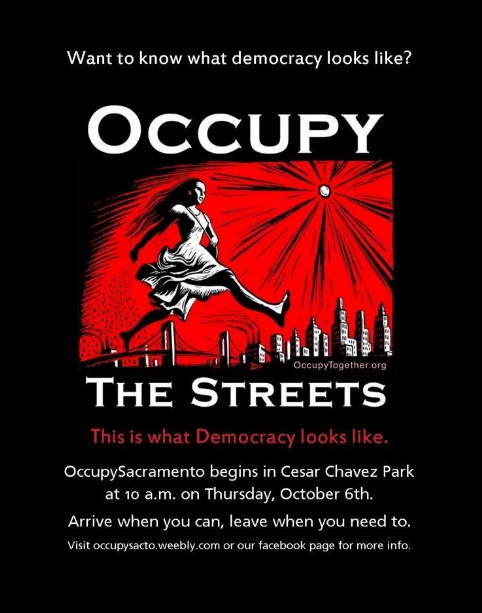
INITIAL POST: Over the last week or so, I have periodically visited Occupy Sacramento in Cesar Chavez Park. About a week and a half ago, on Saturday evening, I participated in a march from the park to nearby Midtown. My young son insisted that we do so, and we did. Upon making its way through the downtown restaurant district along J Street, the march reached 20th and J Streets, the center of the monthly Second Saturday art event for which Midtown is known. As you might have guessed, Midtown has numerous art galleries and has been a countercultural center of Sacramento for decades.
The marchers were both combative and festive, especially upon arriving at 20th and J Streets, where they joined a line of conga musicians and danced in the street. The police presence was, by and large, low key, with the marchers chanting, the police are the 99%. As elsewhere, there is a conscious effort to communicate that Occupy Sacramento is not inherently in conflict with the police. While one can argue with this in terms of historical precedent, the organizers are displaying an impressive pragmatic awareness of the fact that a violent confrontation with the police, no matter how slight, would probably curtail, if not destroy, the movement's potential for growth here. The march was unpermitted, and required marchers to walk along the sidewalk and obey traffic signals. March monitors made sure that there was no pretext for the police to act as they even insisted that marchers make a path for pedestrians to pass on the sidewalk.
Clearly, such fidelity to the letter of the local traffic laws is in marked contrast to the recent leftist emphasis upon Whose Streets? Our Streets! But the importance of challenging the power of the state when it comes to private property and control of streets and sidewalks gave way to more important objectives. First, the primary objective of Occupy Sacramento is to force the city to allow the participants to camp in Cesar Chavez Park without restriction. There have been 58 arrests the park since the occupation began on October 6th, and any arrests during the course of protests separate from this effort could detract from it. After all, the park is, in a sense, the nerve center of the movement, the place were the participants deliberate, conduct teach ins and forums, organize protests and even post information to the Internet through wireless communication. Second, the protests, such as this one, take place after a consensus process of deliberation, hence, it can reasonably be assumed that the participants consciously decided that this march was not the time and place for confrontation, and that should be respected.
I have visited the park several times, sometimes to merely observe and other times to talk with the people that I encounter there. I have seen a racially diverse group of people, perhaps more so than has been reported elsewhere, but this makes sense, as Sacramento has been known for being one of the least segregated cities in the US, although I don't recall a significant Latino presence (by contrast, African Americans are prominent). It is, not surprisingly, impossible to attribute a clear ideological perspective to the people there, although there is a strong left presence, with both anarchists and Marxists well represented. Overall, one gets the impression of people overwhelmed by socioeconomic forces beyond their control, forces that they struggle to identify, much less effectively confront. But, paradoxically, it is this confusion that gives Occupy Sacramento, and possibly the entire Occupy Together movement its strength. In the absence of easily identified enemies, beyond amorphous condemnations of the banks, Wall Street and money in politics, they are tentatively moving towards an indictment of the cash-nexus itself.
Nowhere is this confusion more on display than during the protests of Occupy Sacramento. Last Saturday, there was a march to the State Capital and rally on the north steps to coincide with the October 15th global day of action. Given that it was a Saturday, marchers walked along the sidewalks of a nearly deserted Capital Mall to a deserted state capital. Yet the 200 to 250 participants did so with gusto, and despite what appeared to be garden variety progressive rhetoric at the rally (it was admittedly hard for me to hear a lot of it, because my son was running wildly around the grounds), there was an unmistakeable logic to it all. If the enemy is the dehumanizing power of money, a power that has been rendered more abstract and diffuse, then there was no need for anyone to hear the protesters, to serve as the target for their dissatisfaction. It was enough for them to march down a mall full of office buildings for financial institutions and law firms and conclude with a rally in front of a building known for the acquiescene of its political institutions to the power of capital. One of the more humorous aspects of this march was the fact that my four and half year old son saw the marchers going down the street as we were driving nearby and promptly blurted out We are the 99%! He remembered the chant from the previous march to Midtown.
Beyond this, I'm particularly interested in the day to day activities in the park, the place where the participants interact in assemblies, forums and teach ins. For it is here where the participants seek to make sense of a world gone mad and develop a collective response to it. They struggle to remain respectful of one another during these discussions despite the tremendous variance in their backgrounds and social perspectives. On Sunday, I arrived after a heated discussion about the Citizens United decision between a couple of people, one of whom supported the ruling. A friend of the proponent was critical of the person who argued with him, even though she did not support his stance, because this person, in her view, did so disrepecfully. Of course, one can dismiss this as the elevation of process over substance, but this fails to recognize something that the participants consider more important at this point: the need to create a space where the victims of the existing social order can come together and establish a bond with one another. Otherwise, they will remain isolated and vulnerable.
No doubt, this strikes a leftist ear in an odd, if not jarringly dissonant, fashion. And there is, admittedly, a peril. If one listens carefully, one can hear the echoes of a cyberlibertarian vision, with Wall Street serving as the repository of all of the evils associated with repressive power and privilege. There is, however, only one way for the left to address it, and that is to engage the Occupy Together effort on its own terms. Go the forums, the assemblies, the protests and even the meals and sincerely advocate for anti-authoritarian socialism. Because of the prominent role of anti-authoritarian leftists in organizing this movement, it has already adopted many non-hierarchical practices. Accordingly, now is the time to gently seek to persuade people that these practices prefigure a different way to live. Most importantly, it is essential that we listen as well as speak, because how else are we to learn about the personal and economic distress experienced by so many people? Or, perhaps, more accurately, how else will we understand that those with whom we associate ourselves with politically have an independent, individual agency that must be recognized? Indeed, we must listen before, during and after we speak, because otherwise no one will listen to us because what we say will be irrelvant to them. And, in many instances, it will be best if we just listen and don't say anything at all.
Last year, I read a brief selection by an anarchist in We Are An Image From the Future, a book about the Greek protests of December 2008, released by AK Press. In that piece, the author insightfully observed that the mass protests against the Greek state required anarchists to reevaluate their convictions in light of their experiences, forcing them to accept the fact that people who had been relatively apolitical were now taking the lead and making spontaneous decisions without their assistance. Much the same is now happening with Occupy Together and it is a shocking thing for politically engaged people to accept. And it is happening because of tremendous pain inflicted upon so many Americans in the last 5 or 6 years.
A couple of encounters come to my mind in this regard. Last Wednesday or Thursday, I went over to Occupy Sacramento during my lunch break, and saw a middle aged woman with her two children holding signs on the the southwest corner of the park at 9th and J Streets. The signs were hand made and difficult to read from any distance because much of the lettering was small and sometimes in pencil, but I examined them closely and saw that they insisted upon the need to fund education over finance. I was emotionally overcome by poignancy of the situation, a family so distraught over what was happening that they had to do something, anything, even if it was holding up signs on a street corner that the drivers of passing vehicles could barely read. It was far more effective than any protest I've seen organized by the California Teachers Association.
Today, I had a similar experience. Again, I went over during my lunch break. The number of people there was small, about 25 to 30 people or so. All of a sudden, as I was eating my lunch, a swarthy, middle aged man started yelling, They are taking away our money! They are taking away our rights! They are taking away our dignity! They are going take away our lives! My initial reaction was that he sounded mentally disordered, but as I kept watching and listening, I heard that rare, unmistakable voice of someone who was frightened and angry, so much so that, like the woman and her children, he had to do something, no matter how many people responded to it. He continued to speak in this way, prompting me to think that this is what the ranters during the Glorious Revolution must have sounded like. He walked from the center of the park to the sidewalk along the street, and, upon finishing my lunch, I walked over to him, where he continued to rant as it were, and got his attention. I touched his back with my arm, looked him in the eye, and said, We hear you. I paused as he looked at me, and then said again, We hear you. Always remember that. He thanked me, and I left, chastened by such an intense emotional contact with the desperation that drives people to participate in Occupy Together.
Labels: Activism, Anarchism, California, Occupy Wall Street, Sacramento, Sub-Proletarianization of America
Wednesday, October 05, 2011
UPDATE 1: A compelling story of insisting upon inclusion within OWS:
Please consider reading Manissa McCleave Maharawal's post in its entirety. Interestingly, she initially declined to go to the encampment, because she had heard or intuited, like her other brown friends, that it was a mostly young white male scene. But the police brutality, and the subsequent protest against it, persuaded her to visit it with a friend. And, afterwards, she persuaded more of her friends to accompany her upon her return. It is tempting to read her account in heroic terms, but it is actually a example of what is perpetually necessary to create and expand the inclusiveness required for any legitimate social movement.On Thursday night I showed up at Occupy Wall Street with a bunch of other South Asians coming from a South Asians for Justice meeting. Sonny joked that he should have brought his dhol so we could enter like it was a baarat. When we got there they were passing around and reading a sheet of paper that had the Declaration of the Occupation of Wall Street on it. I had heard the Declaration of the Occupation read at the General Assembly the night before but I didn’t realize that it was going to be finalized as THE declaration of the movement right then and there. When I heard it the night before with Sonny we had looked at each other and noted that the line about being one race, the human race, formally divided by race, class . . . was a weird line, one that hit me in the stomach with its naivety and the way it made me feel alienated. But Sonny and I had shrugged it off as the ramblings of one of the many working groups at Occupy Wall Street.
But now we were realizing that this was actually a really important document and that it was going to be sent into the world and read by thousands of people. And that if we let it go into the world written the way it was then it would mean that people like me would shrug this movement off, it would stop people like me and my friends and my community from joining this movement, one that I already felt a part of. So this was urgent. This movement was about to send a document into the world about who and what it was that included a line that erased all power relations and decades of history of oppression. A line that would de-legitimize the movement, this would alienate me and people like me, this would not be able to be something I could get behind. And I was already behind it this movement and somehow I didn’t want to walk away from this. I couldn’t walk away from this.
And that night I was with people who also couldn’t walk away. Our amazing, impromptu, radical South Asian contingency, a contingency which stood out in that crowd for sure, did not back down. We did not back down when we were told the first time that Hena spoke that our concerns could be emailed and didn’t need to be dealt with then, we didn’t back down when we were told that again a second time and we didn’t back down when we were told that to block the declaration from going forward was a serious serious thing to do. When we threatened that this might mean leaving the movement, being willing to walk away. I knew it was a serious action to take, we all knew it was a serious action to take, and that is why we did it.
I have never blocked something before actually. And the only reason I was able to do so was because there were 5 of us standing there and because Hena had already put herself out there and started shouting mic check until they paid attention. And the only reason that I could in that moment was because I felt so urgently that this was something that needed to be said. There is something intense about speaking in front of hundreds of people, but there is something even more intense about speaking in front of hundreds of people with whom you feel aligned and you are saying something that they do not want to hear. And then it is even more intense when that crowd is repeating everything you say– which is the way the General Assemblies or any announcements at Occupy Wall Street work. But hearing yourself in an echo chamber means that you make sure your words mean something because they are being said back to you as you say them.
And so when we finally got everyone’s attention I carefully said what we felt was the problem: that we wanted a small change in language but that this change represented a larger ethical concern of ours. That to erase a history of oppression in this document was not something that we would be able to let happen. That we knew they had been working on this document for a week, that we appreciated the process and that it was in respect to this process that we wouldn’t be silenced. That we demanded a change in the language. And they accepted our change and we withdrew our block as long as the document was published with our change and they said find us after and we will go through it and then it was over and everyone was looking somewhere else. I stepped down from the ledge I was standing on and Sonny looked me in the eye and said you did good and I’ve never needed to hear that so much as then.
Hat tip to Jews sans frontieres.
INITIAL POST: Preliminarily, it must be acknowledged that Occupy Wall Street is the one of the most significant protest movements of the last 15 years, and retains the potential to become one of the most transformative protest movements in US history. For now, it is comparable in terms of its social impact to the direct action civil disobedience in Seattle in 1998 and the protests against the Iraq war in 2003. It signals the end of the malaise that has, with the exception of the period just prior to the launching of the Iraq war, so immobilized Americans in the aftermath of the 9/11.
Commenced just six days after ceremonies centered around the tenth anniversary of the attacks, the occupation of Wall Street by a small group of protesters shattered the effort of Obama and others to characterize the US as a country defined by the war on terror and the post-9/11 generation who fights it. Veterans have been prominent among the protesters, and they have expressly separated themselves from such a jingoistic portrayal of their experience. A Pew Research Center poll states that 1 out of 3 post-9/11 veterans believes that the wars in Afghanistan and Iraq were not worth fighting and that 6 out of 10 have what the Center describes as isolationist tendencies.
Despite the fact that fewer than three weeks have elapsed since the protests began, the entry of the participants of OWS into the financial district of New York City has already taken on the gloss of historical romanticism, as reported by Kevin Gosztola of firedoglake:
Gosztola isn't entirely accurate here, as it has been reported that anarchists, syndicalists, progressives and communists involved in previous actions designed to highlight poverty and inequality in NYC, such as the Bloombergville, have played a prominent role. Indeed, it appears that OWS evolved out of the Bloombergville earlier this summer:Less than one hundred went into a park on September 17 and did not leave. The police appeared intent on forcing them out of the park but the occupiers found out late in the night they would be allowed to stay. An opening was created. One occupier tweeted it felt like a mini Tahrir Square. And, in the first week, with very little media attention, those who were tired of letting Wall Street and the top 1% ruin their lives and other people’s lives—somewhere between 50 and 200—occupied the park.
Those who slept in the park the first week, especially on the first night, are the vanguard of this movement. They were not part of some known community group or union. They were not affiliated with any campaign launched by any liberal organization. They were not even directly connected to any of the more radical groups in the country, like the Socialist Workers’ Party or Communist Party USA. They were not being visited by celebrities or media personalities. They were just students saddled with tens of thousands of dollars in student loans. They were people who were fed up with growing poverty. They were citizens who were no longer willing to tolerate Wall Street influence over politician, who tailor legislation and policies to benefit corporations and the richest 1% at the expense of the other 99% of Americans.
The response to OWS on the left was initially muted. Max Ajl acknowledged that he was initially dismissive because when someone calls a protest in America lately the joke is usually on the Left. Similarly, I didn't think much would come of it, either, which, in a bizarre way, was a positive sign, because I have rarely, if ever, anticipated the success of a protest movement in advance, having been especially gloomy about the ones that generated the most support. Curiously, a post by lenin over at Lenin's Tomb about the anti-semitism of Gilad Atzmon, a post that became a debate over the relative lack of merit of Atzmon and Slavoj Zizek, has generated over 188 comments, while his more recent post about OWS has only generated 29, most of them several days after it originally appeared on the site. One suspects that, among Leninists and Trotskyites, there is apprehension about the lack of any vanguardist leadership and the amorphous nature of the motivations of the participants, even as their allies in NYC have worked actively to organize it.Part protest base camp/part community center, Bloombergville reclaimed public space for dissent in a way that has not occurred in New York since 9/11. It also created a common ground for a variety of left groups and tendencies to work together in a way also rarely seen in this city.
Operating under the banner of New Yorkers Against Budget Cuts, the majority of the protesters, like Hales, were in their 20s and 30s, face a future of limited job prospects and see a political system disconnected from the concerns of ordinary people. They drew inspiration from mass occupations of public space that have recently propelled protest movements from Egypt to Spain to Madison, Wisconsin as well as from the Hoovervilles of the 1930s.
Bloombergville organized daily protests of as many as 200 people. These actions culminated in a raucous June 28 demonstration in which 13 people were arrested for barricading the entrance to the office building at 250 Broadway. City Council members, who have offices in the building, were inside negotiating the final details of the budget. A near-riot ensued when police attacked protesters who had surrounded and briefly blocked the two police vans called to carry away the arrestees.
Organized through a general assembly that met each night at 8 p.m., Bloombergville also served as the movement’s living room. People could drop in and share donated food and drink, debate politics for hours, take out books from the Bloombergville Library, attend evening teach-ins at Bloombergville University led by City University of New York (CUNY) professors such as Frances Fox Piven and Stanley Aronowitz or take the stage during open-mic night.
Conversely, Pham Binh and Louis Proyect have stood out as a clear-eyed, rational left voices about the importance of OWS, probably because they have been able to visit and talk with the protesters. Binh has posted a number of important on the scene reports, such as this one, and both have effectively asserted the importance of relating to OWS in a non-sectarian fashion. Proyect accurately summarized the situation as follows:
Such an admonition obviously applies to leftists of any kind, and not just Marxists.There is a very strong possibility that over the next five years or so the mass movement that is taking shape today might take on epic proportions and mount a serious challenge to the powers-that-be. It will be absolutely incumbent upon Marxists to figure out a way to relate to that movement not as learned professors chiding it from above but as dedicated participants whose loyalties are to the movement rather than their own group. If they can meet that challenge, the movement will be all the more powerful as a result. If they function in a narrow and self-interested manner, they will have nothing to offer. As someone who has been impressed with the relative open-mindedness and transparency of the ISO, I wish them well.
Meanwhile, the police and the progressive political establishment displayed no such confusion. Faced with a protest movement that showed the potential to become larger and larger, the NYPD moved to suppress it with force, through the indiscriminate use of crowd control measures, pepper spray and and arrests, because, of course, that's what it usually does, and also because, unlike others, it knew, from direct experience, that OWS had evolved out of the Bloombergville, thereby revealing that the vitality of the movement remained even if the Bloombergville had been torn down. For liberals and progressives, the problem was equally acute. Van Jones and his allies, such as MoveON.org, many mainstream unions, such as SEIU and AFCSME, and other progressive organizations, had constructed Rebuild the Dream as a means of channeling social discontent into innocuous forms of protest that do not imperil the reeelection prospects of the President. But then, all of a sudden, out of nowhere, the people moved forward without them, and they found themselves in the embarrassing situation of having an expensive conference in Washington, D.C. while people were being maced and arrested in NYC. And, even worse, people all over the country announced plans for their own occupations. To show you bad it is, there will even be an occupation in Sacramento, starting tomorrow. Progressives therefore did the only thing they could do if they wanted to avoid becoming politically extinct: they embraced OWS, starting with a large march in NYC today.
Among leftists and progressives, there is this great angst about the need for OWS to issue a statement of demands. I've even posted a couple of comments in response to the suggestions of others at Louis Proyect's site, The Unrepentent Marxist, about the need to prioritize immediate human needs over legalistic reforms of the US financial system. And, while I am nervous about the fact that there seems to be some hesitancy to do so, which may reflect an inability of those involved in OWS to develop a consensus in support of it, such angst misses the point. In his seminal work about the Italian protest movements of the late 1960s and 1970s, States of Emergency, Robert Lumley addressed the transformative aspects of feminism in a climate of social turbulence, emphasizing the ability of its proponents to generate new ways of looking at society by highlighting the subjective differences of people and the challenges of creating a new language in order to express such a perspective. Something similar may well be happening during the collective gatherings of OWS, gatherings in which all are empowered to participate in the actions of the whole. Before people can organize themselves to act politically, they must first understand themselves sufficiently to envision themselves within a movement. It is this paradoxical process of personal and collective evolution that is most threatening to the progressive groups that have embraced OWS, and we will soon learn if they can accomodate themselves to it instead of substituting themselves as they have done in similar instances in the past.
Jack Crow of The Crow's Eye may have captured the mood when he described the people involved in OWS as the self-organized:
The struggle, it seems, has only just begun.It is Emergency which defines our coming age. It is to Emergency - and the preface to our age of Emergency was written in the extended verse of the War on Terror - that every justification for continued maintenance of the forms of power will refer. It is Emergency which mobilizes the masses. It is in the name of a succession of Emergencies that the ruling class and its states will attempt to strangle the arising and invigorated struggles against them.
So it means something, I think, that the folks involved in the OWS experiment have begun by rejecting the acculturated norm of Emergency and its consequent hierarchies, urgency, command orientation and urge to assign marching orders and battle order.
I know for Trots and Leninists like Richard Seymour, and the various dialectically constrained parties of Europe and sheltered academia, the OWS reclaimers and the inherent argument of their method are at best problematic, because it recommends abandoning the hierarchical and partisan organizational mode which dominated resistance to capital, imperial nationalism and colonial powers over the last one hundred fifty years. It further anticipates a fight which exceeds the limits of the party structure, and its intellectualist vanguard, who are obedient to norms which are no longer really prevalent. Those engaged with today's conditions are proving forward enough to identify the functional unity of state and corporation, as well as recognizing that the apparatuses used to obtain, process, share and utilize information, security and the capture of privatized knowledge are nested within each others' overlapping spheres of influence and authority.
Labels: 9/11, Activism, Anarchism, Liberals, Marxism, Neoliberalism, Occupy Wall Street, Police, Sacramento, Sub-Proletarianization of America, Unions
