

Thursday, March 29, 2012
General Strike in Spain/Clashes in Barcelona
UPDATE 1: From the Guardian:* Over 1,000 people joined the march from our neighbourhood (Sant Andreu) into town. It wasn’t the 'usual suspects'. It was the regulars of our local high street – where most shops were closed – transplanted onto Meridiana, a major six-lane road into the centre of Barcelona. The good-humored march was one of numerous feeder marches that helped to bring the city to a standstill. The unions report an 800,000-strong demonstration. El Pais puts it at over 275,000.
* It isn’t hard to find evidence of clashes in the centre of town. Barricades had been lit on many of the road junctions around Diagonal, a well-off shopping district. These are being cleared away by street sweepers. But it’s the details that are telling here: the bin lorries are each placarded with 'serveis minims' [minimum service]. Most of the banks have had their windows smashed. They are cordoned off, but there is no attempt at a clean up here.
INITIAL POST:Demonstrators brought the centres of Madrid, Barcelona and other cities to a standstill as trade unions claimed the strike was more widely supported than previous nationwide stoppages in 2010 and 2002. Rajoy's officials claimed, however, that the 2010 strike against a socialist government had received greater support.
Electricity consumption fell by 17%, suggesting the strike was impacting on major industries – though most shops appeared to be open in Madrid.
Street fires were set in both Madrid and Barcelona, where roads into the city were blocked, but there were few reports of serious violence.
The strike was most successful where Spain's big two unions, the General Workers Union and the Workers Commissions, are strongest – in large factories, the civil service and transport.
General Workers leader Cándido Méndez put average participation at midday at 77% but said that it was 97% in industry and construction.
This strike has been an unquestionable success, he said.
Civilized protest looked unlikely to alter the determination of the government to drive on with reforms and austerity.
There was a general strike in Spain today to protest the austerity policies being imposed by the government and the European Union. The police in Barcelona have used rubber bullets and tear gas, with reports of people smashing shop windows. Meanwhile, there have been large protest marches in Madrid and Barcelona. For a Guardian video report of events in Barcelona today, go here. For a livestream broadcast from Barcelona through the Global Revolution website, with English subtitles, go here. For Twitter updates in Spanish and English, go to the #M29 hashtag. Other video sources can be found through Twitter and YouTube as well.
Labels: Activism, Bailout of Finance Capitalists, Europe, Spain, Sub-Proletarianization of Europe, YouTube
Tuesday, December 06, 2011
In Katzelmacher, Fassbinder exposed the enduring German sense of racial superiority in regard to the peoples of southern Europe, and the sexual jealousies connected to it, dramatized by means of the hostility of the young German working class characters to the Greek immigrant, Jurgos. Such attitudes have been on prominent display during the current Eurozone crisis, with Germans and the German media purveying crude stereotypes about the purportedly profligate Greeks so as to justify the colonization of the country by financial interests aligned with the German state. Merkel's proposal for a new Eurozone is based upon implicitly bigoted assumptions about countries like Italy and Greece, as revealed through the notion that Germans, through the administrative processes of the European Union, must seize power from them and act as their firm, disciplinarian parents.
Labels: Europe, Film Notes, Germany, Greece, IMF, Sub-Proletarianization of Europe
Tuesday, November 01, 2011
Oakland Rises by Standing as One
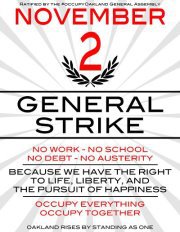
I believe that people are going to shocked at the turnout for tomorrow's announced general strike in Oakland. Of course, most people will work, and most businesses will remain open. But the extent of public participation is going to be amazing. It is an intensification of a wave of direct action protest that has emerged in the East Bay in recent years.
First, there was rioting in downtown Oakland after it appeared that the Alameda County District Attorney was not going to prosecute BART police officer Johannes Mehserle for the killing of Oscar Grant during the early morning hours of New Year's Day, 2009. Later that year, there was the student occupation at UC Berkeley in November 2009 in response to enormous fee increases, an occupation that avoided being attacked by the UC police because protesters came to their defense. UC student protests erupted across the state again in March 2010, with students and their supporters closing Interstate 580 in . . . where else? . . . Oakland. More recently, participants in No Justice! No BART!, an East Bay organization formed to demand the disbanding of the BART police after the killing of Grant, were involved in protests at San Francisco BART stations in August and September after the subsequent killing of Charles Hill at the Embarcadero station.
Occupy Oakland has built upon these previous efforts, presenting the most significant challenge to authority in the East Bay in decades. While those who advocate a pacifist form of non-violence found it objectionable, those who sought to recover Frank Ogawa Plaza for continued occupation reenergized the movement after an early morning police raid. After the city announced last Wednesday that the plaza was going to be fenced off indefinitely, a group challenged the officers surrounding it during a late afternoon protest and attempted to force their way through. Of course, we know what happened as a result, a police riot that raged on the streets for hours, a riot whereby the officers sought to bludgeon, tear gas and stun grenade Occupy Oakland out of existence.
But Mayor Jean Quan, Police Chief Howard Jordan and the officers called in from 17 jurisdictions failed. On the following day, people returned to occupy the plaza, this time without incident. The people who challenged the police the previous day had exhausted the appetite of the Oakland establishment for continued repression. And, now, the Oakland Police Officers Association has issued this open letter to the residents of Oakland:
Support for the general strike tomorrow is growing. Afterwards, we will perceive opportunities for a radical transformation of society that have been heretofore unimaginable. t over at Pink Scare has reminded us of a quote by Lenin which concisely summarizes the situation: There are decades when nothing happens; and there are weeks when decades happen.We represent the 645 police officers who work hard every day to protect the citizens of Oakland. We, too, are the 99% fighting for better working conditions, fair treatment and the ability to provide a living for our children and families. We are severely understaffed with many City beats remaining unprotected by police during the day and evening hours.
As your police officers, we are confused.
On Tuesday, October 25th, we were ordered by Mayor Quan to clear out the encampments at Frank Ogawa Plaza and to keep protesters out of the Plaza. We performed the job that the Mayor’s Administration asked us to do, being fully aware that past protests in Oakland have resulted in rioting, violence and destruction of property.
Then, on Wednesday, October 26th, the Mayor allowed protesters back in – to camp out at the very place they were evacuated from the day before.
To add to the confusion, the Administration issued a memo on Friday, October 28th to all City workers in support of the Stop Work strike scheduled for Wednesday, giving all employees, except for police officers, permission to take the day off.
That’s hundreds of City workers encouraged to take off work to participate in the protest against the establishment. But aren’t the Mayor and her Administration part of the establishment they are paying City employees to protest? Is it the City’s intention to have City employees on both sides of a skirmish line?
It is all very confusing to us.
Labels: Activism, BART Killing, Bay Area, California, Neoliberalism, Occupy Wall Street, Police, Sub-Proletarianization of Europe
Monday, October 31, 2011
Police Infiltrate Occupy Oakland
Another instance of the police engaging in the surveillance of the Occupy Together effort. Note that the 2003 comments of the current interim chief, Howard Jordan, at the start of the video most likely took place after the antiwar protests at the Port of Oakland that I mentioned on Saturday.
Hat tip to spocko at firedoglake.
Labels: Bay Area, California, Neoliberalism, Occupy Wall Street, Police, Sub-Proletarianization of Europe, YouTube
Thursday, October 20, 2011
The Economic Collapse of Greece
Accordingly, stories like this one are common:
And, then, there is this publicly known incident where a debtor set himself on fire in front of the Piraeus Bank in Thessaloniki. While this man was saved, reported suicides have doubled in Greece since the imposition of austerity:I have worked since I was 16 and I have lived in Athens since I was 24. I remember that many times I had to struggle in order to survive with two jobs, but never have I stayed unemployed for too long. During the past eight years there were times when things were tight and difficult and other times when things were more or less ok. But not even in the most difficult period of my life, as a University student, did I find myself in the position I am today. For thirteen years I struggled, I fought, I stood on my feet. But now I can’t take it anymore. I’m giving up.
I’ve been unemployed for ten months. Knowing that I was going to lose my job, I started searching for a new one from as early as the Easter of 2010. By now I’ve send 155 CVs but I only got two replies back, both saying that they didn’t need employees. For the first time in my life I’m facing an eviction order by the end of this month. The landlord says that I have no dignity and that I live on her expense, forgetting the eight years that I have been meeting my obligations regularly or even the improvements I ‘ve made to her house on my own expenses. Still, she’s right. She’s no charity – she wants her money. The movers ask for 1200 euros to take my stuff back to my mother’s city or 150 per month in order to store them in a container. I cannot afford either of the two scenarios. I will probably have to throw away my household of ten years. The tax service is demanding 300 euro as an emergency levy with a 3% interest for every month I don’t pay. Another emergency tax is expected with the next electricity bill and that’s going to be 420 €. I have to pay 640€ every two months for social security, although the company I worked for explicitly told me that they have no job to offer and that even if they did, they would pay a monthly salary of no more than 420 euro. In short: the city in which I have lived for the past 13 years is spitting me off to the margins like if I’m some kind of trash. For the first time in my life, I have no place to stay and no one to hold on to. Any stock of patience and courage I had has now vanished.
With this context in mind, this sort of response starts to make sense:A suicide help line at Klimaka, the charitable group, used to get four to 10 calls a day, but now there are days when we have up to 100, says a psychologist there, Aris Violatzis.
The caller often fits a certain profile: male, age 35 to 60 and financially ruined. He has also lost his core identity as a husband and provider, and he cannot be a man any more according to our cultural standards, Mr. Violatzis says.
Heraklion, commercial center of the island of Crete, has had a spate of such deaths.
Mr. Petrakis, the fruit and vegetable dealer, was just one of three recent suicides at a single wholesale food market on the edge of the city.
Victims once were typically adolescent males or old people facing severe illness, and in normal times suicide cases often involve a mixture of factors including mental illness, says local psychiatrist Eva Maria Tsapaki.
But the economic crash has created a new phenomenon of entrepreneurs with no prior history of mental illness who are found dead every other week, she says. It's very unusual.
If the United Kingdom, France and Germany, with the US conspiring in the background, try to hold the EU together with a new Greek junta, we can only hope that the workers of Europe come to the defense of the Greek people. Meanwhile, protests and riots in Athens have been ongoing throughout the day as the government secured approval of yet another round of austerity measures. For updates of what has been happening on the streets of Greece, go here and here and here and here.The Greek government’s Minister of Interior affairs (Home Office) Harris Kastanidis was spotted in a cinema in Thessaloniki watching a movie. So a few hundred students stormed the cinema chanting slogans and threw him yoghurt. Several members of the audience joined the students booing Kastanidis and clapping when the yoghurt was thrown to him. Among other slogans one can hears: Let’s see who will jump first in the helicopter when this marvellous night like Argentina will come, In Greece, Turkey and Macedonia the enemy is in the ministries and in the banks, Terrorism is the waged slavery, no peace with the bosses.
Labels: Activism, Bailout of Finance Capitalists, Europe, Greece, IMF, Neoliberalism, Police, Sub-Proletarianization of Europe
Wednesday, October 19, 2011
Greece: Strikes, Clashes and Intensified Austerity
UPDATE 1: Updates from Occupied London over the course of the day (start from the bottom and read up):
17:52 PM Syntagma has been completely evacuated by the police. A huge, diverse crowd has attacked the Bank of Greece, trashing it inside. Large groups of demonstrators are trying to regroup in Syntagma. There is an urgent need for medical help at the square.
17:42 PM Cops try to scoop clear Syntagma, attacking from different sides. There is DELTA/DIAS at the Olympiou Dios columns, blocking off people from leaving
16:55 PM Generalised clashes all around Syntagma at the moment. The bulk of the demo has been pushed away form the sq.
16:45 PM A huge black block is attacked massively by police at the moment in front of the Ministry of Finance in Syntagma Sq.
16:22 PM Reltevely passive attitide of the police and reletevly calm situation now all around Syntagma. The masses of people remain there. banners of I do not Pay movement and base unions are in front of the police in the Unkown Soldier.
16.09 PM Step by step police units are occupying the Unkown Soldier Square in front of the Parliament, pushing people back towards Syntagma Square but they meet strong opposition and do not manage to move much forward, demonstrators respond with stones and head to head clashes any time a police unit tries to move forwrad. Thousands still there, just a couple of metres away from the police cordons and attack to them.
15:44 PM Clashes all around the centre of Athens. Tear gases, shock grenades mainly on Akadimias st. but burning barricades are all around the centre. In Syntagma several hundernd of demonstrators attacked with stones and sticks in co-ordinated way against the cops, police uses chemical gases en mase there, but people do not retreat and hold their posiitions in front of the parliament defending themselves, however a part of the Unkown soldier is occupied by the police now. Thick black smoke can be seen in front of the University Refectory.
15:19 PM Police operation along Akadimias st. head to head clashes with the police there. Clashes on the Uknown Soldier Square on the bottom of the staircase leading to the parliament building. Police operation takes place there as well, as they are trying to push the people towards Syntagma Square, stones and molotov cocktails against the police and clashes in front of the parliament carries on.
15:05 PM Base Union and Anarchist blocks are enetring now Syntagma Square from the lower part, from Stadiou st.
14:56 PM Clashes in front of the parliament building still going on, on Panepistimiou stthere are clashes, taxi drivers union along fellow protesters hold a barricade on Akadimias st. and fighting with the cops, at the moment the only street leading to Syntagma is Stadiou st. Tear gases and chemical gases used by the police in Syntagma but people are not leaving the area.
14.44 PM Gas shot straight into crowd at Panepistimiou metro. Earlier on Patison, anarchists attached the government money-printing building.
14.43 PM In front of the parliament people now have reached the bottom of the staircases that leads to the main building of the Parliament. In front of the parliament again on the other side, stones, molotov cocktails and other items are thrown to the police units guarding the parliament. Tension goes high. Police does not dare to attack, while Syntagma and the Unkown Solider square are occupied by protesters-strikers.
INITIAL POST: Reports from Greece are confused, but indicate that the government has prevailed on a preliminary vote for another round of austerity, with the final one scheduled for tomorrow, while police and protesters clash on the streets of Athens and Thessaloniki. Police have cleared protesters from the Syntagma Square in front of the parliament building after wounding 15 people, 6 of them seriously. Prior to the vote, protesters came close to storming the building. Tweets from Theodora Oikonomides give an impression of the intensity of the protests in Athens. For updates, consider the Guardian live blog as well. lenin has a good analysis of the situation here. A 48 hour strike commenced prior to the vote in Parliament continues.
Labels: Activism, Bailout of Finance Capitalists, Europe, Greece, IMF, Neoliberalism, Police, Sub-Proletarianization of Europe
Monday, August 08, 2011
London: Dubstep Rebellion (Part 2)
UPDATE 3: The young take their revenge of the corporations that have so brazenly marketed to them?For three hours mayhem ruled in Hackney's Pembury Estate, the centre of the violence in east London. The police were there, but there was no doubt who set the law in the estate, comprised of local authority mansion-blocks of flats.
Masked youths – both men and women – helped carry debris, bins, sticks and motorbikes, laying them across the roads to form a flaming boundary to the estate.
The crowd in Hackney – numbering at least 300 – appeared larger than any from previous nights of rioting.
In one of the most shocking incidents, a police officer in a solitary parked vehicle was attacked shortly before 9pm.
His windscreen was entirely smashed as a young man scaled the roof and pounded down with a brick. Others attacked from the sides with sticks and bottles.
Trapped, and unable to see out, the officer accelerated through the crowd, and a hail of missiles.
If the elites can loot, why can't they? Is this what happens after the neoliberal expediency of transnational capital is exposed in the public square for all to see? There are accounts of kids as young as twelve years old involved in the looting of these stores.On much of the footage of the widespread theft after the riots, looters can be seen brazenly taking the goods they want, some without taking the precaution of covering their face. In one video shot early on Sunday morning in Wood Green, people can be seen leaving H&M with a haul of goods, with others standing around JD Sports apparently waiting for their turn to take goods.
One north London resident, who wanted to be identified only as Tiel, described a conversation: I heard two girls arguing about which store to steal from next. 'Let's go Boots?' 'No, Body Shop.' 'Hit Body Shop after it's dead [meaning empty].' The girl came out of Boots nonchalantly, as if she'd done her weekly shop at 4:30am, he added. He described others, holding up clothes to themselves in the broken windows of H&M. They were just so blasé about what they were doing.
In Wood Green about 100 youths targeted shops, including electrical stores and clothes chains such as H&M. I've got loads of G-Star, said one teenager, emerging from a clothes shop. Other teenagers were seen with suitcases filled with stolen goods, and in the early hours of Sunday residential front gardens were used to sort and swap them.
UPDATE 2: Locations of confirmed riots in the United Kingdom.
UPDATE 1: lenin engages the ongoing riots and their social implications:
So, even if politicians are in denial, the rich aren't. You may well say, bollocks, they're not taking on the ruling class, they're just destroying their own nest, hurting working class people and small businesses. I can hear this, just as I can hear the sanctimony in its enunciation. The truth is that riots almost always hurt poor, working class people. There's no riot that embodies a pure struggle for justice, that is not also partly a self-inflicted wound. There is no riot without looting, without anti-social behaviour, without a mixture of bad motives and bad politics. That still doesn't mean that the riot doesn't have a certain political focus; that it doesn't have consequences for the ability of the ruling class to keep control; that the contest with the police is somehow taking place outside of its usual context of suspicion borne of institutional racism and brutality. The rioters here, whenever they've been asked, have made it more than abundantly clear what their motives are - most basically, repaying years of police mistreatment.
INITIAL POST: For the third day, there is widespread rioting in London, and reports that it has spread to the city of Birmingham. British youth, many of color, are no longer limiting themselves to non-violent protest and direct action, as they did in December 2010. Initially erupting in Tottenham, after the shooting death of Mark Duggan on Thursday, August 4th, the riots have spread throughout north London and Brixton. The police prevented Duggan's family from seeing his body for 36 hours, and forensics evidence has contradicted the initial police account that Duggan fired at them from a minicab.
As with the Los Angeles riots in 1992, the London ones have expanded into an all out assault upon the symbols of affluence and police power. Officers have been shocked at the level of violence directed against them, and cannot keep up with the mobility of the rioters. Meanwhile, looting is organized and widespread, reminiscent of a 1992 account about how people went into a leather goods store on Telegraph Avenue in Berkeley after the Rodney King verdict and marked the items that they came back and seized a few hours later. It is tempting to address the rioting in sociological terms, as Alexandra Topping did in this eerily anticipatory article published on July 29th, but there is probably more to it than the social work calculus of austerity equals crime. Austerity is the issue, but in broader terms than examined by Topping.
In Europe, especially, France, the United Kingdom and Greece, as well as the United States, young people live, in most instances, in conditions of poverty, with less and less opportunity to escape it. Racial divisions become acute during times of austerity, with, for example, unemployment in the US markedly worse among young African Americans and Latinos. To be poor is bad enough, to be poor and black, poor and Latino or poor and African American and Latino is even worse. Austerity, and the accompanying concentration of wealth within elites, disproportionately concentrates poverty among people of color, whether in the banlieues of Paris or the northern estate towns of London. In Paris in 2005, the electrocution deaths of two teenagers of color chased by the police ignited the riots, while the shooting death of Duggan has done so in London.
Not surprisingly, people respond by ransacking local businesses that sell goods that they would otherwise struggle to purchase. Unable to find a place within the classless society promoted by figures as disperate as Blair, Cameron, Bush, Sarkozy and Obama, they seize what they can only purchase with great difficulty, if at all. Others, acting upon the neoliberal entrepreneurial ethos, loot stores and fence the goods, turning a nice profit on transactions with a zero investment cost. Lost in the condemnation of gangs, animals and thugs by the middle and upper class media is the fact that many rioters have actually internalized capitalist values. Like the great oligarchs, they don't hesitate to use violence to achieve their ends, and, also like the oligarchs, they expropriate the property of others.
In other words, the social nihilism of the elites has been embraced by some of their victims, to strikingly impressive effect. Furthermore, just as these elites have exploited new communications technologies to manipulate markets and financial transactions, the rioters have relied upon encrypted Twitter and Blackberry messages to organize themselves, select targets and evade the police, resulting in pathetic condemnations of these social networking platforms by the police. Possible ideological differences aside, anarchists no doubt appreciate the success of the decentralized communications methods of the rioters against the centralized CCTV network monitored by the police. Like those in the media, Scotland Yard public relations officers persist in claiming that gangs and thugs are responsible for the riots, but such perjorative terms have little meaning in a world where hundreds of people, many of whom do not know each other, can be organized for an attack upon a commercial district within a few hours. If it were merely a gang problem, the police could contain it, but it is the willingness of hundreds, and, probably, thousands of people, throughout London and Birmingham, to respond to such calls that makes the riots impossible to contain at this time.
For the left, the riots present a quandary. On the one hand, the rioters are from communities where many are victimized by police brutality and the austerity of neoliberal capitalism. There is a refreshing spontaneity to their actions, and they have shown a remarkable capacity for social organization on the fly. But, on the other hand, in the absence of additional information, it appears they have chosen their targets rather indiscriminately, with the result that many merchants of their own communities have been attacked, which stands in marked contrast to the calculated actions of people like the Greek anarchists, and possibly the youth of Lyon last fall, who have targeted transnational banks, luxury goods stores and surveillance firms. Accordingly, while many in their communities understand their sense of grievance, many are dismayed at the property destruction carried out by the rioters. Of course, there are personal and generational reasons for this, but it does point towards the urgency of developing a more coherent ideological motivation for the riots, beyond the mimicry of the powerful by the powerless (a subject masterfully examined by Fassbinder in many of his films), if they are to serve as the inception of an ongoing challenge to the neoliberal order.
Labels: Activism, Anarchism, Dubstep Rebellion, Europe, Neoliberalism, Police, Political Violence, Sub-Proletarianization of Europe, United Kingdom
Wednesday, June 29, 2011
The Struggle on the Streets of Greece (Part 2)
 Today, the Greek socialist parlimentary majority, PASOK, approved a rigorous plan of austerity and privatization in order to facilitate a bailout from the IMF and the ECB. It is pretty much acknowledged that, if implemented, the plan will consign a generation of Greeks to poverty. Police were unrestrained in their use of tear gas in an attempt to clear away protesters from nearby Syntagma Square:
 Other accounts convey the eruption of violence throughout the central city of Athens:Protesters fought pitched body-to-body battles with riot police, toxic levels of tear gas filled the air and Syntagma Square, the nerve centre of Greece's new resistance movement, descended into chaos.
Within minutes, the plaza resembled a war zone, more reminiscent of Gaza than the flourishing hub of a western capital with the detritus of battle everywhere: in its burning barricades, smashed pavements, shattered masonry, looted shops, destroyed kiosks and trees.
Dangerous amounts of tear gas are being used to terrorize people, said Athanasios Pafilis, a communist MP as parliament wrapped up two days of debate on the debt-reduction measures. It's an intolerable situation … what we are seeing is chemical warfare and it has to stop.
Unprovoked riot police were firing it all over the place, said Andreas Skourtis, an architect demonstrating against the measures.
They were clearly working to a very well-organised plan. This is a government that has gone out of its way to not only keep crowds away but pass the measures no matter what. People are really angry. Civilians have been attacked not only in Syntagma but all over the city centre.
18.25 GMT+2 About 20 DELTA motorcycle cops rushed through the crowd situated in Ermou Street near Kapnikarea. A clash between groups of protesters and joined DELTA, MAT forces followed. One of the DELTA cops crashed with the protesters and got badly beaten right afterwards.
18.18 GMT +2: The use of tear gas inside Syntagma metro continues; the cops invade now. The people disperse in all directions at the risk of being trampled.
18.15 GMT +2: The cops moved from the surrounding streets and have invaded Syntagma square. The people are encircled. The cops hit brutally, throwing chemicals and stepping over the demonstrators’ tents.
18.05 GMT +2: The forces of repression are shooting rubber bullets at Stadiou and Voukourestiou streets.
18.00 GMT +2: People have gathered in Propylaea, responding to the gathering call at 6 pm.
17.53 GMT +2: Attempted arson at the Agrotikil Bank on Panepistimiou Street. People are smashing the surrounding banks. The protesters who tried to burn the bank stopped when they realized that there were people inside.
17.20 GMT+2: Street battles now in Filellinon Street. Continuous reports of severely wounded protesters. A municipality pillar was burned. Everybody demands the withdrawal of cops; great fatigue and anger of the people. Apart from the merciless chemical warfare, the cops are throwing stones back against demonstrators since hours.
 Beyond the ongoing struggle on the streets, there are some obvious lessons. First, there is no government on the European continent that will resist the dictates of international capital as given expression through the World Bank, the IMF, the US Federal Reserve, the Bundesbank and the ECB. Democratic processes exist for the purpose of legitimizing policies imposed by them. Second, social democratic parties, like the PASOK in Greece, stand ready to preserve state authority by acting as the intermediary by which these policies shall be approved and implemented. lenin has identified the problem:
 lenin recognizes the severity of the situation, but refuses to draw the obvious conclusion: social democratic parties in Europe, with Marxist, Leninist and Trotskyite influences, cannot conceive of a future in the absence of the state institutions by which which they have sought to create a more egalitarian society. Terrified of a collapse of state authority that would make it impossible to use the state's administrative apparatus to provide social welfare in the form of public services, universal education, health care and social security, they are willing to eviscerate these programs in the hope that future generations can revive them. Forced to choose between continued fidelity to neoliberal policy and alternatives that risk permanently reducing the authority of the state, if not fully eliminating it, they will always act in defense of the state. Here, in the US, we experience a peculiar variant of this in regard to the liberal embrace of the state as necessary to protect civil rights and people of color, thus rationalizing support for Democratic party policies that impoverish much of the country in much the same manner as previous Republican ones have done.One might expect social democratic parties to take a different approach, to mobilise their constituencies around a defence of public services and social security. But their long years of complicity in managing neoliberalism means they are unable to think of an alternative to spending cuts. In opposition, they offer gradual and responsible austerity, but they still mean to cut, and cut deep. In government, the emphasis shifts from gradual to deep.
This process doesn't only threaten the major parties. At stake is the very legitimacy of the states carrying out these measures. Hitherto, they have relied on two key sources of public support. One is the ideology of prosperity, in which great inequalities of wealth are tolerable so long as the economy keeps growing. But in the last 30 years, that has depended on record private debt, which is no longer sustainable. The other is welfare, in which the government will provide a basic minimum of nourishment, health and education so that, in theory, all can participate in the opportunities of a market economy. If the market fails, the government will be there with a safety net. This is now under unprecedented attack.
 Despite the vote, Greece is stalemated. The government has obtained the legal authority to impose more merciless austerity measures upon the populace, but lacks the capability to effectively implement them. Accordingly, as already mentioned yesterday, foreign investors are already seeking to induce a Greek Pinochet to come forward and enforce workplace discipline because Papandreou, PASOK, and the labor unions associated with them, are rapidly losing the ability to do so. An attempt by PASOK affiliated transit unions in Athens to disrupt protests through the ruse of participating in the general strike failed as many workers, at the request of the movement, reported to work to operate the subway system.
Meanwhile, the left, despite its great successes, has not developed a sufficiently broad based coalition capable of rendering Greece ungovernable under conditions imposed by the EU, the IMF and the ECB. Such a coalition will be necessary as Greece enters a new phase of conflict. The centers of confrontation will be the workplaces of public sector workers and publicly owned resources, such as the port of Athens, which is designated, along with other public assets for privatization, as well as the banks and other European institutions that will adminster the Greek economy. We can anticipate a coordinated campaign, with violent and non-violent features, for the purpose of making it impossible to carry out the mass firings and asset sales mandated by the austerity plan. European bank branches in Greece, especially German and French ones, are going to be the targets of ongoing vandalism. But it is important to note that, as far as we know, the police are standing steadfast with the government.
The anti-authoritarian movements of Greece face a great challenge, the urgency of participating in a broader coalition of resistance in which many of the participants either do not understand or do not fully share their ideological vision of society. Hence, criticism of the protesters in Syntagma Square for their fetishization of non-violence is not particularly helpful, but engaging them about the synergy created by a movement with violent and non-violent features can release a tremendous radical potential. It is precisely for this reason that a reformist media outlet like the Guardian insists upon placing violent and non-violent protesters in opposition to one another in its coverage, characterizing the violent ones as hooligans, without a base of support, so as to maintain the spiritual purity of those who resist non-violently. Of course, it is not very persuasive, because, after all, there are a lot of people resisting the attacks upon the square and taking the initiative by vandalizing banks and corporate businesses in downtown Athens. And yet, there is, dare one use the word, some sectarianism that must be overcome. Ultimately, the question is not so much one of violence and non-violence, but, rather, the effectiveness of various forms of resistance against this onslaught. In other contexts, social movements have been able to bridge the violent, non-violent direct action divide, as was done during the 2010 Vancouver Winter Olympics. Such an approach requires a willingness of all involved to recognize the possible consequences of their actions in relation to those undertaken by others.
Labels: Activism, Anarchism, Bailout of Finance Capitalists, Europe, Greece, IMF, Political Violence, Sub-Proletarianization of Europe
Tuesday, June 28, 2011
The Struggle on the Streets of Greece (Part 1)
23.30 GMT+2 Up to this time, there are constant harsh clashes. Continually, medics run to help numerous injured protesters, transferring them from outside Hotel Grande Bretagne.
23.17 GMT+2 Dissent is generalized; there are people hurdling rocks to the police across the centre of Athens. In Stadiou Street police are now attacking demonstrators, and the clashes continue in Syntagma as before. Filellinon and surrounding streets are lined with police squads. There are at least 5-6 police units outside the Russian Church near Syntagma. At the Zappeion hundreds of DELTA motorcycle police forces. At the junction of Ardittou and Vouliagmenis streets, near First Cemetery of Athens, there are dozens of motorcyclist cops.
23.15 GMT+2 A huge crowd at Syntagma tonight, multiple times larger than the crowd at the general strike demo in the morning. Clashes between police squads and demonstrators forced the temporary halting of the concert. There are many stun grenades and tear gas thrown against demonstrators’ heads.
Such confrontations have been taking place for hours:
For updates, go here and here.17.00 GMT+2 Demonstrators move away, so the tension shifts to the lower side of the square. Othonos Street has re-opened and is gradually filled with people. The area is under continuous attack from tear gas and shock grenades.
16.50 GMT+2 Syntagma: A lot of tear gas inside the metro station, from Amalias Street. The majority of anarchists are not present at the time, but comrades remain near Syntagma. Police raid en mass the upper side of the square; melees between demonstrators and cops. From Othonos Street a minor militant group with football fans’ distinctive features throws stones against the numerous repression forces. Several organizers of the Syntagma Assembly, possibly along with far-right ‘300 Greeks’, are offering Maalox in order to protect people from chemicals.
16.40 GMT+2 Ongoing clashes; tear gas thrown now in front of the Unknown Soldier Monument. The majority of the people have split away from the place. It is estimated that approximately 2,000 remain gathered. Nevertheless, demonstrators do not leave the square.
16.05 GMT+2 According to reports, three people have been detained at Syntagma – one of the detainees is a trade union member.
15.57 GMT+2 Protesters are taking back the area around Filellinon Street, at the lower side of Syntagma square.
15.45 Athens: Police squads evacuated Amalias Street by a savage chemical warfare operation; asphyxiant gases were poured inside the metro station and thrown even against the Medical Centres’ tend in Syntagma square.
Obscured by the pyrotechnics of the immediate confrontation is the probability that the Greek government will approve the austerity measures by a slight margin. Upon such approval, the conflict will enter a new phase, mass resistance to the implementation of the austerity and privatization program. European capitalists are already aware of this prospect, as reflected in this article in the Guardian last week:
In effect, investors are beginning to imply that regime change will be necessary to ensure the repayment of Greek debt to French, German, British and American financial institutions. Or, to put it more bluntly, a coup, whether initiated by the military, or by a government of national unity within the existing political system. So far, Prime Minister Panpandreou and the Socialists have been unable to reach agreement with the rightist opposition, but the EU, the IMF and the ECB may soon broker such a marriage to preserve the constitutional legitimacy of the austerity program and the repression required to execute it.There is doubt, though, over whether the measures can be imposed on an increasingly unhappy population.
Everything depends on Greece implementing the measures, Lord Brittan, the former vice president of the European commission, told the BBC's Today programme. Legislating is one thing, implementing is another, and Greece's history of implementation is not a happy one, Brittan added.
Jane Foley of Rabobank International agreed, saying there was widespread scepticism in the bond markets about the ability of the Greek political system to implement the reform.
No doubt, the EU, the IMF and the ECB are desperate to avoid the installation of a new junta in the service of international capital, given the grave damage that it would inflict upon the project of a united Europe, but, if necessary, they will accept it. Supposedly, Greek media outlets have been disseminating alarms over the possibility of military intervention in recent days. Proposed new border controls within the EU, prompted by fears of a mass migration from North Africa, will also serve the purpose of keeping most Greeks incarcerated in their newly created debtor's prison. One hopes that the Greeks are already planning beyond this week to resist these measures.
Labels: Activism, Anarchism, Bailout of Finance Capitalists, France, Germany, Greece, IMF, Neoliberalism, Sub-Proletarianization of Europe
Tuesday, June 14, 2011
Blockade of Greek Parliament Planned for Tomorrow
Labels: Anarchism, Bailout of Finance Capitalists, Europe, Greece, IMF, Neoliberalism, Sub-Proletarianization of Europe
Monday, June 06, 2011
While by and large unreported in the US and much of Europe, there is a massive, growing protest movement against even more harsh austerity measures being imposed upon Greece by the IMF, the European Union and the European Central Bank, as indicated by this account of protests in Greece yesterday:The U.S. Central Intelligence Agency warned in a report that the tough austerity measures and the dire situation could escalate and even lead to a military coup, according to a report by Germany’s popular daily Bild.
According to the CIA report, ongoing street protests in crisis-hit Greece could turn into escalated violence and a rebellion and the Greek government could lose control, said Bild. The newspaper said the CIA report talks of a possible military coup if the situation becomes more serious and uncontrolled.
People are protesting a new financial bailout plan that places the people of Greece at the mercy of transnational institutions, virtually eradicating any semblence of Greek sovereignty and local political participation:A crowd whose size is difficult to even estimate gathered in central Athens to protest against the crisis and the Memorandum tonight. The call to a pan-european call of action saw more than 100,000 (some estimates give much higher numbers) flooding Syntagma square and many central nearby avenues. In contrast to previous gatherings, police presence was much higher, with fencing erected around the parliament building and double, or triple rows of riot police around it.
The city is now building up for the General Strike of June 15th, which is also the next date of action announced at Syntagma square. Both mobilisations are aimed against the new agreement between the government and the troika (IMF/EU/ECB) which is planned to be voted at parliament on the morning of the 15th. The general assembly of Syntagma square has already called for a blocking of the parliament from the night of the 14th. In addition to the fencing installed around the parliament, a police water canon has also appeared nearby.
Similar demonstrations took place in Thessaloniki, Patras, Heraklion, Larisa, Volos and many other Greek cities. In the Cretan city of Chania, fascists bearing arms appeared in the gathering, in a failed attempt to provoke the gathered crowd.
In a post written prior to the acceptance of the bailout terms by the Greek government, Yves Smith of naked capitalism explained why it is likely to fail, with this remarkable commentary:Representatives of the European Commission (EC), European Central Bank (ECB), and International Monetary Fund (IMF) signaled Friday that more bailout money would be forthcoming for Greece next month, after the Greek government assured them it would implement billions of euros in cuts and privatizations.
The EC, ECB, and IMF said that the government of Prime Minister George Papandreou had agreed to sell off 50 billion euros in state assets by 2015, and that Athens had also agreed to set up an independently managed privatization agency to oversee the sale.
While the press release did not provide details, the wording implies that the privatization and sell-off of large portions of the Greek state will take place under the control of international banks and financial institutions. Luxembourg Prime Minister Jean-Claude Juncker, the head of the Eurogroup forum of euro-zone finance ministers, made similar proposals last month.
The group, which concluded a four-week mission to Athens on Friday, added that the Greek government's proposal includes a significant downsizing of public sector employment, restructuring or closure of public entities, and cuts to social programs.
Of course, there is also another historical parallel, one that should not be readily dismissed given the contempt that many Greeks have for the military and the police, and that is, of course, the Bolshevik Revolution of 1917. Meanwhile, over at Counterpunch, Michael Hudson provides the background of this crisis, most importantly its origins as a consequence of the tax evasion policies of the 1967-1974 Greek junta and subsequent reliance on the issuance of debt for Greece by transnational financial institutions to maintain the country's infrastructure.Another reason this rescue is not a rescue is that one of its major elements, that of stripping Greece of assets, is unlikely to raise the €50 billion expected. The demands here are astonishing. Greek premier George Papandreou agreed to only €5 billion of asset sales a year ago; the best state owned assets are expected to fetch at best €15 billion. Trust me, if that’s all you can get from the best properties, anything else that can be cobbled together is likely to be worth at most half that in toto. So it’s not hard to foresee that the receipts from the infrastructure sales are likely to fall short by about half.
And the notion that the invading banker hoards are going to supervise tax collection is sure to mean that they will make certain that they are first in getting tax receipts. As various readers have pointed out, lower middle and middle class Greeks have taxes withheld from wages; it’s the rich and the participants in the black economy that escape. It is far fetched to think that foreign involvement will improve matters; indeed, I’d expect everyone who can to operate out of the black economy as an act of rebellion.
Greece looks to be on its way to be under the boot of bankers just as formerly free small Southern farmers were turned into debtcroppers after the US Civil War. Deflationary policies had left many with mortgage payments that were increasingly difficult to service. Many fell into crop lien peonage. Farmers were cash starved and pledged their crops to merchants who then acted in an abusive parental role, being given lists of goods needed to operate the farm and maintain the farmer’s family and doling out as they saw fit. The merchants not only applied interest to the loans, but further sold the goods to farmers at 30% or higher markups over cash prices. The system was operated, by design, so that the farmer’s crop would never pay him out of his debts (the merchant as the contracted buyer could pay whatever he felt like for the crop; the farmer could not market it to third parties). This debt servitude eventually led to rebellion in the form of the populist movement.
Interestingly, some Marxists do apparently believe that Greece may be on the verge of a revolutionary situation:
From here, it sounds a little hyperbolic, although we should not, as I already mentioned, dismiss it. The CIA certainly hasn't, as this scenario has prompted it to suggest the possibility of a military coup if uncontrollable unrest erupts when the Greek Parliament attempts to approve the agreement. But there is another reason why we should be fearful about the prospects for a crackdown in Greece. In Chile, the US, through the CIA, corporations like the International Telephone and Telegraph and labor unions like those affiliated with the AFL-CIO, sought to instigate a coup in Chile for economic reasons, not because of violent instability. Indeed, the US deliberately intensified pre-existing economic problems and social conflict within Chile in order to push rightists and high ranking officers within the Chilean military to forcibly remove Allende and subsequently destroy democratic institutions and the power of the working class.Yesterday's gathering in Athens, apart from its impressive size, had many new elements. The awkwardness and blind rage that characterized the first days of the movement have given way to enthusiasm. The masses have acquired a sense of confidence through the collective show of strength. While the early days were focused on the idea of a silent angry people, yesterday the mood had changed. The people shouted ingenious slogans against the government and the Troika, and everywhere groups of people were spontaneously formed in which everyone wanted to express an opinion on the movement and on the next steps to be taken.
At the same time, in the most advanced part of the protesters, especially in the youth, an interest to seek a political solution for the next day was evident. This explains the enormous interest in participating in the People's Assembly of Syntagma Square, which was attended by 10,000 people, patiently waiting to participate, although very few were able to speak.
From 9.30 pm onwards, the density of the protest made it impossible even to approach the site of the assembly. The predominant element in the meeting was the spontaneous opinions voiced by ordinary workers, unemployed and young people expressing the need to continue the struggle.
Many proposals were made: to besiege the parliament on the day the austerity measures are put to the vote; to fight to set up popular meetings in every neighborhood; to put into practice the decision of the People's Assembly for an indefinite general political strike; to fight the media propaganda with an organized campaign in the neighborhoods and squares. On one point all were agreed: next Sunday there will be a million people in the streets of Athens!
The junta, lead by General Augusto Pinochet, created a dictatorship for the purpose of disempowering the populace for the benefit of capitalists, or, as liberals would say, investors, both within and without Chile. Social welfare programs for low and middle income people were slashed, while generous subsidies were provided for investors willing to purchase state assets. Unions were domesticated under legal restrictions that persist to this day. Radical protest was ruthlessly suppressed, with many leftists either killed or driven from the country. Land reform was, of course, reversed to the extent that it had been implemented at all. Chile thus became the laboratory for neoliberal economic experimentation that was thereafter implemented throughout most of the Americas.
Sounds familiar, doesn't it? In fact, it sounds a lot like the increasingly severe austerity measures that the EU, the ECB and the IMF have compelled the Greek government to accept over the last year and a half. In such a situation, the restoration of workplace discipline is essential. Capitalists, or, investors, if you will, can't recover their profits if the populace insist upon protesting the measures through job actions, strikes, protests and industrial sabotage. In this instance, the bankers of Germany, and especially France, can't collect their loans, plus interest, if the workers of Greece refuse to work more hours for less pay with increased productivity. Hence, the true threat of a coup lies, not so much in the spasmodic violence associated with protests against the bailout, but, rather, in the economic necessity for strict measures to force the populace to work under conditions imposed by the government and its foreign allies. Needless to say, such measures are much more easily imposed through a military dictatorship than through an obstensibly democratic political system weakened by the economic crisis. So, the leaked release of the CIA report may actually be an act of black propaganda, designed to obscure the real reasons for the coup if it should happen.
Labels: Activism, Anarchism, Bailout of Finance Capitalists, Chile, Europe, Greece, IMF, Neoliberalism, Sub-Proletarianization of Europe, Unions
Saturday, May 14, 2011
 Attacks on immigrants and anarchists in Athens since May 10th:
 For updates on the situation in Greece, visit the From the Greek Streets blog at Occupied London.Hassan, a 9 year old from Afghanistan:
Hassan is since 6 months in Greece. The rest of his family is in Germany. Only a few months ago his mummy was beaten up by a Greek old men in Victoria square. They spend all the time in their room, because they are afraid to go out.My mummy, my small brother and me were going home this afternoon. We had to cross Omonia square. I am very afraid. We had to run a lot because we were chased in Omonia. All my friends were chased and beaten – also their mums and dads. One of my friends was brought to hospital. Why was this happening? I am in my room now, but I am very afraid!
Ahmad, 12 years old from Afghanistan:
In the early morning hours of the 10th May a theft ended up in the tragic murder of a come-to-be father in the centre of Athens. During the following hours of the day, the media started reporting about three dark skinned suspects, hence, initiating a propaganda which ended up in a manhunt by fascists of the extreme right group Golden Dawn on all migrants in the centre of the city. Around 16 o’clock 100 inhabitants of the neighbourhood, as the media said, protested against the violent death of the Greek citizen. Only some hours later central streets were closed by the police, the neighbourhood was patrolled by armed officers, while a group of 100 fascists attacked migrants and refugees at a central square, beating up many of them. A young men from Bangladesh was so violently stabbed 10 times that he died on the way to the hospital. The fascists split into smaller groups and while some of them threw stones on squatted houses of the areas, others invaded private households of migrants leaving behind them destruction and blood. The public discourse is reigned again by the construction of fear and racist propaganda. During the whole night inhabitants of different neighbourhoods of Athens reported single attacks of fascists on bypassing migrants. At the 11th of May Neonazis threw a molotov cocktail into the house of a Pakistani national in the region of Reddi. In two cases labourers interfered and protected their migrant colleagues from the violent outbursts of fascists.Yesterday some Greeks came to Victoria square. They beat all people there. They also beat me on my head!
The attacks continued also Wednesday 11th and at the 12th with further demonstrations – meaning a huge and enduring POGROM against migrants.
Fascist groups attacked Wednesday and Thursday again the two anarchist squats of the area, this time together with the police, and after splitting into smaller groups of up to 10 chased immigrants in the further area…..
At the 12th and during the beginning of the demonstration against the murderous police brutality of the 11th against demonstrators of the general strike in another part of the cities’ centre around 500-1.000 fascists demonstrated towards Omonia square and invaded a soup kitchen of the municipality of Athens, where poor people – mostly migrants – try survive from hunger, beating up blindly refugees and migrants and stabbing them with knives and hitting them with bottles!!!!! After returning back to the area of Victoria Square and St. Panteleimon / Attiki they attacked again the anarchist squats while continuing their POGROM against migrants in the whole area in the most violent way. Rumours talked about more migrant deaths. The hospitals talked about at least 25 migrants with severe injuries 12 of which were stabbed with knives one was shot!!!
The area around Omonia, St. Panteleimon, Victoria Square and Attiki has become a field of war with extreme right wing groups walking around with Greek flags shouting fascist slogans against migrants. Consciously and on purpose the cold-blooded Neonazis kill and destroy in the whole neighbourhood without being severely disturbed by the high numbers of police officers in the area. Migrants report of repeated violent and cruel attacks: beating with clubs on the head, stabbing with knives. A number of migrant shops were destroyed also and fascist were chasing and beating even small children of 6-10 years, beating also them on all parts of their bodies!!!!!
Attiki Square and St. Panteleimon Square that had been in the past central places of agglomeration were already occupied by fascist groups and marked with graffities of Greek flags. Now Victoria Square also seems like a deserted empty hole. The migrants who know have disappeared and hide inside their homes. Fear is ruling the area that is covered by silence.
The place of the death of the 44 old man has become a place of pilgramage and worship for the extreme right wing. The slogan on the mourning table says: Here three migrants stabbed a Greek family man to death!’ The demonstrators are shouting: ‘Greece to the Greek Christians’, ‘Foreigners, out of Greece’ and threaten everybody who is renting flats to migrants by saying: ‘violence has to be answered with violence!’. Their memorial for the dead is accompanied by the Greek anthem…
The murder of the 44 old Greek in the early morning hours of the 10th is being misused as the symbol for the new crusade of the Neonazis in the area. Instead of mourning the loss with respect, the grieving fascists are violating and exploiting the tragic death for their own purposes. Though the media report also about the pogrom and the extreme right wing violence in the area, they highlight the death of the Greek citizen and the increased criminality and violence in the cities centre and the ghettoisation due to immigrants – but the victims of the Neonazis were referred to until the 13th only in one sentence as collateral damage. Only since the further brutalisation and intensification of the pogrom at the 12th newspapers are titling also about the right wing violence.
The municipality of Athens plans to encounter the problem by police raids against illegal.migrants, shops, street vending and brothels while increasing their repressive measures, they plan to ‘clean’ the area. The centre of Athens is an area to be gentrified and up-graded, thus, the pogrom of the Neonazis is adding its part on the dirty job to be done – no matter what the consequences.
Labels: Anarchism, Europe, Greece, IMF, Immigration, Neoliberalism, Sub-Proletarianization of Europe
Friday, May 13, 2011
A common response to such protests has been police and fascist terror against the undocumented, and the anti-authoritarian movement has, as usual, attempted to defend them. Consider, for example, what has happened in the aftermath of Wednesday's protest, as reported by Occupied London:Today, we witnessed the the barbarism of the IMF government, which seeks to repress every healthy act of resistance to their plans, laid out by Greek and international capital, and faithfully implemented by their local servants. Dozens of injured demonstrators were transfered to our hospital by ambulances, or by themeselves. Most of them were suffering from fractured skulls. Among them, a 30-year old demonstrator, which arrived in a serious antemortem ["prothanatio"] state, anisocoria and extradural hematoma. At this moment, he is in surgery, operated by colleagues fighting to save his life. We denounce this form of police brutality, and consider the members of Greek government as responsible for this attempt at murder, as well as all attacks upon demonstrators.Violence and repression against the people will not serve them much longer.
And, then, more recently, this:In the early hours of May 12th a 21-year old Bangladeshi migrant was stabbed to death in the Kato Patisia district of Athens. The victim, wrongly reported in mainstream news (and reposted on this blog) as a Pakistani migrant, was lethally stabbed almost certainly by fascist thugs who have launched a series of attacks in the centre of Athens following the murder of a Greek man on Tuesday night, on the corner of Ipirou and Tritis Septemvriou Street. Eyewitnesses report that the murderers of the 21-year old man chased him around the neighbourhood and spoke Greek. On Wednesday night alone fascist thugs roamed through a number of districts of central Athens, injuring at least another fifteen migrants most of which were hospitalised.
Did anyone stand up for the foreigners forced off the buses? The report does not address this urgent question. In Greece, as in France and Italy, the government is complicit in the scapegoating of the undocumented for its political and econcomic failures.In Thessaloniki, a fascist gathering at the square opposite the city’s train station was temporarily cancelled after approximately 300 anti-fascists gathered at the point first. The fascists were forced to meet at their headquarters instead. There are two demonstrations in the city at the moment, a fascist one (around 50-people strong) and an anti-fascist one, with about 300 people participating.
In Athens, there are reports that fascists stopped public transportation buses passing by Tritis Septemvriou street, where the murder of a 44-year old man on Tuesday night sparkled the tension. The fascists forced passengers out, beating those who looked foreign to them.
Labels: Anarchism, Europe, France, Greece, IMF, Immigration, Italy, Neoliberalism, Sub-Proletarianization of Europe
Monday, March 28, 2011
The Sub-Proletarianization of America (Part 9)
INITIAL POST: General Electric made 14.2 billion dollars in profit last year, paid no taxes and now insists upon substantial concessions from its unionized workers:
As David Dayen of firedoglake says, we have truly entered a New Gilded Age. Perhaps, we may have to painfully acknowledge that the Gilded Age was more representative of life under capitalism than the social welfare of the post-World War II era. Even worse, it is entirely possible that the current form of the collective organization of workers in large, bureaucratically administered labor unions, developed along corporate lines, is coming to an end. As ineffectual as they have been over the last 40 years, as mendacious as some specific unions have been, like SEIU in recent years, it is hard to imagine that workers will do better in an alienated, atomized environment.This year, 14 unions representing more than 15,000 workers will negotiate a new master contract with General Electric. Among the major concessions GE has signaled that it will ask of union workers is the elimination of a defined contribution benefit pension for new employees, a move the company has already implemented for its non-union salaried employees. Likewise, GE is signaling to the union that it will ask for the elimination of current health insurance plans in favor of lower quality health saving accounts, a move the company has already implemented for non-union salaried employees as well.
In addition, General Electric may ask some workers for a wage freeze.
I'm not aware of many Marxists or anarchists who have critically engaged the prospect of organizing for a socialist future in the absence of labor unions, although there must be some anti-authoritarians who have engaged the subject. Classical Marxists and anarchists, if one may use such a term, remain philosophically wedded to the notion that the union represents an essential, intermediate means of collectively organizing workers for the purpose of progressing towards the implementation a socialist society. In both instances, workers assume more and more responsibility within the union so as to be able to take control of their workplace. But how is this possible in the absence of a vibrant, viable union movement?
Globally, such an approach may already be antiquated, as many workers around the world are considered wageless, as addressed in this provocative New Left Review article by Michael Denning:
Of course, the problem in the US, Europe and much of East Asia is that the lumpenproletariat, for lack of a better word, isn't large enough or desperate enough yet to present the prospect of violent, revolutionary action described by Fanon, although, interestingly enough, it has been a prominent feature of the revolutionary movements throughout North Africa and the Middle East, which is why it has the potential to spread to other parts of the world with similar social conditions. Furthermore, this vaguely defined lumpen group is not of peasant origin, but the refuse of deindustrialization and the decline of the collective solidarity among semi-skilled workers. Fanon describes a lumpen class of dispossessed peasants in the lesser developed world created by capitalist industrial development, whereas some G-20 countries like the US, the UK and much of Europe, with the exception of Germany, are arguably creating a lumpen group as a consequence of the radical financialization and marketization of their societies. Hence, the question of how to politically reach these people by means of a social doctrine that doesn't rely upon the dystopian disintegration of society.The first great theoretical engagement with this new form of wageless life also came out of a reflection on the Algerian revolution: Frantz Fanon’s revival of the nineteenth-century Marxist word ‘lumpenproletariat’ in The Wretched of the Earth. Coined by Marx in the 1840s as one of a family of terms—the lumpenproletariat, the mob, i lazzaroni, la bohème, the poor whites—it characterized the class formations of Second Empire Paris, Risorgimento Naples, Victorian London and the slave states of North America. In most cases, Marx even used the original language to suggest the historical specificity of these formations rather than the theoretical standing of the concept. For him, such expressions had two key connotations: on the one hand, of an unproductive and parasitic layer of society, a social scum or refuse made up of those who preyed upon others; on the other hand, of a fraction of the poor that was usually allied with the forces of order—as in the account of Louis Napoleon’s recruitment of the lumpenproletariat in The Eighteenth Brumaire, or Marx’s analysis of the slaveholders’ alliance with poor whites in the US South.
In these formulations, Marx had two antagonists. First, he was combating the established view that the entire working class was a dangerous and immoral element. He drew a line between the proletariat and the lumpenproletariat to defend the moral character of the former. Second, he was challenging those—particularly his great anarchist ally and adversary Bakunin—who argued that criminals and thieves were a revolutionary political force. By the mid-twentieth century, the concept of the lumpenproletariat had pretty much disappeared from socialist and Marxist discourse. However, its reinvention in The Wretched of the Earth to describe the entirely new urban populations of the Third World made it one of the key stakes in the theoretical debates of the 1960s and 1970s. The discussion of the lumpenproletariat comes primarily in the book’s second essay, Spontaneity: Its Strength and Weakness, in which Fanon delineates the contradictions of the anti-colonial coalition, as urban nationalist militants turn to the peasant masses. He makes three powerful and controversial claims. The first is a sociological one about the emergence of a new dispossessed population, the people of les bidonvilles: Abandoning the countryside . . . the landless peasants, now a lumpenproletariat, are driven into the towns, crammed into shanty towns and endeavour to infiltrate the ports and cities, the creations of colonial domination; These men, forced off the family land by the growing population in the countryside and by colonial expropriation, circle the towns tirelessly, hoping that one day or another they will be let in. Fanon resorts to biological metaphors: The shanty town is the consecration of the colonized’s biological decision to invade the enemy citadels at all costs, and, if need be, by the most underground channels. It is an irreversible rot, a gangrene eating into the heart of colonial domination. However hard [this lumpenproletariat] is kicked or stoned it continues to gnaw at the roots of the tree like a pack of rats.
Secondly, Fanon, like Marx, argues that this lumpenproletariat is readily manipulated by the repressive forces of colonial order—if it is not organized by the insurrection, it will join the colonialist troops as mercenaries—and gives examples from Madagascar, Algeria, Angola and the Congo. Thirdly, and most famously, against the accepted wisdom of both nationalist and communist movements, he insists that
it is among these masses, in the people of the shanty towns and in the lumpenproletariat that the insurrection will find its urban spearhead. The lumpenproletariat, this cohort of starving men, divorced from tribe and clan, constitutes one of the most spontaneously and radically revolutionary forces of a colonized people . . . These jobless, these species of subhumans, redeem themselves in their own eyes and before history.
For Fanon's warning may still be apt: if it is not organized by the insurrection, it will join the colonialist troops as mercernaries. In the context of the developed world, his remark can be posthumously construed as pointing towards the failure of the left to organize increasing numbers of temporary and informal workers, leaving them susceptible to appeals from the right, particularly racist and xenophobic ones. So far, in the US at least, the union movement has been incapable of meeting this challenge, as the percentage of unionized workers remains shockingly low. Meanwhile, in Europe, the overt bigotry of public racism and xenophobia, as has been on display in Germany, France and Italy in recent years, may, paradoxically, indicate that unions remain a source of effective resistance. Even so, if the world of temporary and informal employment, as well as the increasing recourse to barter, is still relatively small in comparison to the lesser developed world, it is growing, making it all the more urgent that they be encouraged to socially organize themselves and assert a political role in society.
Denning provides this example in his article, an example that may have contemporary relevance for developed countries as well:
Constructing such a collective social identity within the US, and possibly, even within Europe and East Asia as well, is a daunting prospect. But it may have better chances for success than seeking to induce people to associate themselves with sclorotic labor unions lead by people who travel to Davos, legitimize neoliberal policy and fight amongst each other for members. Unions effectively organized workers during industrialization, but seem incapable of doing so as developed countries become more and more service oriented.In 1972, an activist in the Gandhian Textile Labour Association, Ela Bhatt, began to bring together the women head loaders and street vendors of the Gujarat mill town of Ahmedabad into a union, the Self-Employed Women’s Association. She had been assigned to survey families affected by the closure of two major textile mills.
Ironically, she recalls three decades later, I first glimpsed the vastness of the informal sector while working for the formal sector.While the men were busy agitating to reopen the mills . . . it was the women who were earning money and feeding the family. They sold fruits and vegetables in the streets; stitched in their homes at piece-rate for middlemen; worked as labourers in wholesale commodity markets, loading and unloading merchandise; or collected recyclable refuse from city streets . . . jobs without definitions. I learned for the first time what it meant to be self-employed. None of the labour laws applied to them; my legal training was of no use in their case.
Over the next thirty years, SEWA became a cluster of three types of membership-based organizations of the poor: first, a union—by 2004, the largest primary union in India—of a variety of informal trades—rag pickers, home-based chindi and garment stitchers, bidi rollers, vegetable vendors—bargaining with buyers, contractors and municipal authorities over piece-rates and pavement space; second, a coalition of dozens of producer co-operatives, producing shirt fabrics, recycling waste paper and cleaning offices; and third, several institutions of mutual assistance and protection, including a SEWA bank and health cooperatives, organized around midwives who were themselves part of the informal sector.
A key part of its history has been a struggle over representation. When someone asks me what the most difficult part of SEWA's journey has been, Bhatt writes,
SEWA rejected the rhetoric of the informal sector that dominated official discourse: dividing the economy into formal and informal sectors is artificial, Bhatt argues, it may make analysis easier, or facilitate administration, but it ultimately perpetuates poverty: to lump such a vast workforce into categories viewed as “marginal”, “informal”, “unorganized”, “peripheral”, “atypical”, or “the black economy” seemed absurd to me. Marginal and peripheral to what, I asked . . . In my eyes, they were simply “self-employed”. Indeed the women street vendors who were among the first to build SEWA called themselves traders.I can answer without hesitation: removing conceptual blocks. Some of our biggest battles have been over contesting preset ideas and attitudes of officials, bureaucrats, experts and academics. Definitions are part of that battle. The Registrar of Trade Unions would not consider us ‘workers’; hence we could not register as a ‘trade union’. The hard-working chindi workers, embroiderers, cart pullers, rag pickers, midwives and forest-produce gatherers can contribute to the nation’s gross domestic product, but heaven forbid that they be acknowledged as workers! Without an employer, you cannot be classified as a worker, and since you are not a worker, you cannot form a trade union. Our struggle to be recognized as a national trade union continues.
Labels: Activism, Animals, Marxism, Neoliberalism, Sub-Proletarianization of America, Sub-Proletarianization of Europe, Unions
Wednesday, March 23, 2011
Sarkocy wants NATO to provide the force, while leaving the decisions as to the deployment of it to the eleven countries taking part in operations, thus excluding Turkey. Is this an indication that ground troops may soon be necessary? What are the consequences for the future of NATO if Sarkozy prevails? Germany is already on the sidelines, and Turkey may soon find itself there.Nicolas Sarkozy has belittled Nato's role in the military operations against Muammar Gaddafi, re-igniting the row over who replaces the Americans in charge of the campaign in Libya.
Senior Nato officials said the alliance would decide within days whether to take over the bombing campaign against Gaddafi's forces and David Cameron announced that Nato would "shortly be providing the command and control and the machinery" for the attacks on ground targets in Libya.
The Nato decision is expected by Monday, before foreign ministers meet in London on Tuesday to discuss Libya. Senior officials were confident that the alliance would agree to assume command of all three elements of the campaign against Gaddafi – the air assaults, as well as the no-fly zone and arms embargo already under Nato command.
Turkey and France have been embroiled in a bitter row all week, with Ankara demanding that the Nato alliance, of which it is the member with the second biggest army after the US, takes over and Sarkozy opposed.
UPDATE 3: Libyan airstrikes have brought the economic ambitions of competitors, such as Turkey's Recip Tayyip Erdogan and France's Nicholas Sarkozy to the surface:
France is, of course, adamantly oppposed to the entry of Turkey into the European Union.The clash between Turkey and France over Libya is underpinned by acute frictions between Erdogan and Sarkozy, both impetuous and mercurial leaders who revel in the limelight, by fundamental disputes over Ankara's EU ambitions, and by economic interests in north Africa.
The confrontation is shaping up to be decisive in determining the outcome of the bitter infighting over who should inherit command of the Libyan air campaign from the Americans and could come to a head at a major conference in London next week of the parties involved.
Using incendiary language directed at France in a speech in Istanbul, Erdogan said: I wish that those who only see oil, gold mines and underground treasures when they look in [Libya's] direction, would see the region through glasses of conscience from now on.
President Gül reinforced the Turkish view that France and others were being driven primarily by economic interests. The aim [of the air campaign] is not the liberation of the Libyan people, he said. There are hidden agendas and different interests.
UPDATE 2: Oh, by the way, could someone just tell Dennis the Menace to shut up and go away? He seems to have forgotten that he further embarasses himself every time he purports to represent an ethical liberal position in public. He'll stick with his assertion that the President should be impeached over bombing Libya until . . well, you know, until the President takes him for a ride on Air Force One again. And, then, there are sell outs like Juan Cole and David Corn.
Cole has always been phony. Years ago, in 2006, I posted a comment on his blog in response to his post about his sadness over the fact that the son of the Israeli novelist David Grossman had been killed during the Israeli ground invasion of southern Lebanon, emphasizing Grossman's opposition to it. I responded with a comment to the effect that Grossman did not oppose the Israeli attacks upon Lebanon until he was afraid that his son was going to be ordered to participate in the pending invasion. I also observed that, according to press reports, Grossman expressed no remorse over the loss of Lebanese lives as a result of the Israeli air strikes and ground assault. Cole deleted it, of course, and I thereafter stopped paying attention to anything he had to say.
UPDATE 1: A provocative commentary by Vijay Prashad:
Meanwhile, Germany is staying out of it as arguments over the mission erupt within NATO. And, not surprisingly, Steven Erlanger and Judy Dempsey of The New York Times are hysterical over this continuing newfound German assertion of independence from the US and France.Such options are no longer central, or even on the table. Qaddafi’s rule might fall in a week or a month. In the interim, he is a caged animal, and his loyalists will not dissolve easily. In the short term, he may conduct some kind of spectacular attack on a tanker in the Mediterranean, or else, as he himself warned, inside Europe. This is precisely the kind of pretext that the warmongers seek. The Gulf of Sidra will stand in for the Gulf of Tonkin. Ships of war will dock at Benghazi, and the ground troops will slide along the road that was once the graveyard of Field Marshall Montgomery and Rommel (their half tracks and tanks still litter the road outside Tobruk). Such an assault, which might be inevitable, will revive the debacle in Iraq that lasted from 2003 to 2007, with loyalists now underground in a brutal insurgency against the foreign troops and the people of the east, a defense of their realm and a sectarian conflict at the same time. If this were the scenario, then, as Michael Walzer put it, it would extend, not stop, the bloodshed.
The forces of counter-revolution line up with the West. The Gulf Cooperation Council hastened to pledge its unequivocal support. The United Arab Emirates is sending twenty-four aircraft and Qatar will send as many as six. They will also help fund the between $1-2 billion/month cost of the enforcing the no-fly zone. Saudi Arabia’s troops remain in Bahrain. Their air force is geared up, and it too might fly alongside the French over Libyan skies. No Tunisian and Egyptian planes are on the offer. It is a telling sign that only the counter-revolutionary regimes are excited at the prospect of this battle. They know that it is precisely the best opportunity to stop the tide of the Arab Revolt of 2011.
INITIAL POST: No doubt you've noticed that I haven't posted anything about the US, French and British airstrikes against Gaddafi's forces in Libya. There is a good reason for it. I don't understand it, so maybe some of you out there can help.
I've heard a number of explanations as to the objectives of the participants, but I've yet to be fully convinced of any of them. Let's go through them. First, there is the claim that the US, France and the British want to assist the rebels in overthrowing Gaddafi so as to increase their influence in the country, a country with the largest known oil reserves in Africa, with much of it being easily refineable, high quality crude. There is a superficial logic to this, except that the US and Europe had a good working relationship with Gaddafi, and Gaddafi was playing by the rules of the game by kleptocratically investing his oil profits in Europe, so much so that he counted former British Prime Minister Tony Blair and current Italian Prime Minister Silvio Berlusconi among his friends. He also provided assistance to Berlusconi in regard to preventing African immigrants from crossing the Mediterranean through Libya. As for the US, he was a staunch supporter of the so-called war on terror.
Perhaps, the US, the French and the British believe that they can cut a better deal on the sharing of profits from future oil exploration and sales than they had with Gaddafi. Much of the oil is supposedly in the eastern regions of Libya under rebel control, and, by this line of reasoning, a line in favor among some on the British left, they would be satisfied with a de facto partition of Libya that resulted in the rebels taking control of much of the country's oil reserves. Possibly. But there are some obvious problems with this, most importantly the fact that the rebels remain more unpredictable in their future dealings with the US and Europe than Gaddafi would have been. So, there is no certainty that the rebels would supply oil on terms more favorable than Gaddafi. Furthermore, there is also no certainty as to how the rebels would put their oil profits to use. There is still a possibility that they would put them to the sort of mischievous use for which Gaddafi and the Iranians have been known. One wonders if the US and Europe expect the rebels to conduct themselves in a manner similar to the mafiosos of Kosovo, with whom they have a good relationship.
Second, there is the belief that the Libyan airstrikes are a sort of camouflage, an intentional effort to distract attention from the US/Saudi efforts to suppress democratic movements in Yemen and Bahrain. Here, again, there is a superficial logic, but it assumes that there is a necessity for the effort, a necessity that I fail to perceive. In the US, there is no significant outcry about the violence inflicted upon protesters in Yemen and Bahrain, indeed, few Americans are even aware of it. To the extent that they are aware, they have, at least in regard to Bahrain, accepted the new propaganda line that the protesters must be suppressed to contain Iran. Apparently, even the Europeans have accepted it, with a European Union foreign policy advisor, Robert Cooper, recycling US fears of the Iranians by expressing alarm over the prospect of a Shia government there. As for the crackdown itself, he concluded accidents happen. His boss, EU foreign policy chief Catherine Ashton, is impressed by the offer of talks by the Crown Prince. No one has been willing to touch the most taboo subject of all, the question as to whether the Iranian social model, as seriously flawed as it is, would constitute a significant improvement in the lives of everyone in Bahrain with the exception of the wealthy elite that runs the country. In any event, there is no indication that a Libyan distraction is required.
Third, there is the possibility of another, potentially more compelling distraction. Both Europe and the US are imposing harsh austerity programs after having channeled trillions of dollars of through transnational finacial institutions to preserve them and the investments of the people who purchased their financial instruments. Clearly unable to resist the cuts of a Republican House of Representatives, President Obama shows that he can stand up to that evil African Gaddafi. Similarly, the British Prime Minister, David Cameron, is implementing a harsh austerity program that will inflict the most punishment upon the poorest people in society. Reminscent of Thatcher'as response to the Iraqi invasion of Kuwait in 1990, he has also been the most strident advocate for military action. Meanwhile, the last member of the intervention triumvirate, the French President, Nicolas Sarkozy, finds himself extremely unpopular, so he may believe that the airstrikes will improve his domestic political prospects. French pilots flew the first missions over Libya. It is, however, a doubled edged sword. In addition to the possibility that the intervention will fail, people are beginning to notice, at least in the US, that the military operation is substantially eroding the proposed savings from domestic budget cuts proposed by Republicans, placing the credibility of the austerity effort at risk. For now, though, it is merely an indication that the accumulation of capital through the military industrial complex still works as it has done since the beginning of World War II. After all, governments have to purchase those weapons somewhere.
Labels: American Empire, David Grossman, Europe, France, Germany, Gulf States, Libya, NATO, Neoliberalism, Sub-Proletarianization of America, Sub-Proletarianization of Europe, United Kingdom
